Slow manual handling can create loading delays, tired workers, damaged cartons, and crowded warehouse aisles. When every box must be carried by hand, these small problems grow quickly. A well-selected gravity roller conveyor provides a simple way to improve product flow without adding a powered drive system.
A gravity roller conveyor is a non-powered conveyor system that moves cartons, totes, pallets, or other flat-bottomed loads across rotating rollers. Workers can push the load along a level conveyor, or the conveyor can use the force of gravity to move products down a controlled slope. It is commonly used in warehouses, loading docks, assembly areas, and truck-loading operations.
What Is a Gravity Roller Conveyor? How the Conveyor System Works and Where to Use It
What Is a Gravity Roller Conveyor?
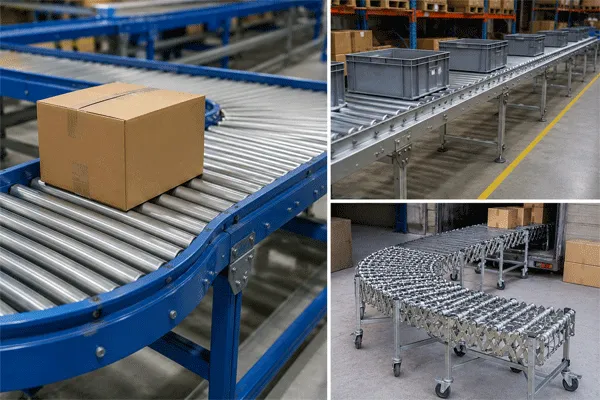
A gravity roller conveyor is a type of material handling equipment made from a frame, a series of rollers, support legs, and optional guides or stops. Unlike a power conveyor, it does not rely on an electric motor to turn the rollers. The product moves because a worker pushes it or because the conveyor is installed at a slight decline.
This simple design makes roller conveyors useful for moving cartons, bins, crates, drums, pallets, and packaged goods over short or medium distances. A gravity conveyor can connect workstations, move goods through a packing area, or help workers transfer products between a warehouse and a vehicle.
Hytrol describes gravity conveyors as non-powered transport solutions that use gravity or another external force. They can be configured as roller, chute, or skatewheel conveyor systems and are commonly installed on a decline or in a straight line through shipping and assembly areas.
Simple definition: A gravity conveyor moves a load without a powered drive. The rollers reduce friction, allowing the load to travel with less manual effort.
How Does a Gravity Roller Conveyor Work?
A gravity roller conveyor works by supporting a product across several freely rotating rollers. As the product moves forward, each conveyor roller turns beneath it. This lowers the resistance between the product and the conveyor surface.
There are two common operating methods:
- Manual push operation: The conveyor section remains level, and an operator pushes each carton or pallet.
- Decline operation: The conveyor is installed at a controlled angle, allowing the natural force of gravity to move the load.
The slope must be carefully selected. Too little slope may cause packages to stop. Too much slope may make them move too fast, collide, or fall from the end. Product weight, bottom condition, roller bearing resistance, roller diameter, and travel distance all affect the correct incline.
Basic operating sequence
Receiving point
      ↓
Load placed on rollers
      ↓
Manual push or gravity movement
      ↓
Load travels along the conveyor
      ↓
Stop, workstation, or transfer point
A gravity roller conveyor system may also include brakes, end stops, side guides, transfer plates, curves, and ball-transfer tables. These parts help control the direction and speed of the product as it moves along the conveyor.
What Are the Main Parts of a Roller Conveyor System?
Although the design looks simple, every part affects performance. A standard roller conveyor system normally contains the following components:
| Component |
Main function |
| Rollers |
Support and move the product |
| Side frames |
Hold the rollers in position |
| Axles or shafts |
Allow each roller to rotate |
| Bearings |
Reduce rotational resistance |
| Support legs |
Set the conveyor height and slope |
| Cross braces |
Improve stability |
| Side guides |
Prevent products from moving off the side |
| End stops |
Stop loads at the discharge point |
| Coupling plates |
Join one conveyor section to another |
| Brakes or speed controllers |
Control movement on sloped lines |
The roller material may be galvanized steel, stainless steel, aluminum, or plastic. A stainless steel gravity roller is often selected for wet, washdown, food-related, or corrosive conditions. Plastic rollers may suit lighter packages and quieter operations.
Interroll states that its gravity rollers are intended for economical use in gravity or manually pushed conveyor lines. Its product ranges include rollers for lightweight and medium-duty goods, as well as different tube materials and diameters.
The right construction depends on the load. A light carton line does not need the same frame strength, axle size, or heavy-duty roller design as a pallet conveyor carrying dense industrial products.
What Types of Gravity Conveyor Systems Are Available?
There are several types of gravity conveyor systems, and each supports a different load shape or operating layout.
Gravity roller conveyor
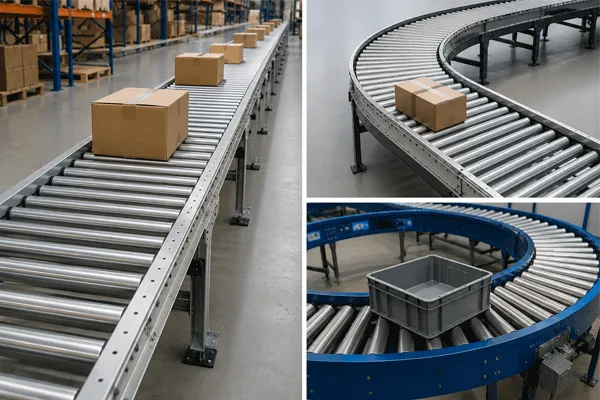
This is the most common option for cartons, totes, trays, crates, and pallets with firm, flat bottoms. The product must contact enough rollers to remain stable.
Gravity skate wheel conveyor
A gravity skate wheel conveyor uses many small wheels instead of full-width rollers. It is lightweight and easy to relocate. It works well for cartons and packages but is less suitable for loads with soft, uneven, or damaged bottoms.
Flexible gravity conveyor
A flexible gravity conveyor can expand, contract, bend, and move between work areas. A flexible gravity roller conveyor is often used at dispatch doors or for loading and unloading vehicles where a permanent conveyor system is not practical.
Heavy-duty gravity roller conveyor
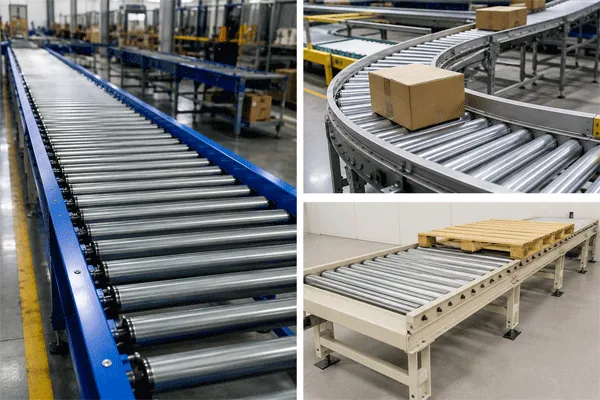
A heavy-duty gravity roller conveyor uses stronger frames, larger rollers, reinforced supports, and higher-capacity bearings. It can handle pallets, castings, containers, industrial components, or other heavy loads.
Ball-transfer table
A ball-transfer table allows operators to rotate or redirect products. It is useful where packages move from one conveyor line to another or where workers must position loads before scanning, packing, or inspection.
Hytrol notes that expandable conveyors are commonly used for trailer loading and unloading because they can extend into a vehicle and then collapse when not required.
What Is a Gravity Roller Conveyor? How the Conveyor System Works and Where to Use It
How Are Gravity Roller Conveyors Different From Powered Conveyors?
The main difference is the drive method. Gravity roller conveyors have no powered motor. Powered roller conveyors use motors, belts, chains, or motorized rollers to move products automatically.
A belt conveyor uses a continuous conveyor belt rather than separate rollers. It works well for small, soft, uneven, or irregular products that may not travel smoothly across gravity rollers. A chain-driven roller conveyor is normally selected for heavier loads that require controlled, powered movement.
| Factor |
Gravity roller conveyor |
Powered roller conveyor |
Belt conveyor |
| Motor required |
No |
Yes |
Yes |
| Product movement |
Push or slope |
Automatic |
Automatic |
| Initial complexity |
Low |
Medium to high |
Medium to high |
| Speed control |
Limited |
Good |
Good |
| Accumulation control |
Basic |
Advanced options |
Application-dependent |
| Best for |
Simple carton or pallet flow |
Automated transport |
Small or irregular goods |
| Relocation |
Usually easy |
More difficult |
More difficult |
| Electrical installation |
Not normally required |
Required |
Required |
A power conveyor is more suitable when products must move uphill, travel long distances, maintain a fixed speed, or integrate with automated sorting and production equipment. Power conveyor systems can also reduce manual pushing in high-volume operations.
Gravity conveyors offer a simpler option when the route is short, the load is easy to control, and automation is not necessary. Many facilities use both systems in a complete conveyor system: powered transport for the main line and sections of gravity conveyor for packing, accumulation, inspection, or dispatch.
Conceptual selection chart
The chart below compares general system complexity. It is a planning illustration rather than measured performance data.
System complexity

Gravity roller conveyor  ██
Skatewheel conveyor      ██
Powered roller conveyor  ████
Belt conveyor            ████
Automated sortation      █████
Where Are Roller Conveyors Commonly Used?
Roller conveyors are commonly used in facilities that move packaged or unitized loads. Typical applications include:
- Distribution centers
- E-commerce fulfillment facilities
- Manufacturing plants
- Food and beverage warehouses
- Parcel-handling operations
- Port logistics facilities
- Truck terminals
- Assembly lines
- Packing stations
- Retail stockrooms
- Cold-storage facilities
- Spare-parts warehouses
Inside a warehouse, a gravity conveyor may connect order picking, checking, labeling, packing, and dispatch stations. It can also create a temporary accumulation area where cartons wait before loading.
At a loading dock, gravity conveyors can be used between the dock and the trailer. A flexible system can extend closer to the cargo, reducing the distance workers must carry each package. Gravity pallet roller conveyors may also help move pallets near receiving and dispatch areas. Hytrol identifies transportation and logistics applications such as loading docks and distribution centers where gravity pallet conveyors support loading and unloading operations.
As a professional semi trailer manufacturer, we often consider how the vehicle will interact with the customer’s warehouse equipment. Trailer floor height, rear-door dimensions, side access, internal width, suspension, and loading method can all influence material flow.
For example, a side curtain trailer may allow forklifts to load from the side, while an enclosed trailer may rely on rear access. A properly planned conveyor for your warehouse should match the trailer opening and dock height rather than ending at an awkward transfer point.
What Are the Main Benefits of Gravity Conveyors?
One of the main benefits of gravity is simplicity. There is no drive motor on a standard gravity conveyor, so installation can be faster and electrical work is usually limited or unnecessary.
Other advantages include:
- Lower equipment complexity: Fewer powered parts can mean fewer drive-related service points.
- Flexible layout: Straight sections, curves, spurs, and portable units can be combined.
- Easy expansion: Additional sections can extend the conveyor lines.
- Lower energy use at the conveyor: Product movement does not require an electric drive.
- Improved product flow: Workers can push goods instead of carrying them.
- Better workstation organization: The conveyor creates a defined route for materials.
- Simple relocation: Portable and flexible gravity sections can move as operations change.
- Useful accumulation: Products can wait between work processes.
- Wide load range: Light cartons and properly engineered pallet loads can both be handled.
Gravity roller conveyors offer the greatest value when the application is straightforward. They are not automatically the right conveyor for every process. A steep decline, fragile product, unstable load, high throughput, or automated control requirement may justify a powered system.
The buyer should compare total operating needs rather than purchase price alone. A low-cost gravity conveyor may require more manual work, while a power conveyor may reduce labor but introduce controls, motors, sensors, and maintenance requirements.
What Products Can Travel on Gravity Rollers?
Gravity rollers work best with loads that have a rigid, reasonably flat bottom. The base must contact enough rollers to remain balanced.
Suitable products may include:
- Corrugated cartons
- Plastic totes
- Wooden or plastic pallets
- Trays
- Crates
- Metal boxes
- Flat-bottomed containers
- Packaged machine parts
- Drums on a specially designed system
- Building-material packages
A common design guideline is to support the load on at least three rollers at one time. This is not a universal engineering rule for every product, but it is a useful starting point when selecting roller centers. A short carton needs closer spacing than a long pallet.
Products that may not suit a basic roller line include:
- Soft bags
- Packages with sagging bottoms
- Goods with protruding straps
- Very small items
- Loads with feet that fall between rollers
- Irregular scrap material
- Unstable stacked cartons
- Damaged pallets
- Products likely to leak onto the bearings
A skatewheel conveyor may handle some light cartons more easily, while a conveyor belt provides continuous support for bags and small packages. For heavy or high-value cargo, an engineer should check load distribution, impact forces, frame capacity, roller capacity, and stop strength.
What Is a Gravity Roller Conveyor? How the Conveyor System Works and Where to Use It
How Do You Select the Right Gravity Conveyor for Your Warehouse?
Selecting a gravity conveyor starts with the product, not the conveyor catalog. Gather accurate operating data before comparing models.
Product information
Record:
- Minimum and maximum load weight
- Product length, width, and height
- Bottom surface and material
- Center of gravity
- Package condition
- Load stability
- Required orientation
- Expected impacts
- Temperature and moisture exposure
Process information
Also define:
- Required conveyor length
- Throughput per hour
- Manual or decline operation
- Loading and discharge height
- Number of workers
- Available floor area
- Curves and transfer points
- Pallet or carton type
- Cleaning requirements
- Future expansion plans
When selecting the right conveyor system, ask what happens before and after the conveyor. A gravity conveyor may receive products from a packing table, forklift, powered roller line, or truck. The discharge point may connect to a palletizer, workstation, storage lane, or another conveyor section.
A conveyor system is right only when the full workflow is safe and smooth. Buying an isolated section without checking the transfer points can create gaps, product jams, awkward lifting, or damaged packages.
Why Do Roller Diameter and Roller Centers Matter?
The diameter roller selection affects load capacity, rolling resistance, and impact strength. Larger or heavier-duty rollers are often used for pallets and industrial products. Smaller rollers can provide closer spacing for short packages.
Roller centers describe the distance from the center of one roller to the center of the next. Close spacing provides more support but increases the number of rollers and total cost. Wide spacing may work for large, rigid loads but can allow small products to tip or become trapped.
Consider this simplified example:
| Product length in travel direction |
Example roller-center approach |
| 300 mm carton |
Close spacing needed |
| 600 mm tote |
Moderate spacing may work |
| 1,200 mm pallet |
Wider spacing may be possible |
| Load with feet or runners |
Align rollers with support points |
The exact spacing must be checked against the product base and conveyor capacity. Pallet runners should remain properly supported. A weak or broken pallet may behave differently from a new one.
Frame width also matters. The useful roller width should support the package without allowing too much side movement. Side guides can help, but they should not squeeze the load or create friction that prevents gravity movement.
How Much Slope Does a Gravity Conveyor Need?
There is no single slope that works for every gravity conveyor. The required decline depends on:
- Load weight
- Roller bearing resistance
- Product bottom condition
- Roller material
- Conveyor length
- Product contact area
- Desired speed
- Temperature
- Dust or contamination
- Start and stop frequency
A heavy carton with a smooth base may start moving on a gentle slope. A light carton with a rough or damaged base may require more decline. However, increasing the angle can cause excessive speed.
Test the lightest, heaviest, smallest, and largest products before final installation. The test should include normal packaging conditions, not only perfect sample cartons.
Where loads can gain speed, consider:
- Friction rollers
- Speed controllers
- Braking devices
- Intermediate stops
- End stops
- Shorter decline sections
- Operator-controlled release gates
At marine terminals, OSHA requires gravity conveyor sections to be firmly placed and secured. Where needed for safe operation, provisions must also be made to brake objects at the delivery end.
How Should Gravity Roller Conveyors Be Used Safely?
Simple equipment can still create pinch, crush, impact, and falling-object hazards. Workers should never ride, sit, stand, or walk on roller conveyors.
Basic safety practices include:
- Secure every portable conveyor section.
- Keep fingers away from gaps between rollers.
- Install guards where trapping points exist.
- Use side guides where products may fall.
- Fit suitable end stops.
- Keep loading and unloading areas clear.
- Do not exceed the rated load.
- Remove damaged pallets and cartons.
- Train employees before operation.
- Lock out powered equipment connected to the line before servicing it.
- Inspect legs, braces, rollers, bearings, and connectors.
- Never reach into a jam without controlling the load.
OSHA requires guarding around conveyor danger zones in marine-terminal operations and states that conveyor rollers and wheels must remain secured in position. It also requires loading and unloading areas to remain clear of obstructions during operation.
For powered sections, OSHA specifies additional controls, including emergency stopping provisions and lockout or other methods to render conveyors inoperable during repairs.
CEMA also recommends combining equipment safeguards with workplace risk assessments, employee training, and site-specific safe operating procedures.
How Do You Maintain a Gravity Roller Conveyor?
Gravity conveyors need less drive-related maintenance than power conveyor systems, but they still require regular inspection.
A practical maintenance checklist includes:
| Inspection point |
What to check |
| Rollers |
Rotation, dents, corrosion, contamination |
| Bearings |
Noise, resistance, looseness |
| Frame |
Cracks, bending, loose fasteners |
| Supports |
Stability and correct height |
| Cross braces |
Missing or damaged hardware |
| Side guides |
Alignment and secure mounting |
| End stops |
Impact damage and strength |
| Couplings |
Secure connection between sections |
| Floor anchors |
Movement or looseness |
| Work area |
Debris, packaging straps, obstructions |
Remove string, plastic wrap, straps, and labels before they wind around a roller axle. Replace seized rollers because they increase pushing force and can damage package bottoms.
Cleaning methods should match the conveyor material. Do not apply oil or cleaning chemicals to bearings unless the equipment supplier approves them. In wet or corrosive areas, stainless steel or protected components may provide longer service life.
Case Study: Matching a Conveyor Line to Semi Trailer Loading
Consider a distribution company that loads boxed spare parts into enclosed semi trailers. Workers originally carried cartons from the packing zone to the trailer. The walking distance increased as the trailer filled, slowing each loading cycle.
The company installed a powered conveyor from the packing area to the dock and added a flexible gravity conveyor for the final distance inside the trailer. Workers could extend and curve the flexible section as loading progressed.
The project team also reviewed the trailer specification:
- Rear opening height and width
- Internal floor condition
- Dock compatibility
- Door clearance
- Payload requirement
- Axle configuration
- Suspension height
- Cargo-securing points
- Internal lighting
- Local transport regulations
The result was not simply a conveyor purchase. It was a combined loading-system decision.
This is an important lesson for fleet owners and logistics companies. Warehouse equipment and transport equipment must work together. When we develop OEM or ODM semi trailers, we ask customers about cargo dimensions, dock conditions, forklift use, road conditions, loading frequency, and local regulations. These details help us configure the trailer around the real operation.
Frequently Asked Questions
Does a gravity roller conveyor need electricity?
No. A standard gravity roller conveyor does not use a motor. Workers push the product on a level system, or a slight decline uses gravity to move it.
Can gravity roller conveyors handle pallets?
Yes, but the system must be designed for the pallet weight, runner direction, condition, and size. Pallet applications normally require heavy-duty rollers, stronger frames, suitable supports, and correctly spaced rollers.
What is the difference between a gravity roller conveyor and a skatewheel conveyor?
A roller conveyor uses full-width cylindrical rollers. A skatewheel conveyor uses many smaller wheels. Roller systems normally provide better support for heavier or wider loads, while skatewheel units are often lighter and easier to relocate.
Can I use gravity conveyors for loading trucks and semi trailers?
Yes. Flexible gravity conveyors are often used for loading and unloading cartons. The equipment must be stable, properly positioned, and suitable for the vehicle height, cargo, and working environment.
How many rollers should support a carton?
The product should generally remain supported by several rollers throughout travel. Three supporting rollers is a common starting point, but the final spacing should be checked against the package length, weight, bottom strength, and operating conditions.
Should I choose a gravity conveyor or power conveyor?
Choose a gravity conveyor for simple, short-distance movement where manual pushing or a controlled decline is acceptable. Choose a power conveyor when you need automatic movement, fixed speed, uphill travel, high throughput, controlled accumulation, or integration with automated equipment.
Conclusion: Key Points to Remember
- A gravity conveyor is a non-powered material handling system.
- Gravity roller conveyors move flat-bottomed loads across freely rotating rollers.
- Products can move through manual pushing or the force of gravity.
- Roller conveyors are often used in warehouses, packing areas, factories, loading docks, and trailer-loading operations.
- Roller diameter, capacity, frame strength, and roller centers must match the load.
- Gravity rollers work best with firm, stable product bottoms.
- Flexible gravity units can support temporary conveyor lines and vehicle loading.
- Heavy loads require a properly engineered heavy-duty roller system.
- A power conveyor is better for automated, uphill, long-distance, or speed-controlled movement.
- Slope must be tested with the full range of products.
- Stops, guides, brakes, guards, and stable supports improve safety.
- Warehouse conveyors and semi trailers should be planned as one connected logistics process.
- Trailer buyers should consider dock height, rear access, cargo dimensions, and loading equipment before confirming the vehicle configuration.
For fleet owners, logistics companies, distributors, port operators, construction contractors, and international project buyers, efficient loading begins with compatible equipment. A gravity roller conveyor can improve movement inside the facility, while a well-designed semi trailer protects capacity, loading efficiency, and transport reliability beyond the warehouse.












 17:52
17:52