A mismatched groove pulley can make a belt slip, overheat, vibrate, or fail early. The damage may stop a conveyor, hydraulic unit, or loading system without warning. Correctly matching the pulley groove, belt profile, diameter, bore, speed, and load creates a safer and more reliable drive.
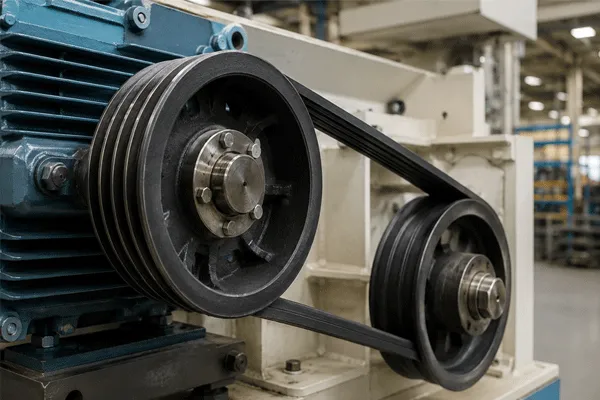
A groove pulley is a rotating wheel with one or more channels around its circumference. The groove holds and guides a belt, rope, or cable so the pulley can transmit power, change speed, redirect force, or support lifting. In belt drives, a grooved pulley is also commonly called a sheave.
What Is a Groove Pulley? V-Belt Sheave Types, Working Principle, and Selection Guide
Article Outline
- What is a groove pulley?
- Is a pulley the same as a sheave?
- How does a groove pulley transmit power?
- What are the main groove pulley types?
- What is the difference between a V-groove pulley and a flat pulley?
- Why do groove profile and pulley diameter matter?
- Should you choose one groove or two grooves?
- Which pulley materials and bore designs are available?
- How do speed, torque, wrap angle, and belt tension affect selection?
- Where are groove pulleys used in semi trailers and industrial equipment?
- What causes pulley and belt failure?
- How do you choose the right pulley?
- Frequently asked questions
- Key points to remember
What Is a Groove Pulley?
A groove pulley is a circular mechanical part with a channel machined or formed around its outer edge. The channel is designed to accommodate a belt, rope, wire cable, or another flexible drive element. As the pulley rotates, friction or mechanical engagement moves that flexible element.
The pulley can act as either the driving or driven component:
- The driving pulley receives power from an electric motor, engine, hydraulic motor, or gearbox.
- The driven pulley receives rotational force through the belt.
- An idler pulley guides the belt, changes its route, or helps maintain belt tension.
In a basic belt drive system, the motor rotates the driving pulley. The drive belt transfers motion to the second pulley. The second pulley then turns a shaft connected to a pump, fan, conveyor, compressor, winch, or other machine.
Groove pulleys are commonly used because they provide a simple way to transmit rotational power between shafts without direct gear contact. They can also absorb some vibration and shock while allowing flexibility in shaft position.
Is a Pulley the Same as a Sheave or “Sheaf”?
The words pulley and sheave overlap, but they are not always used in exactly the same way.
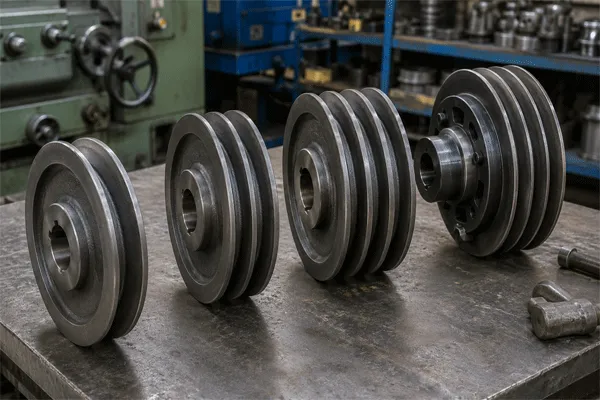
A pulley can refer to the complete rotating wheel or to an assembly that includes the wheel, shaft, bearing, frame, and flexible element. A sheave usually means the grooved wheel itself. In industrial belt-drive catalogs, a V-grooved pulley is often called a V-belt sheave.
The correct engineering term is sheave. “Sheaf” is a common spelling error and normally refers to a bundle of grain or papers, not a mechanical component.
In rope and cable systems, the sheave groove supports and guides the rope. Groove profile is especially important because an incorrect radius or angle can damage the rope. Crosby identifies several wire-rope sheave profiles for cranes, drilling equipment, mobile lifting systems, and heavy-haul applications, showing that sheave geometry changes according to the rope and applicable design requirement.
Simple terminology guide
| Term |
Typical Meaning |
| Pulley |
General rotating wheel or complete pulley assembly |
| Sheave |
Grooved wheel used with a belt, rope, or cable |
| V-belt pulley |
Pulley with one or more V-shaped grooves |
| Flat pulley |
Smooth pulley designed for a flat belt |
| Idler pulley |
Free-running pulley used for guidance or tension |
| Driven pulley |
Pulley that receives power from the driving pulley |
| Sheaf |
Incorrect spelling in this mechanical context |
What Is a Groove Pulley? V-Belt Sheave Types, Working Principle, and Selection Guide
How Does a Groove Pulley Transmit Power?
A groove pulley transmits power through contact between the belt and the pulley surface. The driving shaft turns the pulley. Friction between the belt and the pulley pulls the belt forward, and the moving belt rotates the driven pulley.
A V-belt operates differently from a flat belt. Its sidewalls press against the angled walls of the V-shaped groove. This wedging action increases grip between the pulley and belt, helping the drive carry torque with less slippage.
The belt should contact the sides of the groove rather than bottoming out at its base. When the belt sits too deeply, it may no longer wedge correctly. When it sits too high, the profile may be too large for the groove. Either condition can cause poor power transmission, heat, noise, and reduced wear life.
Driving Shaft
     ↓
Driving Groove Pulley
     ↓
V-Belt Carries Force
     ↓
Driven Pulley
     ↓
Machine Shaft, Pump, Fan, Conveyor, or Winch
The Gates industrial drive-design procedure considers design power, belt section, speed ratio, pulley datum diameter, belt speed, center distance, belt length, and the required number of belts or ribs. This shows why a pulley should not be selected by outside diameter alone.
What Are the Main Groove Pulley Types?
Groove pulleys are grouped by the flexible element they carry and the shape of the groove.
V-belt pulley
A V-belt pulley has one or more V-shaped channels. It is one of the most common types used in industrial power transmission.
V-belts are available in several profiles, including conventional, narrow-section, cogged, banded, and metric profiles. The belt section must match the pulley groove profile.
Rope or cable sheave
A rope sheave has a rounded groove that supports wire rope, synthetic rope, or cable. These sheaves are found in lifting equipment, winches, cranes, trailer recovery systems, cable guides, and loading mechanisms.
A rope or cable should not run in a V-belt groove. The contact geometry, material requirements, safety factors, and wear behavior are different.
Timing belt pulley
A timing belt pulley has teeth rather than a simple smooth groove. The teeth engage with the belt and prevent relative slip. Timing pulleys are used when accurate rotational synchronization is required.
Multi-rib pulley
A multi-rib pulley contains several small parallel grooves. It works with a ribbed belt and offers a wide contact surface in a compact space.
Variable-pitch pulley
A variable-pitch pulley allows the effective operating diameter to change. It can adjust the speed ratio within a limited range without replacing the complete pulley.
Idler and tension pulley
An idler pulley does not normally supply power. It guides the belt, increases wrap angle, controls the belt path, or helps maintain operating tension.
| Pulley Type |
Groove Shape |
Main Function |
| V-belt pulley |
V-shaped |
General power transmission |
| Rope sheave |
Rounded |
Guide or redirect rope and cable |
| Timing pulley |
Toothed |
Synchronized motion |
| Multi-rib pulley |
Multiple narrow grooves |
Compact, high-contact drive |
| Flat pulley |
Smooth face |
Run a flat belt |
| Idler pulley |
Depends on belt type |
Guide or tension a belt |
What Is the Difference Between a V-Groove Pulley and a Flat Pulley?
A V-groove pulley grips the angled sides of a V-belt. The wedging effect helps the drive transmit torque while reducing slippage. It also helps keep the belt centered in the groove.
A flat pulley has a broad, smooth surface designed for a flat belt. Flat belts can operate at high speed and may provide high efficiency under suitable alignment and tension. However, they do not have the same self-centering wedging action as a standard V-belt.
V-groove pulley advantages
- Strong grip in a compact drive
- Good torque capacity
- Self-centering belt path
- Suitable for short center distances
- Easy use with one or multiple belts
- Common standard sizes and profiles
Flat pulley advantages
- Simple construction
- Suitable for wide flat belts
- Efficient at higher belt speeds
- Useful for conveyors and line-shaft systems
- Can transmit power over longer center distances
The two types do not use interchangeable belts. The pulley designed for a specific application must match the flexible drive element.
A timing belt also requires its own toothed pulley. Installing a standard V-belt, flat belt, or timing belt on the wrong pulley type will prevent proper operation.
Why Do the Groove Profile and Pulley Diameter Matter?
The groove profile controls how the belt sits and where it makes contact. Important groove dimensions include:
- Groove angle
- Top width
- Groove depth
- Groove spacing
- Root radius
- Sidewall finish
- Pitch location
- Number of grooves
Industry groove tables use different angles and dimensions according to the belt profile and pitch-diameter range. Martin Sprocket’s published engineering data, for example, lists different recommended pitch diameters and groove angles for 3V, 5V, and 8V wedge sheaves.
The pulley diameter affects belt bending, rotational speed, torque, and belt life. A small pulley creates sharper bending each time the belt passes around it. When the diameter falls below the belt maker’s recommended minimum, internal belt stress rises and service life may fall.
Important pulley measurements
| Measurement |
Meaning |
| Outside diameter |
Diameter across the pulley’s outer edges |
| Pitch diameter |
Effective diameter at the belt’s reference or pitch line |
| Datum diameter |
Standardized reference diameter used in some belt systems |
| Bore diameter |
Hole size fitted to the shaft |
| Face width |
Total width across all grooves |
| Groove spacing |
Distance between adjacent groove centers |
The pitch diameter is more useful than the outside diameter when calculating the operating speed ratio. The belt does not transmit motion at the outermost edge of the pulley.
Simplified speed-ratio relationship
For a basic two-pulley drive without meaningful slip:
Driven Speed ≈ Driver Speed × Driver Pitch Diameter ÷ Driven Pitch Diameter
A small driving pulley turning a larger driven pulley reduces speed and increases available torque at the driven shaft, subject to system losses. A large driving pulley turning a smaller driven pulley increases speed.
Should You Choose a 1-Groove Pulley or Two Grooves?
A 1 groove pulley carries a single belt. It is compact and suitable for many light-duty or moderate-power applications.
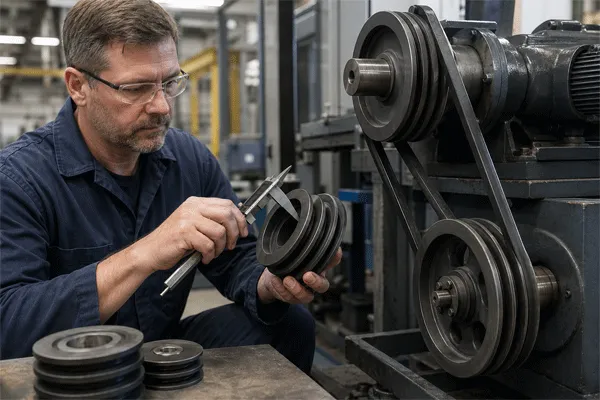
A pulley with two grooves carries two matching belts. When the drive is designed correctly, the two belts share the load and provide higher power transmission capacity than a single belt.
Multi-groove pulleys may have three, four, six, eight, or more grooves for demanding industrial applications. More grooves do not automatically make a drive better. The complete system must distribute the load evenly.
Single-groove pulley
Best suited to:
- Light-duty machinery
- Small pumps
- Fans
- Simple auxiliary drives
- Limited installation space
- Lower power requirements
Two-groove or multi-groove pulley
Best suited to:
- Higher torque
- Heavy-duty fans and pumps
- Conveyors
- Crushers
- Compressors
- Equipment with shock loads
- Applications that require greater power capacity
All belts in a multi-belt drive should have compatible length and performance. Replacing only one old belt in a matched set can cause uneven belt tension. One strand may carry more load than the others.
Banded belts can be useful where shock, pulsation, belt whip, or belt turnover is a concern. Gates describes its banded designs as joining multiple strands so they act as one unit and distribute load more evenly in heavy shock applications.
What Is a Groove Pulley? V-Belt Sheave Types, Working Principle, and Selection Guide
Which Pulley Materials and Bore Designs Are Available?
Pulley material affects strength, weight, corrosion resistance, inertia, wear, and price.
Cast iron
Cast iron is a common pulley material for industrial belt drives. It offers good wear resistance, vibration damping, machinability, and cost control.
It is widely used for:
- Pumps
- Fans
- Compressors
- Conveyors
- Agricultural equipment
- Industrial machinery
Steel
Steel pulleys provide high mechanical strength and may suit severe impact, heavy load, high speed, or welded custom constructions. Their design must account for balance, weld quality, runout, and fatigue.
Aluminum
Aluminum pulleys are lightweight and resist atmospheric corrosion. Lower rotating mass can be useful in certain high-speed or weight-sensitive systems.
Engineering plastics
Plastic pulleys may be used for lower loads, quiet operation, low inertia, or corrosive environments. Temperature and mechanical load limits must be checked carefully.
Common bore options
- Fixed bore
- Pilot bore
- Finished bore with keyway
- Taper-lock bushing
- QD bushing
- Splined bore
- Bearing-mounted idler bore
- Custom machined bore
A fixed bore is machined to one shaft diameter. It may include a keyway and set screw. A taper bushing allows the same pulley body to fit different shaft sizes by changing the bushing.
For service and export projects, a bushing-mounted pulley may simplify installation and future replacement. However, the shaft tolerance, key dimensions, torque, operating speed, and hub strength still require verification.
Pulley runout and machining accuracy also matter. Gates warns that inaccurate manufacturing or rebore work can reduce drive performance and recommends close bore and outside-diameter tolerances.
How Do Speed, Torque, Wrap Angle, and Belt Tension Affect Pulley Selection?
Choosing the right pulley requires more than matching the shaft bore.
Speed
Pulley speed affects centrifugal force, heat, balance requirements, and belt behavior. A pulley that performs well at low speed may need additional balancing at higher rotational speed.
Torque
Torque is the turning force the system must transmit. Higher torque may require:
- A larger pulley diameter
- A stronger belt section
- More grooves
- A wider belt
- A higher service factor
- Stronger shaft and hub connections
Wrap angle
The wrap angle is the amount of pulley circumference contacted by the belt. Greater belt contact generally provides more opportunity to transmit force.
A very small pulley or unsuitable shaft layout may reduce contact on one pulley. An idler can sometimes increase wrap angle, but its position and diameter must follow the belt manufacturer’s design guidance.
Belt tension
Correct belt tension is crucial for maintaining grip between the pulley and belt.
Too little tension can cause:
- Slippage
- Heat
- Noise
- Polished pulley grooves
- Reduced power transmission efficiency
- Belt turnover
Too much tension can cause:
- Bearing overload
- Shaft deflection
- Rapid belt wear
- Hub damage
- Increased energy loss
Optibelt’s maintenance guidance links low tension, pulley misalignment, worn grooves, incorrect profiles, and forced installation with noise or rapid belt wear. It also recommends regular drive inspection.
Where Are Groove Pulleys Used in Semi Trailers and Industrial Equipment?
A groove pulley is not normally a primary load-bearing part of a standard semi-trailer chassis. However, it can appear in many trailer-mounted systems and related transport equipment.
Depending on the trailer design, pulleys may be used in:
- Cable winches
- Recovery systems
- Sliding or lifting mechanisms
- Mechanical tarping systems
- Conveyor unloading trailers
- Walking-floor support equipment
- Hydraulic power packs
- Pump drives
- Tanker unloading equipment
- Cement blower systems
- Car-carrier lifting mechanisms
- Loading ramps
- Auxiliary generators
- Workshop and fleet-service equipment
A wire-rope sheave may redirect cable force in a loading or recovery system. A V-belt pulley may drive a pump, fan, compressor, conveyor, or hydraulic unit. These components serve the same basic goal—controlled transfer of force—but their groove design and selection rules are different.
As a professional semi-trailer manufacturer, we treat auxiliary mechanical systems as part of the complete operating environment. A pulley for a mining trailer, tanker, or conveyor trailer may face dust, vibration, shock, rain, road contamination, and irregular loading.
For customized trailer equipment, buyers should provide:
- Trailer application
- Pulley function
- Motor or engine power
- Input speed
- Required output speed
- Operating torque
- Belt or cable specification
- Shaft diameter
- Duty cycle
- Environmental conditions
- Required guard arrangement
- Local safety and road requirements
This information helps engineers determine whether a standard part is suitable or whether the specific application needs a custom pulley system.
What Causes Pulley and Belt Failure?
Most early failures come from a mismatch, poor installation, contamination, or lack of maintenance.
Common causes
| Symptom |
Possible Cause |
| Belt slips |
Low tension, overload, oil, worn groove |
| Belt rides too low |
Worn groove or incorrect belt profile |
| Belt rides too high |
Belt too large or groove too small |
| Edge wear |
Pulley misalignment |
| Belt cracks |
Small pulley, heat, age, chemical exposure |
| Pulley vibration |
Imbalance, runout, loose bore, bent shaft |
| Bearing failure |
Excessive belt tension or poor alignment |
| Uneven multi-belt wear |
Unmatched belts or inconsistent grooves |
| Belt jumps off |
Misalignment, shock load, low tension |
| Groove wears rapidly |
Dirt, wrong belt, soft material, slippage |
Never force a belt over a pulley with a lever or screwdriver. This can damage the tensile cords even when the outer surface still looks normal.
The pulley and belt should also remain free from oil, grease, loose material, and sharp debris unless the belt system is specifically designed for that environment.
Moving belts and pulleys create nip and entanglement hazards. OSHA requires exposed belts, pulleys, shafts, gears, and other moving power-transmission parts to be guarded when they can contact workers or create a hazard.
How Do You Choose the Right Groove Pulley?
Use a structured pulley selection process rather than matching appearance alone.
Step 1: Identify the flexible element
Confirm whether the pulley carries:
- Standard V-belt
- Narrow V-belt
- Cogged V-belt
- Banded V-belt
- Flat belt
- Timing belt
- Multi-rib belt
- Wire rope
- Synthetic rope
- Cable
Step 2: Match the groove type
The groove is critical. Confirm the belt section, groove angle, width, depth, and approved pulley series.
Do not assume that visually similar V-belts use the same pulley grooves.
Step 3: Calculate design power
Begin with actual motor power and apply a suitable service factor for:
- Operating hours
- Shock load
- Start frequency
- Load variation
- Environmental conditions
- Driven equipment type
Step 4: Confirm speed and torque
Record the driver speed, required driven speed, and operating torque. Use pitch or datum diameter—not only outside diameter—to establish the ratio.
Step 5: Check minimum pulley diameters
Select diameters permitted for the belt profile. Too small a pulley can increase bending stress and shorten belt life.
Step 6: Determine the groove count
Calculate whether a single belt can transmit the required design power. Use two belts or a multi-groove pulley when required by the drive calculation.
Step 7: Confirm the bore and hub
Check:
- Shaft diameter
- Keyway
- Bushing type
- Hub length
- Shaft fit
- Set screws
- Axial retention
- Available installation space
Step 8: Select pulley material
Choose cast iron, steel, aluminum, or another material based on speed, torque, impact, corrosion, weight, and cost.
Step 9: Check alignment and tension
Provide a practical method to align the shafts and set correct belt tension. Allow enough movement for installation and retensioning.
Step 10: Confirm safety and maintenance access
The drive needs a suitable guard, inspection access, drainage where necessary, and room to replace belts without damaging them.
Pulley inquiry checklist
| Required Information |
Example |
| Pulley type |
V-grooved pulley |
| Belt section |
SPA, SPB, A, B, 3V, 5V |
| Number of grooves |
1, 2, 3, 4 or more |
| Pitch or datum diameter |
According to drive calculation |
| Bore |
Fixed bore or taper bushing |
| Shaft size |
Actual shaft diameter |
| Input power |
Motor or engine rating |
| Input speed |
Revolutions per minute |
| Driven speed |
Required output RPM |
| Duty |
Light, normal, shock, continuous |
| Material |
Cast iron, steel, aluminum |
| Environment |
Dust, water, heat, corrosion |
| Application |
Pump, conveyor, winch, fan |
Illustrative Heavy-Duty Trailer Equipment Case
Consider a trailer-mounted conveyor that uses an auxiliary motor and belt drive. The original design uses a small single-groove pulley because it is inexpensive and easy to install.
During loaded operation, the conveyor demands more torque. The single belt begins to slip. Operators increase the belt tension, which places more load on the bearing. The belt runs hot, and both the belt and bearing require frequent replacement.
A better engineering review may lead to:
- A larger minimum pulley diameter
- A two-groove pulley
- Two matched V-belts
- A suitable service factor
- Improved shaft alignment
- Correct tensioning
- A stronger bearing arrangement
- A ventilated safety guard
- Better protection against dust
The solution is not simply “use a bigger pulley.” The entire belt and pulley system must work together.
Frequently Asked Questions About Groove Pulleys
What is a V-groove pulley used for?
A V-groove pulley transmits rotational power through a V-belt. It is commonly used with motors, pumps, compressors, fans, conveyors, generators, agricultural machinery, and auxiliary trailer equipment.
Is a groove pulley the same as a sheave?
A sheave is generally a grooved wheel used with a belt, rope, or cable. “Pulley” is the broader term and may refer to the wheel or complete assembly. In a V-belt drive, the words are often used interchangeably.
What is the difference between a driving and driven pulley?
The driving pulley receives power from the motor or engine. The driven pulley receives that power through the belt and turns the connected machine shaft.
How do I measure a V-belt pulley?
Measure the outside diameter, bore, face width, number of grooves, and groove profile. Drive calculations should use the specified pitch or datum diameter rather than assuming it is equal to the outside diameter.
Can I use one belt in a two-groove pulley?
The equipment may rotate, but this is generally not the intended operating arrangement for a drive designed to use two belts. One belt would carry the full load and could wear or fail early. Follow the approved drive design.
What happens when the pulley groove is worn?
A worn groove allows the belt to sit too deeply and reduces sidewall grip. This can cause slippage, heat, loss of speed, and rapid belt wear. Replace a pulley that falls outside the accepted groove-wear limit.
Why Work With an Engineering-Oriented Semi-Trailer Manufacturer?
Heavy-duty transport equipment works under real-world stress. Roads are rough. Loads change. Dust enters moving parts. Downtime costs money.
We manufacture and customize flatbed, skeleton, side curtain, fence, lowbed, lowboy, removable gooseneck, tanker, bulk cement, dump, and car-carrier semi trailers for international projects. Our engineering support can also cover compatible trailer parts and auxiliary systems according to the required application.
OEM and ODM support may include:
- Trailer structure design
- Load and axle configuration
- Steel grade selection
- Suspension and braking options
- Hydraulic and mechanical systems
- Loading or unloading mechanisms
- Winch and cable arrangements
- Conveyor-related components
- Corrosion protection
- Road-condition adaptation
- Spare-parts planning
- Export documentation
For pulley-related components, the best inquiry includes the drawing, shaft dimensions, operating load, speed, belt or cable model, environment, and required quantity. This allows us to evaluate the component as part of the full trailer system rather than as an isolated part.
Key Points to Remember
- A groove pulley has one or more channels for a belt, rope, or cable.
- The correct mechanical spelling is sheave, not sheaf.
- A driving pulley supplies motion, while a driven pulley receives it.
- A V-shaped groove increases grip through wedging action.
- V-belt, flat-belt, timing-belt, and rope pulleys are not interchangeable.
- The belt should contact the groove sidewalls correctly.
- Groove profile must match the exact belt section.
- Pitch diameter is used for drive-ratio calculations.
- Minimum pulley diameter affects belt bending and service life.
- A 1 groove pulley suits lower power; two grooves can support greater loads.
- Multi-belt drives need matched belts and consistent grooves.
- Cast iron is common, while steel offers strength and aluminum reduces weight.
- Fixed bore and taper-bushing designs suit different installation needs.
- Incorrect tension can cause either slippage or bearing overload.
- Alignment, wrap angle, load, speed, and torque all affect pulley selection.
- Exposed belts and pulleys require suitable safety guarding.
- Choose the complete belt drive as a system, not one component at a time.












 15:26
15:26