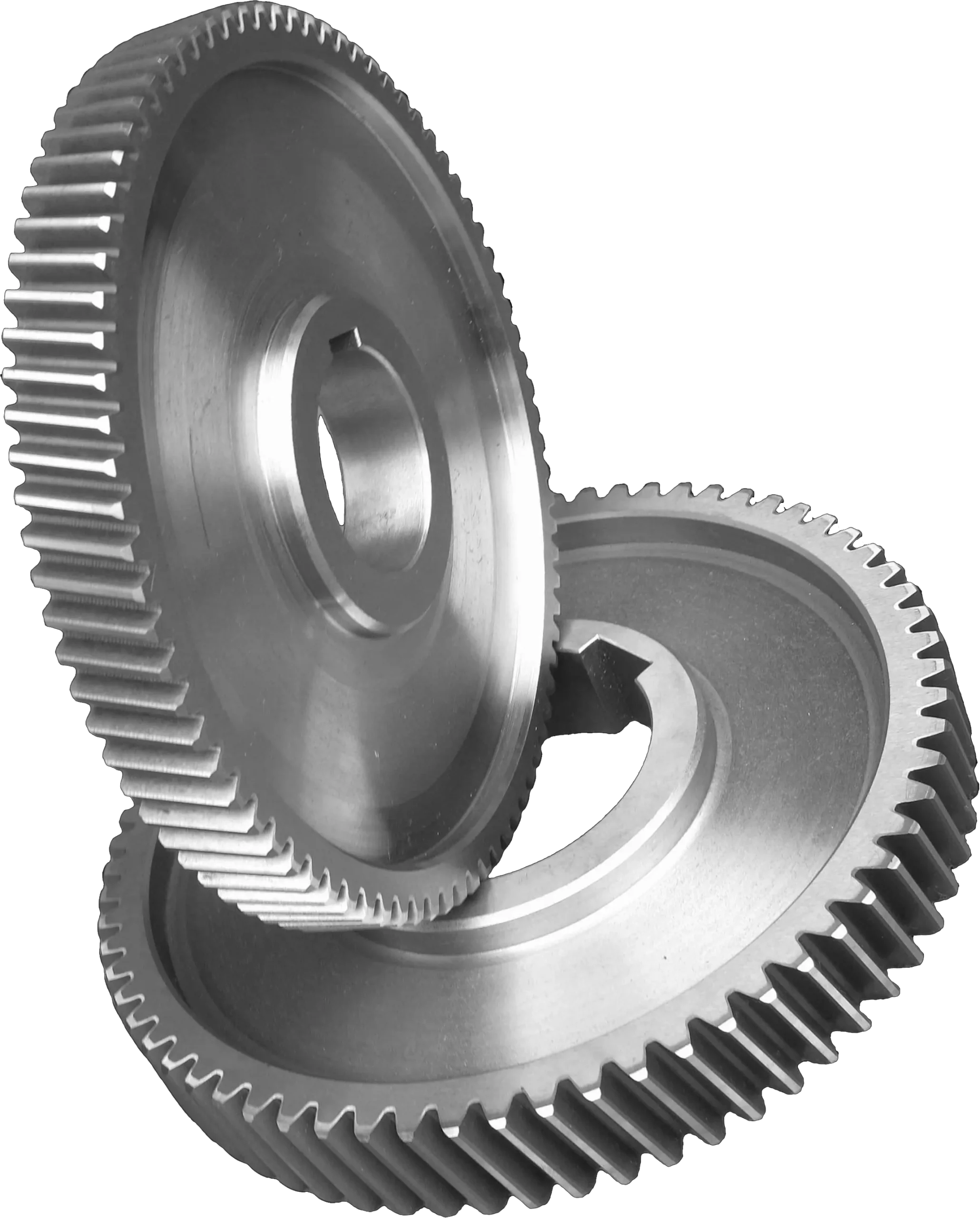
A poorly matched roller chain sprocket can turn a simple drive into a source of noise, vibration, tooth wear, and chain failure. The problem often starts with pitch, tooth count, bore, or alignment. The solution is to select the sprocket as part of the complete power transmission system.
A roller chain sprocket is a toothed wheel designed to engage a matching roller chain and transmit torque between shafts. Correct selection depends on chain size, pitch, number of teeth, bore size, hub type, material, operating speed, and load. Industrial roller chain sprockets commonly follow ANSI B29.1, ISO 606, or related British Standard dimensions.
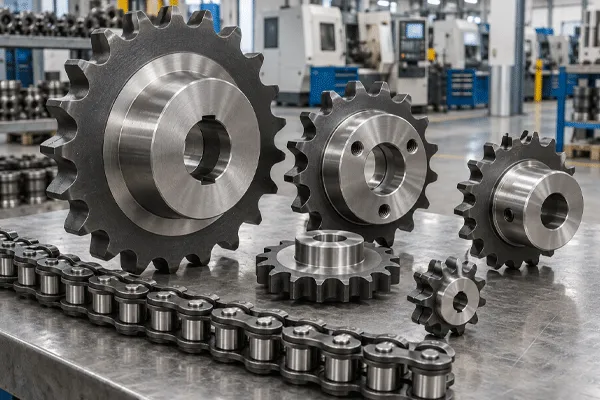
Roller Chain Sprockets: ANSI Types, Selection and Manufacture Guide
What Is a Roller Chain Sprocket and How Does It Work?
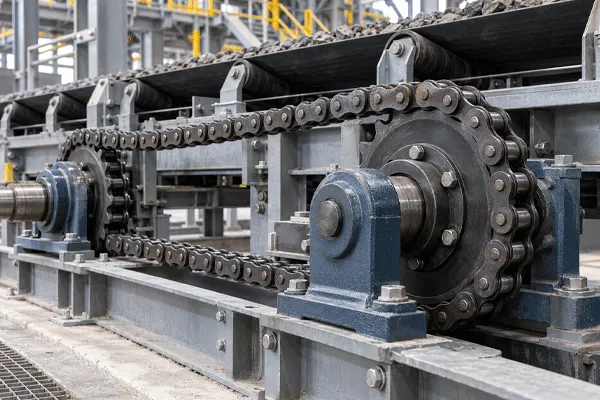
A roller chain sprocket is a toothed transmission component that works with a matching roller chain. As the sprocket begins to rotate, its teeth engage the chain rollers and pull the chain around the pitch circle. The chain then transfers mechanical power to another sprocket mounted on a driven shaft.
The basic system usually contains:
- a driving sprocket;
- a driven sprocket;
- a roller chain;
- shafts;
- bearings;
- keys or a bushing;
- guards and lubrication where required.
Unlike a friction belt drive, the sprocket and chain engage mechanically. This means the system can transmit substantial torque without relying on friction between smooth surfaces.
This is why roller chain drives remain common in industrial machinery, conveyors, packaging equipment, agricultural machinery, and many other mechanical systems.
ASME B29.1 covers precision power transmission roller chains, attachments, and sprockets, including dimensions, tooth profiles, runout tolerances, pitch diameters, outside dimensions, and other interchangeability requirements.
At KTD, we manufacture standard and custom chain sprockets for OEM power transmission systems, including single-, double-, triple-, and custom multi-strand arrangements.
What Are the Main Roller Chain Sprocket Types?
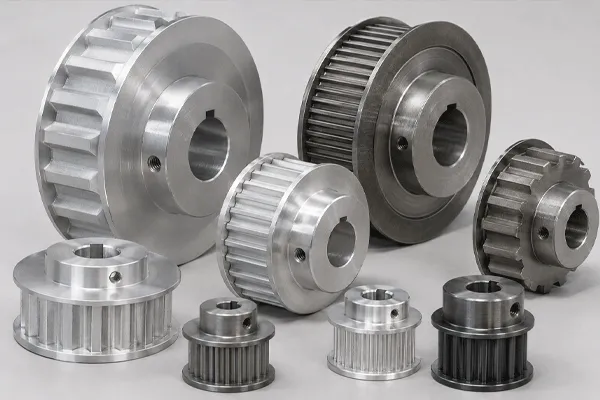
There are several roller chain sprocket types, and the best structure depends on how the sprocket mounts to the shaft, how much torque it carries, and how often it needs to be removed.
Common types include:
| Sprocket Type |
Main Feature |
Typical Use |
| Plate sprocket |
Flat plate without a large hub |
Compact drives |
| Hub type sprocket |
Integrated hub for shaft connection |
General machinery |
| Finished bore sprocket |
Bore, keyway, and often setscrew completed |
Ready-to-install drives |
| Taper-bushed sprocket |
Uses removable taper bushing |
Easy installation and maintenance |
| QD sprocket |
Quick detachable bushing system |
Industrial service |
| Single-strand sprocket |
Works with one chain strand |
Standard drives |
| Duplex sprocket |
Works with two strands |
Higher torque |
| Triplex sprocket |
Works with three strands |
Heavy-duty drives |
| Idler sprocket |
Guides or tensions chain |
Chain routing and tensioning |
KTD’s current range includes bore type, hub type, plate type, single strand, and double strand roller chain sprockets, together with simplex, duplex, triplex, and custom multi-strand configurations.
A hub type design generally provides more material around the shaft connection. A plate design saves axial space. A finished bore sprocket simplifies installation when the shaft diameter and key dimensions are already known.
There is no universally best design. The right structure depends on the machine.
How Do ANSI and British Standard Roller Chain Sprockets Differ?
One of the first decisions in the selection of roller chain sprockets is the standard.
In North American equipment, ANSI roller chain is common. Typical designations include chains such as #40, #50, #60, and #80.
European and many international machines often use ISO-compatible or British Standard chains such as 08B, 10B, 12B, and 16B.
The important point is simple:
A similar-looking chain number does not mean the chains or sprockets are interchangeable.
ANSI and British Standard systems may differ in dimensions including:
- roller dimensions;
- plate geometry;
- width;
- tooth form requirements;
- associated sprocket dimensions.
ASME B29.1 is the current ASME standard for precision power transmission roller chains, attachments, and sprockets. ISO 606:2015 specifies short-pitch precision roller and bush chains and their associated sprockets for mechanical power transmission.
KTD currently manufactures both ANSI and ISO metric configurations and cites ANSI B29.1, ISO 606, and DIN 8187 on its product page.
A practical RFQ rule
Do not send only:
“I need a 15 teeth sprocket.”
Instead send:
- chain standard;
- chain number;
- number of strands;
- number of teeth;
- bore;
- keyway;
- hub dimensions;
- material;
- quantity.
That one step prevents a large share of purchasing mistakes.
How Do Chain Size, Pitch, and Number of Teeth Affect a Sprocket?
The pitch of the chain must match the sprocket tooth geometry.
Pitch is the distance between equivalent points on adjacent chain pins. If the sprocket pitch does not match the chain, proper engagement is impossible.
The chain size also determines dimensions such as roller diameter and inner width, so selecting a sprocket by outside appearance is risky.
Number of teeth
The number of teeth affects several aspects of a chain drive:
- sprocket diameter;
- chain articulation;
- operating smoothness;
- speed ratio;
- available shaft spacing.
For example, a system might use a 12 teeth, 14 teeth, or 15 teeth driving sprocket where space is tight, while larger driven sprockets may use 30, 45 teeth, or more depending on the required ratio.
A smaller sprocket rotates the chain through a sharper angle each time a roller enters or leaves engagement. A larger sprocket generally produces smoother articulation, but it also requires more installation space.
Sprocket size and speed ratio
For a simple two-sprocket system:
Speed ratio ≈ driven sprocket teeth ÷ driving sprocket teeth
If the driver has 15 teeth and the driven sprocket has 45 teeth:
45 ÷ 15 = 3:1
The driven shaft rotates at roughly one-third of the driving shaft speed, ignoring losses.
This is why the size of the sprocket is not chosen only for fit. Tooth count is part of the machine’s transmission ratio.
Roller Chain Sprockets: ANSI Types, Selection and Manufacture Guide
What Do Pitch Diameter, Outside Diameter, and Caliper Diameter Mean?
A sprocket has several important diameters.
Pitch diameter
Pitch diameter is the theoretical circle where chain pin centers travel while engaged with the sprocket.
It strongly relates to tooth count and chain pitch.
Outside diameter
The outside diameter is the diameter measured across the tooth tips.
It matters for:
- machine clearance;
- guards;
- nearby components;
- housing design.
However, outside diameter alone does not identify a sprocket.
Caliper diameter
Caliper diameter is another sprocket inspection dimension used to verify tooth geometry. ASME B29.1 includes dimensional information and tolerances related to commercial and precision sprockets, including caliper dimensions and tooth section geometry.
Hub diameter
The hub diameter affects shaft connection strength and installation space.
For a high torque application, the designer must check not only the teeth but also:
- sprocket bore;
- key;
- hub wall thickness;
- shaft strength;
- keyway stress.
A perfectly machined tooth profile cannot compensate for an undersized shaft connection.
What Bore and Bushing Options Are Available?
The center of the sprocket is just as important as its teeth.
Common options include:
Pilot bore
A pilot bore leaves material for later machining.
This is useful when a distributor or machine builder wants to finish the bore size locally.
Finished bore
A finished bore is machined to the final shaft diameter and may include:
- keyway;
- setscrew;
- retaining feature.
A finished bore sprocket is convenient when shaft specifications are already fixed.
Taper-bushed
A taper bushed or taper-bushed design uses a removable tapered bushing to clamp the sprocket onto the shaft.
This can simplify:
- installation;
- removal;
- replacement;
- shaft-size adaptation.
Quick detachable systems
A quick detachable or QD-style arrangement is another common industrial mounting method.
KTD currently lists stock pilot bores, finished bores with keyways and setscrews, plus taper-bushed / QD-style mounting options.
Bushed sprockets
Bushed sprockets are useful where maintenance access and shaft interchangeability matter.
For an OEM machine, however, a custom integral hub may reduce total part count. The decision should follow maintenance strategy rather than habit.
When Should You Use Single-, Double-, or Multi-Strand Roller Chain Sprockets?
A standard single-strand chain is often enough for moderate torque.
When the required torque rises, engineers may use multiple parallel chain strands.
Common configurations include:
- simplex — one strand;
- duplex — two strands;
- triplex — three strands;
- custom multi-strand.
Multi strand roller chain sprockets distribute transmitted load across multiple chain rows.
This can increase power capacity without requiring one extremely large chain.
KTD currently manufactures simplex, duplex, triplex, and custom multi-strand sprockets for high-torque transmission.
Conveyor example
A heavy conveyor may use double-strand chain arrangements where continuous service, shock loads, and high torque require more capacity than a small single-strand drive can provide.
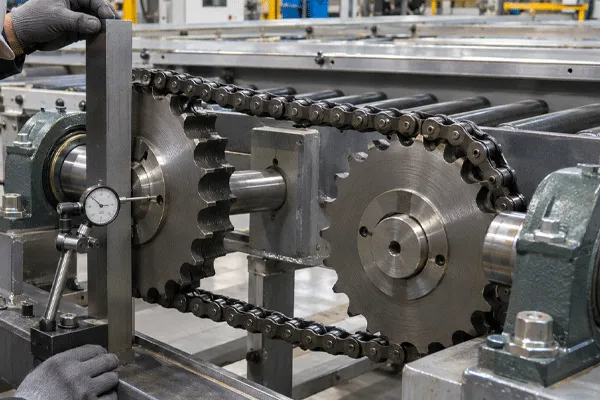
Double sprockets are also common on chain-driven conveyor rollers. One chain can receive torque from an upstream roller while another passes torque to the next roller.
This creates a compact mechanical drive across a long conveyor bed.
What Materials Are Used to Manufacture Roller Chain Sprockets?
Material selection depends on wear, load, environment, speed, and cost.
Carbon steel
Carbon steel is one of the most common materials for industrial sprockets.
KTD lists 1045 carbon steel as a primary material in its current sprocket range.
It offers a useful balance of:
- strength;
- machinability;
- cost;
- heat-treatment response.
Alloy steel
Alloy steel is selected when higher strength or more demanding service conditions are involved.
Stainless steel
304 and 316 stainless steel are useful where corrosion-resistant performance matters.
Typical applications include:
- food processing;
- packaging;
- chemical equipment;
- washdown conveyors;
- coastal environments.
Plastic sprockets
Plastic sprockets may be useful for light loads, reduced noise, or special corrosion requirements.
KTD also states that special materials such as engineering plastics and specific stainless grades can be produced for custom projects.
What about steel sprockets?
For most demanding industrial drives, steel sprockets remain a strong default because they combine wear resistance, structural strength, and manufacturing flexibility.
Why Are Hardened Teeth Important in Industrial Power Transmission?
The chain roller repeatedly contacts the sprocket tooth as the system runs.
That creates wear.
Over time, poor tooth wear resistance can change the effective tooth profile and reduce smooth engagement.
For demanding service, hardened teeth can increase wear resistance.
KTD uses induction hardening on selected sprockets and currently states a typical tooth surface hardness of HRC 45–50 for those configurations.
When should sprockets be heat treated?
A heat treated sprocket is worth considering when the application involves:
- high operating hours;
- abrasive contamination;
- higher speeds;
- shock loads;
- frequent starting and stopping;
- high torque.
However, harder is not automatically better.
The core still needs enough toughness to resist cracking. A sprocket manufacturer should choose the heat-treatment method according to material and service conditions rather than simply maximizing hardness.
This is especially important in heavy-duty industrial power transmission, where both wear resistance and shock resistance matter.
Roller Chain Sprockets: ANSI Types, Selection and Manufacture Guide
How Do You Select the Right Roller Chain Sprocket?
Successful roller chain sprocket selection starts with the complete drive, not the sprocket alone.
Use this checklist.
1. Confirm the chain standard and size
Determine:
- ANSI or ISO/British Standard;
- chain number;
- single, duplex, or triplex.
2. Calculate transmitted torque
The sprocket must carry the actual torque generated by the drive.
High torque may require:
- larger chain;
- multiple strands;
- stronger material;
- stronger shaft connection.
3. Determine tooth count
Choose driving and driven sprocket tooth counts based on the desired speed ratio, available space, and chain behavior.
4. Confirm shaft data
Provide:
- shaft diameter;
- keyway;
- bore tolerance;
- hub restrictions.
5. Review environment
Ask whether the system faces:
- water;
- dust;
- chemicals;
- food washdown;
- abrasive contamination;
- high temperature.
6. Confirm duty cycle
A machine running a few minutes each day does not have the same requirements as a 24-hour conveyor.
Roller chain sprocket selection checklist
| Specification |
What to Provide |
| Standard |
ANSI / ISO / British Standard |
| Chain size |
Example: #40, #60, 08B, 12B |
| Strands |
Simplex / Duplex / Triplex |
| Teeth |
Required number |
| Bore |
Pilot / Finished / Taper Bushed |
| Keyway |
Size and standard |
| Material |
Carbon / Alloy / Stainless / Other |
| Treatment |
Black oxide / zinc / hardening |
| Quantity |
Prototype or production volume |
This makes selection of roller chain sprockets much faster and reduces drawing revisions.
What Are Idler Sprockets and When Are They Needed?
Not every sprocket transmits motor power directly.
Idler sprockets are used to guide or tension the chain.
They may help:
- change chain routing;
- increase chain wrap;
- maintain tension;
- clear obstacles;
- manage long chain runs.
An idler can rotate freely on a bearing or bushing rather than being locked to a driven shaft.
Placement matters.
Poor idler position can increase chain articulation, vibration, or wear instead of solving it.
For long drives, designers should evaluate the complete chain path rather than simply adding an additional sprocket when slack appears.
Where Are Roller Chain Sprockets Used in Industrial Applications?
Roller chain drives remain common because they are mechanically simple, durable, and capable of efficient power transfer.
Material handling
Chain drives power:
- roller conveyors;
- bucket elevators;
- sorting systems;
- transfer lines.
KTD specifically identifies material handling and conveyor equipment as an application area for its sprockets.
Agricultural machinery
Sprockets are used in:
- harvesters;
- tractors;
- processing equipment;
- forestry machines.
These systems often experience shock loads and contamination.
Manufacturing equipment
A factory machine may use sprockets to synchronize shafts or transfer power between sections.
Packaging and food processing
Stainless designs help in washdown environments where standard carbon steel may corrode.
Vehicle applications
Roller chain sprockets also appear outside factory equipment in products such as all-terrain vehicles (ATVs), dirt-bikes, certain motor vehicles, and some watercraft mechanisms.
However, those vehicle applications may use standards, materials, safety factors, and validation requirements different from industrial equipment.
For KTD, the main commercial focus remains industrial power transmission, OEM machinery, conveyors, and customized mechanical systems.
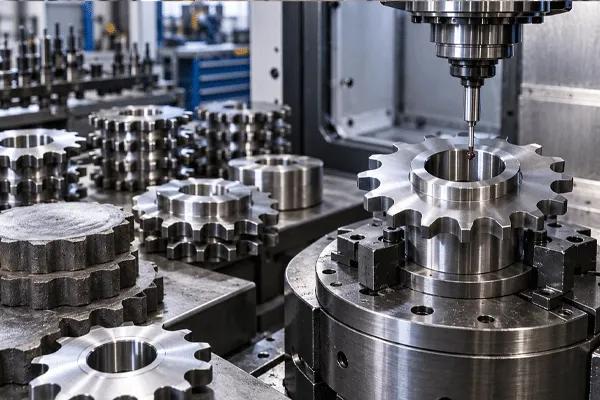
How Are Precision Roller Chain Sprockets Manufactured?
The quality of a sprocket depends heavily on how manufacturers manufacture the tooth form, bore, hub, and mounting features.
A typical production route may include:
- material preparation;
- blank turning;
- CNC machining;
- tooth cutting;
- bore and keyway machining;
- heat treatment when required;
- surface treatment;
- dimensional inspection;
- runout inspection;
- final quality control.
KTD emphasizes CNC precision machining, concentricity control, tooth-profile accuracy, induction hardening, and surface protection on its current Chain Sprocket page.
Why concentricity matters
The sprocket teeth must rotate around the true shaft center.
If the sprocket is eccentric, chain tension rises and falls on every revolution.
That can cause:
- vibration;
- noise;
- bearing load;
- uneven tooth wear;
- chain fatigue.
Tooth geometry
Correct tooth geometry allows chain rollers and chain pins to articulate smoothly.
Good manufacturing is therefore not only about making a round steel part with teeth.
It is about creating a repeatable geometry that supports stable power transfer.
Why Choose Custom Roller Chain Sprockets for OEM Machinery?
Standard sprockets solve many applications.
But OEM machinery often creates constraints that catalogue parts cannot meet.
A custom roller chain sprocket may require:
- special tooth count;
- unique outside diameter;
- non-standard hub;
- special sprocket bore;
- splines;
- unusual keyways;
- lightening holes;
- custom materials;
- multiple strands.
KTD currently supports custom tooth counts, specialized pitch diameters, unique hub configurations, custom bores, non-standard keyways, splines, and other made-to-order features.
This is where a component manufacturer can add value.
Instead of forcing a machine around an available catalogue sprocket, the sprocket can be engineered around the machine’s shaft, frame, load, and service requirements.
For buyers comparing suppliers—including large catalogue companies such as B&B Manufacturing and specialized OEM factories—the useful question is not simply “Who has this sprocket?” It is:
Who can verify the chain standard, tooth geometry, shaft interface, material, treatment, and inspection requirements for my application?
That question produces a much more reliable sourcing decision.
How Can Proper Sprocket Selection Improve Chain Life?
The chain and sprocket work as one system.
Installing a new roller chain on a badly worn sprocket can accelerate chain wear.
Installing a precision sprocket with an already elongated chain can damage the new teeth.
The best maintenance practice treats both components together.
Watch for:
- hooked sprocket teeth;
- abnormal noise;
- chain elongation;
- uneven tooth polishing;
- damaged rollers;
- misalignment;
- inadequate lubrication.
Correct alignment is especially important.
The driving and driven sprockets should be positioned so the chain runs without being pulled sideways.
When the sprocket, roller chain, shaft, and bearing are correctly matched, the system delivers more stable and efficient power transfer with less vibration and lower wear.
That improves not just sprocket life, but the life of the whole machine.
Frequently Asked Questions About Roller Chain Sprockets
What is a roller chain sprocket?
A roller chain sprocket is a toothed wheel designed to engage a matching roller chain. It transfers rotational mechanical power from one shaft to another and is widely used in conveyors, machinery, agricultural equipment, and other industrial systems.
How do I know what sprocket fits my roller chain?
Start with the chain standard and chain number. An ANSI #60 chain requires a compatible ANSI #60 sprocket, while a British Standard chain such as 12B requires the matching metric/BS tooth form. Then specify strand count, number of teeth, bore, hub, and shaft connection.
What is the difference between ANSI and British Standard sprockets?
ANSI and British Standard / ISO roller chain systems use different dimensional series. Even when pitch appears similar, roller dimensions, widths, and tooth requirements may differ. Do not assume they are interchangeable. ASME B29.1 and ISO 606 are useful reference standards for the respective industrial chain families.
How many teeth should a roller chain sprocket have?
The correct tooth count depends on required speed ratio, chain size, available space, load, and operating smoothness. Small sprockets save space but create greater articulation as each chain link enters the sprocket. Larger sprockets generally provide smoother engagement but need more room.
When should I use a taper-bushed sprocket?
A taper-bushed sprocket is useful when fast installation, shaft-size flexibility, and easier removal are important. It is common in industrial drives where maintenance teams need to replace components without permanently machining the sprocket to one shaft.
Can roller chain sprockets be manufactured in stainless steel?
Yes. KTD currently offers 304 and 316 stainless steel in addition to carbon and alloy steel. Stainless sprockets are particularly useful in wet, food-processing, chemical, and corrosive environments.
Key Takeaways: Roller Chain Sprocket Selection and Manufacture
- A roller chain sprocket transfers torque by mechanically engaging a matching roller chain.
- The chain pitch, chain number, and sprocket tooth geometry must match.
- ANSI and British Standard / ISO systems should not be treated as interchangeable.
- Tooth count affects speed ratio, sprocket size, chain articulation, and operating smoothness.
- Common sprocket structures include plate, hub, finished bore, taper-bushed, and QD designs.
- Simplex, duplex, triplex, and custom multi-strand sprockets serve different torque requirements.
- Carbon steel is a common industrial material, while stainless steel provides better corrosion resistance.
- Hardened teeth can improve wear resistance in demanding applications.
- Bore size, keyway, hub diameter, shaft strength, and sprocket material should be considered together.
- Idler sprockets guide or tension a chain rather than directly driving a shaft.
- Precision tooth machining and concentricity are essential for stable chain engagement.
- The best sprocket should be selected as part of the entire industrial power transmission system, not as an isolated part.
- For custom OEM equipment, a made-to-order sprocket can solve non-standard shaft, hub, tooth-count, material, or mounting requirements.
For OEM machinery, conveyors, and customized industrial drives, KTD can manufacture ANSI and ISO metric roller chain sprockets with different strand configurations, materials, bore structures, tooth counts, and surface treatments. Providing the chain standard, chain size, tooth count, shaft drawing, material requirement, operating load, and quantity at the RFQ stage allows the engineering team to evaluate the application more efficiently.












 10:06