Choosing the wrong timing pulley can cause belt noise, poor engagement, early wear, and unstable machine operation. These problems often start with a simple mistake: confusing metric and imperial dimensions or assuming similar tooth profiles are interchangeable. The right solution begins with understanding the belt standard and matching every critical dimension.
A precision timing pulley must match the timing belt’s exact tooth profile, pitch, width, and applicable standard. Metric profiles include HTD, T, and AT, while common imperial profiles include MXL, XL, L, H, and XH. Although some dimensions convert to similar millimeter values, different tooth shapes are not automatically compatible.
A reliable timing pulley manufacturer should offer more than standard sizes. Buyers also need accurate machining, suitable materials, consistent dimensions, and custom production support. This guide explains how to identify the correct pulley standard, avoid compatibility problems, and select a reliable manufacturing partner for industrial machinery.
Precision Timing Pulley Manufacturer for Metric & Imperial Timing Belts: Pitch, HTD and Custom Standards
1. What Is the Difference Between Metric and Imperial Timing Pulley Standards?
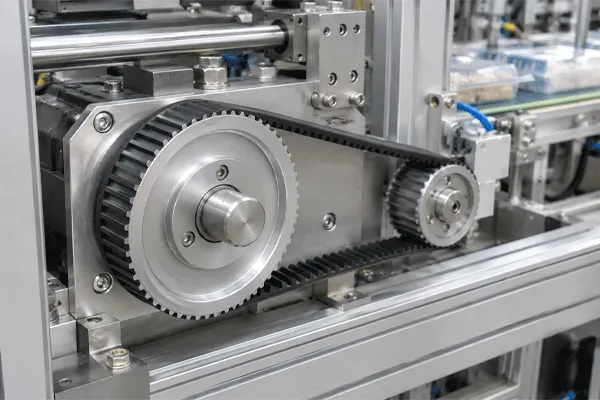
A timing pulley is a toothed mechanical component that works with a synchronous belt to transfer rotary motion. Unlike a conventional friction belt, the belt teeth engage with the pulley teeth. This creates a positive drive and helps maintain accurate synchronization between connected shafts.
The main difference between metric and imperial timing systems is how their nominal tooth spacing is defined. Metric systems use millimeters, while imperial systems use inches. However, the unit of measurement is only one part of the specification. Tooth shape, depth, width, and dimensional tolerances also matter.
For example, an XL timing pulley uses a nominal 0.200-inch pitch, equivalent to 5.08 mm. A T5 pulley uses a nominal 5 mm pitch. These values are close, but they do not represent the same standard.
| Feature |
Metric Timing Pulleys |
Imperial Timing Pulleys |
| Measurement unit |
Millimeters |
Inches |
| Common profiles |
HTD, T, AT, GT |
MXL, XL, L, H, XH |
| Typical applications |
Modern automation and industrial machinery |
Legacy machinery and imported equipment |
| Specification format |
3M, 5M, 8M, T5, AT10 |
MXL, XL, L, H, XH |
| Main consideration |
Exact profile and pitch |
Exact profile and pitch |
At KTD, we support both metric and inch-based timing pulley requirements. This helps OEM manufacturers, machine builders, and international distributors source components for new equipment as well as replacement projects.
2. How Does Timing Belt Pitch Affect Timing Pulley Compatibility?
Pitch is the distance between corresponding points on two neighboring belt teeth, measured along the belt’s pitch line. It is one of the most important dimensions when selecting a timing belt pulley.
A matching nominal pitch is necessary, but it is not enough. The pulley must also have the correct tooth geometry. Otherwise, the belt may not sit correctly in the pulley grooves. This can lead to uneven contact, increased noise, vibration, and reduced service life.
For example, an engineer may compare two belts with a nominal 10 mm pitch. One uses a T10 trapezoidal profile, while another uses an AT10 profile. Their nominal spacing is the same, but their tooth geometry and design characteristics differ.
Important: Never select a replacement pulley based only on the numerical pitch. Confirm the complete belt designation and tooth profile.
What Is Pitch Diameter?
Pitch diameter is an important reference dimension used in timing pulley design. It relates to the belt’s effective running position around the pulley rather than simply measuring the outside edge of the component.
It helps engineers evaluate:
- Transmission speed relationships.
- Pulley center distance.
- Available installation space.
- Belt engagement.
- Compatibility with the existing drive system.
The pitch diameter depends on the belt pitch and the number of pulley teeth. A pulley with more teeth generally has a larger pitch diameter when using the same belt profile.
For example, an HTD 8M pulley with 30 teeth has a theoretical pitch diameter of approximately 76.4 mm. This is a useful reference when checking a machine design, but it should not be confused with the actual outside diameter.
When developing a custom pulley, the manufacturer should consider the belt manufacturer’s profile specifications and the complete drive arrangement.
3. Which Metric Timing Pulley Profiles Are Common in Industrial Applications?
Metric timing pulley profiles are widely used in automation equipment, packaging machinery, textile production, medical devices, and material handling systems. Different profiles are designed to meet different requirements for load, positioning accuracy, and operating speed.
Some common profiles include:
| Profile |
Common Pitch Options |
Typical Applications |
| HTD |
3M, 5M, 8M, 14M, 20M |
Industrial drives and automation |
| T |
T2.5, T5, T10, T20 |
General conveying and positioning |
| AT |
AT5, AT10, AT20 |
Higher-load positioning and linear drives |
| GT / GT2 |
2M, 3M, 5M, 8M |
Precision motion and automation |
| RPP |
3M, 5M, 8M, 14M |
Synchronous industrial drives |
| STD |
3M, 5M, 8M, 14M |
Power transmission and positioning |
HTD Timing Pulleys
HTD profiles use rounded tooth geometry designed for effective engagement and load transfer. They are common in industrial transmission systems that require stable operation.
HTD5M and HTD8M are frequently considered for different equipment sizes and load requirements. Larger profiles may be used in applications requiring greater transmission capacity.
T and AT Timing Pulleys
T and AT profiles use trapezoidal tooth geometry. T profiles are common in general positioning and conveying applications.
AT profiles are designed with a stronger tooth structure for applications that require higher load capacity and reduced backlash.
GT and RPP Timing Pulleys
GT profiles are used in precision motion applications where accurate positioning and smooth engagement are important.
RPP profiles are another curvilinear family found in industrial synchronous drive applications. Their compatibility must be checked against the specific belt manufacturer’s specifications.
KTD’s published product range includes HTD, STD, RPP, T, and AT profile options, with custom configurations available according to project requirements.
The important point is simple: select the belt profile first, then select the matching pulley.
Precision Timing Pulley Manufacturer for Metric & Imperial Timing Belts: Pitch, HTD and Custom Standards
4. Which Imperial Timing Belt Pulley Profiles Are Used in Industrial Machinery?
Imperial timing profiles remain important in many machines, particularly equipment designed around inch-based engineering drawings or older transmission standards.
Even when a factory operates in a country using metric measurements, its equipment may still use imperial timing belts and pulleys. Replacing these components with a similar-looking metric product can create unnecessary compatibility problems.
Common imperial profiles include:
| Profile |
Nominal Pitch (Inches) |
Equivalent Pitch (mm) |
| MXL |
0.080 |
2.032 |
| XL |
0.200 |
5.080 |
| L |
0.375 |
9.525 |
| H |
0.500 |
12.700 |
| XH |
0.875 |
22.225 |
| XXH |
1.250 |
31.750 |
These values are nominal pitch conversions. They do not mean that different tooth profiles can be used interchangeably.
Understanding Common Imperial Profiles
MXL: A small-pitch profile used in compact and light-duty mechanical systems.
XL: A common profile for general industrial machinery and smaller synchronous drives.
L: A larger imperial profile used in equipment requiring a different belt size and transmission arrangement.
H: A widely recognized imperial profile for industrial timing belt applications.
XH and XXH: Larger-pitch profiles used in drive systems designed around their specific tooth geometry and dimensional requirements.
When sourcing replacement parts, buyers should check the original belt marking, technical drawing, or equipment documentation.
If the original designation is missing, measure the belt carefully and identify its tooth profile before placing an order.
A precision manufacturer should be able to work with both metric and inch-based drawings. This is especially important for international OEM projects where the machine designer, component supplier, and final equipment user may work with different measurement systems.
5. Can Metric and Imperial Timing Belts and Pulleys Be Interchanged?
In most cases, metric and imperial timing components should not be treated as interchangeable simply because their converted dimensions appear close.
Consider XL and T5 profiles:
- XL has a nominal pitch of 5.08 mm.
- T5 has a nominal pitch of 5 mm.
- Their tooth profiles are different.
- Their pulley grooves are designed for different belt geometries.
The small difference in nominal spacing may look insignificant, but a synchronous drive depends on repeated tooth engagement. Small dimensional errors can accumulate across the contact area.
The same issue applies to different metric profiles. HTD5M, T5, and AT5 all have a nominal 5 mm pitch, but they have different tooth shapes.
Three Common Compatibility Mistakes
1. Matching only the pitch number
A 5 mm pitch does not automatically mean that the belt and pulley use the same tooth profile.
2. Converting inches into millimeters without checking the profile
A converted value does not change the original tooth geometry or manufacturing standard.
3. Using outside diameter as the only identification method
Different tooth counts and profiles can produce similar outside diameters.
Before replacing a pulley, confirm the complete belt specification and the machine’s original design requirements.
6. How Do You Choose the Right Timing Pulley for Your Machine?
Selecting the correct pulley requires more than identifying its nominal pitch. Engineers must consider the complete drive system, including belt width, tooth count, shaft dimensions, operating conditions, and required transmission performance.
Start by confirming the belt designation. Then select the required pulley tooth count according to the desired speed relationship.
For a simple two-pulley drive, the larger pulley generally rotates more slowly than the smaller pulley when both are connected by the same timing belt.
For example, a 20-tooth driving pulley connected to a 40-tooth driven pulley produces a 2:1 speed reduction. This means the driven shaft rotates at approximately half the speed of the driving shaft under normal operating conditions.
Engineers should also check:
- Available installation space and center distance.
- Belt width and pulley face width.
- Required operating torque and rotational speed.
- Shaft diameter and mounting arrangement.
- Radial and axial runout.
- Belt tracking and flange requirements.
- Operating temperature and environmental exposure.
A good design balances transmission requirements with the physical limits of the machine.
For example, a compact robotic system may need a small pulley with low rotational inertia and accurate positioning. A packaging conveyor may require a wider contact surface and stable operation over long working cycles.
These are different engineering problems. The same standard profile may be available for both, but their final pulley dimensions and mounting features may be different.
7. What Should You Check Beyond Pitch and Tooth Profiles?
Two pulleys can share the same tooth profile and tooth count but still be unsuitable for the same machine. The reason is that mounting and dimensional details are equally important.
Bore Dimensions
Bore dimensions determine whether the pulley fits the shaft. A finished bore may require a specific tolerance to achieve the intended fit.
For some applications, a keyway or spline connection is also required to transfer torque securely.
Hub and Flange Design
Hub design affects the mounting stability and shaft engagement length. A suitable hub provides enough contact area for the intended connection method.
A flange helps prevent the belt from moving sideways during operation. Depending on the machine design, a pulley may use one flange, two flanges, or a special flange arrangement.
Important Timing Pulley Specifications
| Specification |
Why It Matters |
| Bore diameter |
Ensures correct shaft fit |
| Bore tolerance |
Controls mounting clearance |
| Keyway dimensions |
Supports secure torque transfer |
| Hub length |
Provides shaft engagement |
| Face width |
Provides adequate belt support |
| Outside diameter |
Checks machine clearance |
| Radial runout |
Helps control rotating accuracy |
| Axial runout |
Helps maintain stable belt tracking |
| Flange position |
Prevents unwanted belt movement |
The pulley face must also provide enough clearance for the belt to operate without rubbing against adjacent machine parts.
For precision equipment, these details can directly affect positioning accuracy, vibration, noise, and bearing loading.
Precision Timing Pulley Manufacturer for Metric & Imperial Timing Belts: Pitch, HTD and Custom Standards
8. How Does a Precision Timing Pulley Manufacturer Ensure Consistent Quality?
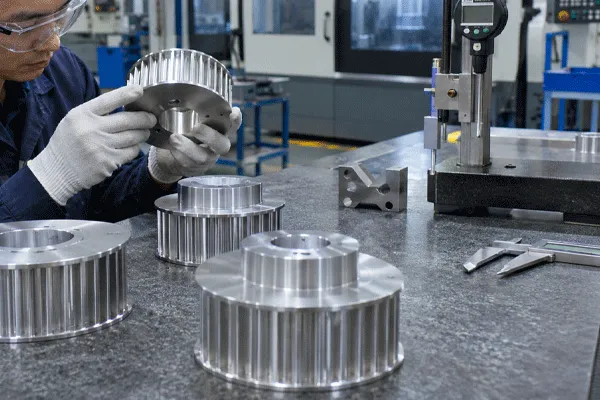
Accurate design must be supported by reliable manufacturing processes. A timing pulley manufacturer needs to control tooth geometry, bore dimensions, concentricity, surface finish, and overall dimensional consistency.
At KTD, our manufacturing approach combines precision machining and engineering support. Our published product capabilities include CNC machining, precision gear hobbing, and dimensional inspection. Our timing pulley product range specifies standard H7 bore tolerance, with H6 available upon request.
Main Manufacturing and Inspection Processes
1. Material verification
Confirm that the selected aluminum, carbon steel, stainless steel, brass, or engineering plastic meets the drawing requirements.
2. Tooth machining
Use appropriate tooling and machining processes to produce the required tooth profile.
3. Bore machining
Maintain the specified shaft-fit dimensions and tolerances.
4. Surface treatment
Apply suitable treatments such as anodizing, black oxide, or plating where required.
5. Dimensional inspection
Check critical dimensions, concentricity, and runout.
6. Final quality control
Verify the finished part against the approved technical drawing.
Depending on the geometry and production requirements, CNC turning, CNC milling, and gear hobbing may all be involved in pulley manufacturing.
A lathe can produce the basic cylindrical geometry, while CNC milling and hobbing support more complex features and accurate tooth formation.
For high-speed applications, dynamic balancing may also be required to reduce vibration.
Manufacturing quality is not just about producing the correct shape. It is about ensuring that every finished part performs consistently in its intended machine.
9. How Should You Compare a Timing Pulley Supplier and Manufacturer?
The timing pulley market includes specialist pulley manufacturers, belt manufacturers, distributors, and companies offering broader mechanical power transmission products.
Buyers researching suppliers may encounter other names such as Chuanqi Gears, Sanmin, and Nordex. However, these names should not be treated as proof of a particular company’s timing pulley manufacturing capabilities. Always check the actual product catalog and technical documentation.
What Should You Evaluate Before Choosing a Supplier?
- Does the company support both metric and imperial profiles?
- Can it manufacture standard and non-standard tooth configurations?
- Does it provide CNC machining and dimensional inspection?
- Can it process your required material?
- Does it support custom bore, hub, and mounting designs?
- Can it provide samples and batch production?
- Does it offer engineering communication and drawing review?
- Can it maintain consistent quality across repeat orders?
Searches for a top 10 custom timing pulley list or 10 custom timing pulley manufacturers can help identify potential sources, but a ranking cannot establish whether a specific supplier can meet your drawing.
The best manufacturing partner is the one that can meet your actual technical and delivery requirements.
KTD, based in Qingdao, China, focuses on industrial power transmission components and OEM manufacturing. Our product range includes timing pulleys, timing belts, industrial gears, Poly-V pulleys, chain sprockets, and conveyor rollers.
Our engineering team supports standard product supply as well as drawing-based customization. This provides a practical sourcing option for international OEMs, equipment manufacturers, distributors, and industrial brands.
10. When Should You Choose a Custom Timing Pulley Manufacturer?
Standard products are suitable for many applications. However, some machines have unique dimensions or installation conditions that make catalog components unsuitable.
A custom timing pulley may be required when:
- The existing machine uses a non-standard shaft diameter.
- The required tooth count is unavailable in standard stock.
- The machine needs a special hub or flange arrangement.
- A legacy machine uses an older imperial profile.
- The design requires a particular material or surface treatment.
- Space restrictions require a special pulley diameter.
- The original component has been discontinued.
For example, an equipment manufacturer may need to replace an older imperial pulley while keeping the original shaft, belt, and installation space unchanged. In this case, the engineering team must first identify the existing belt standard and determine whether the original design can be reproduced accurately.
If the existing design is no longer suitable, engineers may evaluate a complete drive conversion. However, changing the pitch or tooth profile requires checking belt compatibility, center distance, pulley dimensions, and speed requirements.
How KTD Supports Custom Timing Pulley Manufacturing
At KTD, we support standard and custom timing pulley production for different industrial requirements.
Our manufacturing capabilities include:
- Metric and imperial timing pulley profiles.
- Custom tooth counts and pulley dimensions.
- Non-standard bore and hub configurations.
- Keyway and flange customization.
- Aluminum, steel, stainless steel, and other suitable materials.
- CNC machining and dimensional inspection.
- Drawing review and DFM feedback.
- Prototype and batch production.
We can review customer drawings and provide manufacturing feedback before production. This helps identify dimensional conflicts and potential manufacturing concerns at an early stage.
Whether your project requires a standard HTD pulley, an imperial XL component, or a fully customized transmission part, the objective remains the same: accurate dimensions, reliable engagement, and consistent performance.
For more information, visit our Timing Pulley Product Range or Custom Manufacturing Services.
Frequently Asked Questions
1. What is the difference between metric and imperial timing pulleys?
Metric timing pulleys use nominal pitch dimensions in millimeters, while imperial timing pulleys use inch-based designations. Common metric profiles include HTD, T, and AT. Imperial profiles include MXL, XL, L, H, and XH. Both systems require exact belt and pulley profile matching.
2. Can I use an XL timing pulley with a T5 timing belt?
Not as a direct substitution. XL has a nominal pitch of 5.08 mm, while T5 has a 5 mm pitch. Their tooth geometries also differ. Always use a pulley designed for the exact belt profile.
3. What does HTD mean in timing pulley specifications?
HTD refers to a high-torque-drive tooth profile family with rounded tooth geometry. Common sizes include HTD3M, HTD5M, HTD8M, and HTD14M. The correct pulley must match the belt’s pitch and profile.
4. Can a manufacturer produce timing pulleys according to customer drawings?
Yes. A qualified manufacturer can produce non-standard tooth counts, bore dimensions, hubs, flanges, and other features according to approved technical drawings. KTD supports OEM and custom manufacturing for industrial timing pulleys.
5. Which materials are available for industrial timing pulleys?
Common materials include aluminum alloys, carbon steel, stainless steel, brass, and engineering plastics. The correct option depends on load, rotational speed, operating environment, weight requirements, and wear conditions.
6. What information is needed to request a timing pulley quotation?
Prepare the following information:
- Belt profile and nominal pitch.
- Number of pulley teeth.
- Belt width and pulley face width.
- Bore diameter and tolerance.
- Hub and flange configuration.
- Material and surface treatment.
- Quantity and application requirements.
- Dimensioned drawing or sample, if available.
Providing complete technical information helps the manufacturer review the design and prepare an accurate quotation.
Key Takeaways
- Metric and imperial timing pulleys use different nominal measurement systems.
- Similar pitch values do not guarantee tooth profile compatibility.
- HTD, T, AT, GT, MXL, XL, and H are different profile families.
- Always identify the original belt before selecting a replacement pulley.
- Tooth count and pitch diameter affect the transmission ratio and installation space.
- Bore tolerance, keyway, hub, flange, and runout are important quality factors.
- A precision manufacturer should provide suitable machining and inspection processes.
- Custom manufacturing is useful for legacy machinery and non-standard equipment.
- Choose a supplier based on technical capability, quality consistency, and engineering support.
Looking for a reliable timing pulley manufacturer for your next industrial project?
KTD provides standard and customized timing pulleys for international OEMs, machinery manufacturers, distributors, and industrial equipment brands. From metric and imperial profiles to custom machining and drawing-based production, our team is ready to support your transmission requirements.
Contact KTD today to discuss your timing pulley specifications and request a technical quotation.












 09:15