A standard timing belt works well until your machine needs a special length, width, tooth profile, backing, cleat, or chemical resistance. Forcing a catalog belt into a non-standard drive can create tracking problems, poor synchronization, and downtime. A properly specified custom timing belt solves the drive around the machine.
A custom timing belt is a synchronous belt manufactured or modified for a specific drive system. Custom options can include non-standard length and width, polyurethane or rubber construction, special tooth profiles, open-ended or endless designs, tensile reinforcement, cleats, backing, guide ribs, perforations, and application-specific materials for precision motion or conveying.
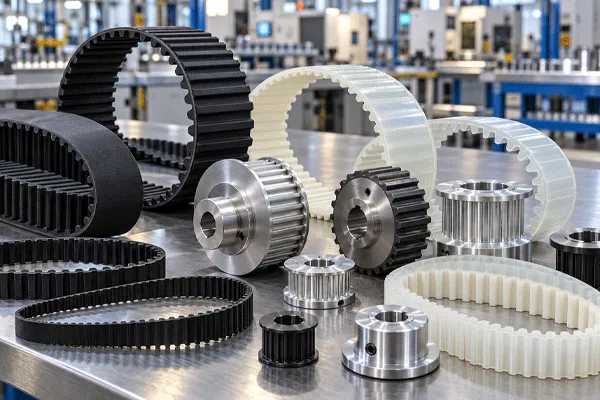
Custom Timing Belts: Materials, Tooth Profiles, Customization and Selection Guide
Article Outline
- What is a custom timing belt?
- When should you customize a timing belt?
- Rubber vs. polyurethane timing belts
- How do timing belt tooth profiles differ?
- HTD, trapezoidal, GT and other synchronous profiles
- Endless vs. open-ended and welded belts
- Tensile cord and belt construction choices
- Cleats, backing, guide ribs and perforations
- How belt and pulley matching affects precision
- How to select a custom belt for demanding applications
- Frequently asked questions
What Is a Custom Timing Belt?
A timing belt is a toothed belt that engages a matching toothed pulley. Unlike a smooth flat belt or a traditional V-belt, the teeth create positive engagement, so the drive can maintain a fixed relationship between the input and output shafts.
That is why timing belts are also called synchronous belts. When the belt and pulley remain correctly engaged, the system can provide repeatable synchronization without the normal slip associated with friction-only drive belts.
A custom timing belt goes one step further. Instead of choosing only from standard catalog lengths and widths, the belt is designed or modified for the real machine.
Custom variables may include:
- tooth profile;
- pitch;
- belt length;
- width;
- tensile cord;
- material;
- backing;
- cleats;
- perforations;
- guide ribs;
- surface finish;
- food-contact requirements.
KTD currently manufactures rubber and polyurethane synchronous belts across HTD, Imperial, T-series, S-series, and P-series profiles, with standard and customized constructions for OEM machinery and automation.
The purpose of customization is not to make a belt look different. It is to make the complete drive system work correctly.
When Do You Need a Custom Timing Belt Instead of a Standard Belt?
A catalog belt should always be considered first. If a standard profile, pitch length, and width satisfy the machine, there is little benefit in adding unnecessary customization.
A custom belt becomes valuable when standard dimensions create a compromise.
Common reasons include:
- non-standard center distance;
- unusual belt width;
- limited installation space;
- special conveyor positioning;
- high chemical exposure;
- food processing;
- vacuum conveying;
- unusual product spacing;
- linear motion;
- special tensile requirements.
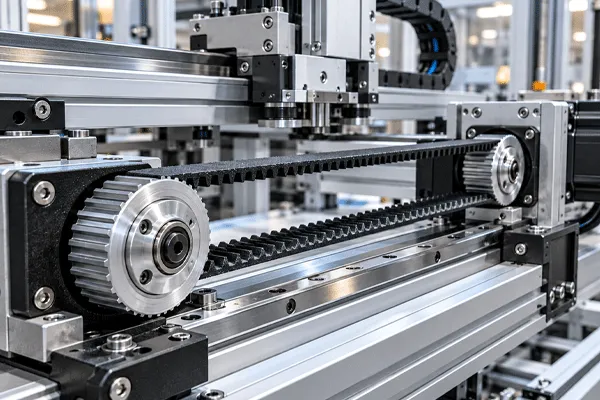
For example, an automation machine may need a belt to move a carriage over a long axis. An endless standard belt may be difficult to install around the machine structure. An open-ended belt can be fixed at each end of the moving carriage instead.
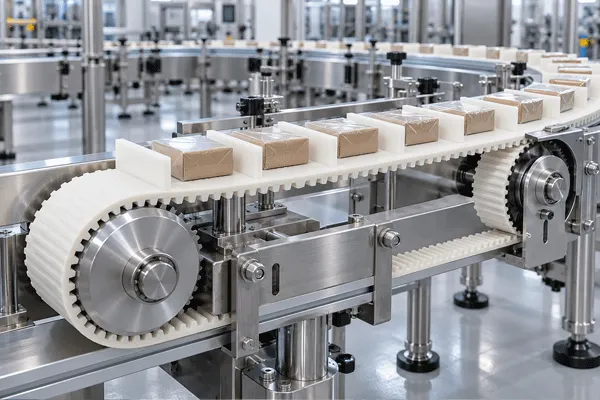
A packaging conveyor may need another solution. The belt may need welded cleats every exact distance so each carton arrives under a filling or labeling station at the correct time.
This is where custom timing design becomes part of machine design rather than simply a replacement-parts decision.
KTD currently lists open-end belts, non-standard endless pitch lengths, guide ribs, foam or felt backing, cleats, perforations, and special gripping profiles among its timing-belt customization options.
Rubber or Polyurethane Timing Belts: Which Material Is Better?
There is no universal best belt material. Rubber and polyurethane solve different problems.
Rubber timing belts
Industrial rubber timing belts commonly combine:
- elastomeric teeth and backing;
- tensile cords;
- wear-resistant tooth fabric.
Rubber is widely used for general power transmission because it combines flexibility, tensile strength, vibration damping, and cost efficiency.
KTD currently lists EPDM as its primary rubber compound and offers fiber-treated tooth surfaces for industrial applications.
Rubber belts fit applications such as:
- CNC machinery;
- industrial equipment;
- compressors;
- textile equipment;
- general automation.
Some global belt systems use neoprene rather than EPDM. For example, Gates PowerGrip HTD belts use neoprene construction with fiberglass tensile cords and nylon tooth facing.
This is important for buyers: do not use the word “rubber” as the complete material specification. Ask what rubber compound the timing belt manufacturer actually uses.
Polyurethane timing belts
Polyurethane timing belts are especially useful when the application requires:
- good abrasion resistance;
- resistance to oils and chemicals;
- clean operation;
- custom attachments;
- food-grade material options;
- low dimensional change.
KTD uses cast PU for timing belts and states that food-grade options are available for relevant conveying applications.
PU belts are widely used in packaging, automation, medical equipment, conveying, and food-handling systems.
Quick comparison
| Requirement |
Rubber Belt |
Polyurethane Belt |
| General industrial drive |
Excellent |
Excellent |
| Custom cleats |
Possible |
Very common |
| Food-grade options |
Application dependent |
Strong option |
| Chemical resistance |
Compound dependent |
Often better |
| High wear environment |
Good |
Very good |
| Precision conveying |
Good |
Very good |
| Cost efficiency |
Strong |
Moderate |
Material should follow the application—not marketing preference.
How Do Timing Belt Tooth Profiles Affect Performance?
The tooth profile determines how the belt tooth contacts the pulley groove.
This directly affects:
- load distribution;
- tooth stress;
- positioning;
- noise;
- allowable torque;
- pulley compatibility.
Older synchronous designs commonly use trapezoidal teeth.
Examples include:
These profiles remain common in legacy machinery and lighter-duty precision drives.
Modern curvilinear designs use rounded tooth geometry. HTD is a widely used example.
Gates describes HTD as a curvilinear tooth system designed to distribute loading differently from conventional trapezoidal timing profiles. Its PowerGrip HTD range currently includes 3M, 5M, 8M, 14M, and 20M pitches.
KTD’s current timing belt range also includes:
| Profile Family |
Available Sizes Listed by KTD |
| HTD |
3M / 5M / 8M / 14M / 20M |
| Imperial |
MXL / XL / L / H / XH / XXH |
| T-Series |
T2.5 / T5 / T10 / T20 |
| S-Series |
S2M–S14M |
| P-Series |
P2M–P14M |
The important rule is simple:
Never select a belt tooth profile without confirming the pulley profile.
A 5 mm pitch alone is not enough information.
What Are HTD, GT, GT2 and GT3 Timing Belt Profiles?
These names are sometimes mixed together in RFQs, but they should not be treated as generic synonyms.
HTD
HTD uses a rounded or curvilinear tooth form rather than the older trapezoidal geometry.
It is widely used for industrial drives requiring higher capacity and reliable synchronous engagement.
GT, GT2 and GT3
GT is a Gates proprietary tooth-system family. Gates explains that the GT profile uses a modified curvilinear tooth geometry designed to work with its matching sprocket groove geometry.
GT2 and GT3 therefore should not simply be written on a drawing as though “GT” were a generic profile name.
For example, Gates currently lists GT3 in:
- 2MGT;
- 3MGT;
- 5MGT;
- 8MGT;
- 14MGT.
Its GT2 Twin Power products also use double-sided teeth and are designed for synchronous driving from either belt surface.
What should an OEM buyer do?
Specify:
- profile family;
- pitch;
- belt width;
- pulley geometry;
- belt construction;
- application torque.
If you are replacing an existing GT2 or GT3 system, provide the original belt designation and pulley data rather than asking only for a “GT belt.”
A custom supplier should verify compatibility before quoting.
Endless, Open-Ended or Welded Timing Belt: Which Construction Should You Choose?
A timing belt can be supplied in several physical constructions.
Endless belt
An endless belt forms a continuous loop.
It is normally used for rotational belt drive systems where the motor pulley drives another shaft.
Typical applications include:
- machine drives;
- compressors;
- pumps;
- packaging machinery;
- automation systems.
The advantage is continuous construction without a field connection.
Open-ended belt
Open-ended belt is supplied in continuous lengths and cut according to the application.
It is especially useful for linear motion control systems.
One end may connect to one side of a moving carriage and the other end to the opposite side.
Common applications include:
- CNC axes;
- gantry systems;
- doors;
- linear automation;
- long travel machines.
KTD currently supplies open-ended PU timing belts and lists HTD, T-series, and S-series among available open-end profile families.
Welded endless belts
Some thermoplastic urethane timing belts can be cut from open-ended material and joined by a weld to create an endless loop.
This approach makes unusual circumferences possible.
But a welded belt is not automatically equivalent to a truly endless molded or extruded construction in every high-torque application. The joint can influence allowable load.
If you plan to weld a belt, tell the supplier:
- transmitted torque;
- speed;
- pulley diameter;
- working temperature;
- duty cycle.
A custom belt should be selected according to the actual joint strength required.
How Do Tensile Cords and Belt Construction Affect Precision?
The teeth transfer motion, but the tensile member controls belt stretch.
A typical belt construction contains:
- tooth material;
- tensile cord;
- backing;
- optional tooth fabric or coating.
Common tensile materials include:
- fiberglass;
- steel wire;
- aramid fiber;
- Kevlar-type reinforcement.
KTD currently lists Kevlar/aramid, steel wire, and fiberglass as tensile-cord options.
Fiberglass
Fiberglass is common in rubber synchronous belts.
Gates, for example, uses fiberglass cords in several HTD and GT product families because they provide strength with good flex life and resistance to elongation.
Steel cord
Stainless steel cable or other steel tensile elements may be considered for some thermoplastic belt constructions where very low stretch and dimensional stability matter.
Aramid
Aramid or Kevlar reinforcement offers high tensile strength with relatively low weight.
The right cord is not simply the strongest one available.
A stiffer tensile layer may improve positioning but can also affect:
- minimum pulley diameter;
- reverse bending;
- flexibility;
- fatigue behavior.
For precision belts, engineers should consider tensile reinforcement together with pulley diameter and speed.
Custom Timing Belts: Materials, Tooth Profiles, Customization and Selection Guide
What Customization Can Be Added to a Timing Belt?
This is where timing belts move beyond simple power transmission.
A customized synchronous belt can also convey, position, grip, separate, index, or lift products.
Custom widths
Standard width may not match the required load or available machine space.
A supplier can slit wider production material into custom widths where the construction allows it.
Cleats and attachments
A welded attachment or cleat can create fixed product spacing.
Common uses include:
- packaging;
- food processing;
- assembly;
- sorting;
- labeling.
Backing
Additional backing changes the contact surface.
Examples include:
Soft backing may protect fragile products. High-friction backing may improve grip.
Guide ribs
A tracking rib can engage a matching groove in the pulley or support bed, helping control sideways movement.
Perforation
A belt may be perforate-processed for vacuum systems.
Specified hole sizes allow suction through the belt to hold sheets, packaging film, cartons, or other light products.
Special compounds
Depending on the application, customization may also involve:
- anti-static properties;
- food grade materials;
- oil resistance;
- chemical resistance;
- low-temperature compounds;
- high temperature capability.
KTD’s current Custom Timing Belt offering includes guide ribs, foam/felt backing, cleats, perforations, and specialized material options.
The more complex the customization, the more important drawing control becomes.
Do not specify only “PU belt with cleats.”
Specify the exact cleat:
- shape;
- material;
- spacing;
- height;
- position;
- tolerance.
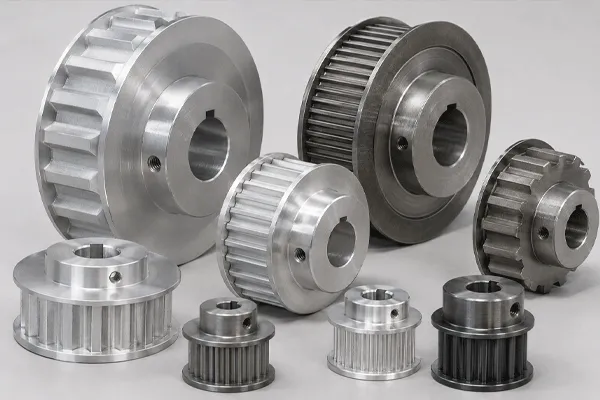
Why Must the Timing Belt and Pulley Be Matched?
A timing belt is one half of the system.
The other half is the pulley.
If the tooth geometry does not match correctly, contact can concentrate on a small area of the belt tooth.
That can cause:
- tooth wear;
- noise;
- heat;
- belt tracking problems;
- tooth jump;
- reduced life;
- lost positioning accuracy.
KTD currently manufactures timing belts and matching timing pulleys within the same broader transmission product system and specifically emphasizes matched belt/pulley geometry.
For an OEM project, send both belt and pulley information where possible.
Important pulley data includes:
- tooth profile;
- pitch;
- number of teeth;
- outside diameter;
- bore;
- flange configuration;
- shaft speed.
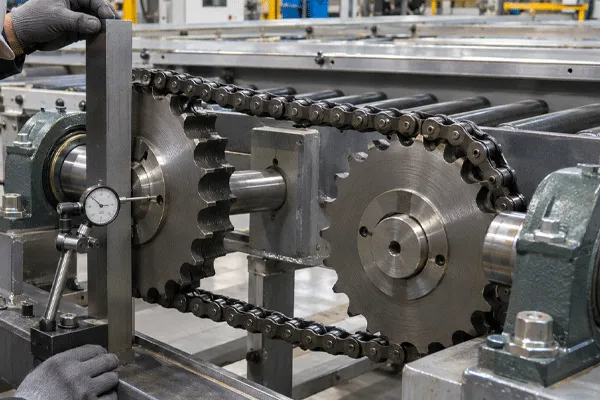
What about belts and chains?
Both belts and chains can provide positive transmission.
Chains offer strong mechanical engagement and suit harsh heavy-duty environments.
Synchronous belts offer several advantages where clean operation, lower noise, and no lubrication are important.
The correct answer depends on the machine.
Do not replace a chain with a belt—or a belt with a chain—without checking load, shaft forces, drive ratio, environment, and failure behavior.
How Do You Select a Custom Timing Belt for Demanding Applications?
Good product selection starts with operating data.
A belt manufacturer should ask more than length and width.
1. Define the application
Is the belt used for:
- rotary power transmission;
- linear movement;
- conveying;
- indexing;
- positioning?
2. Confirm torque and speed
A high torque drive may require a larger pitch or wider belt.
Higher speed can place more importance on:
- balance;
- tooth engagement;
- belt flexibility;
- pulley quality.
3. Determine tooth profile
Confirm whether the drive uses:
- trapezoidal;
- HTD;
- T;
- AT;
- S;
- P;
- proprietary GT-type geometry.
Never assume profiles with the same nominal pitch are interchangeable.
4. Select material
Consider:
- oil;
- chemicals;
- humidity;
- washdown;
- temperature;
- food contact.
For hygienic conveying or chemical exposure, polyurethane may provide advantages over standard rubber constructions.
5. Select reinforcement
Choose tensile material according to:
- stretch;
- load;
- flexibility;
- pulley size;
- positioning needs.
6. Define customization
Specify:
- custom width;
- length;
- cleats;
- backing;
- holes;
- tracking guides;
- coatings.
7. Define tolerance
For precise timing, ask how belt pitch, length, width, and attachments are controlled.
The word “precision” alone does not define a measurable requirement.
Custom Timing Belts: Materials, Tooth Profiles, Customization and Selection Guide
Custom Timing Belt RFQ Checklist
| Information |
What to Send |
| Belt profile |
HTD / T / AT / S / Imperial / Other |
| Pitch |
mm or inch |
| Length |
Pitch length or open-ended length |
| Width |
Required belt width |
| Material |
Rubber / PU |
| Reinforcement |
Fiberglass / steel / aramid |
| Pulley |
Profile and tooth count |
| Speed |
rpm / linear speed |
| Torque or load |
Working and peak value |
| Environment |
Oil / chemical / washdown / temperature |
| Custom features |
Cleats / backing / holes / guides |
| Quantity |
Prototype and production volume |
The more complete this information is, the easier it is to design for optimal performance.
Where Are Custom Timing Belts Used?
Custom synchronous belt systems appear across diverse industries.
Industrial automation
Robotic systems, CNC machines, pick-and-place equipment, and multi-axis machines depend on repeatable movement.
A properly matched timing belt and pulley can provide synchronized movement without ordinary friction-drive slip.
KTD specifically positions HTD and T-series belts for CNC machines, servo drives, positioning systems, and automated machinery.
Packaging
Packaging machines often require exact product spacing.
A PU belt with welded cleats can carry each product at a known interval.
Food processing
Food production may require:
- washdown resistance;
- clean surfaces;
- approved materials;
- corrosion-resistant machine components.
Food-grade PU is one option for suitable applications.
Printing
Printing and converting machines require repeatable registration between rollers and moving material.
Medical and precision equipment
Clean operation, low stretch, and repeatable positioning can make synchronous belts attractive for medical devices and precision equipment.
Extreme applications
For extreme applications, no single belt material solves everything.
Very high temperature, aggressive chemicals, unusual bending, vacuum conditions, or very small pulleys may require specialized materials or even a different transmission technology.
A capable supplier should sometimes say, “A timing belt is not the right solution.”
That is better engineering than forcing a product into the wrong application.
What Causes Custom Timing Belts to Fail Early?
Many belt failures begin outside the belt itself.
Incorrect tooth profile
Using the wrong belt profile with the pulley causes poor engagement.
Bad alignment
Misaligned shafts can force the belt sideways.
This damages:
- teeth;
- sidewalls;
- cords;
- flanges.
Incorrect tension
Too little tension can lead to tooth jump.
Too much tension increases bearing and shaft loads.
Undersized belt
If the belt is too narrow for the peak torque, tooth and tensile stress increase.
Wrong material
Oil, chemicals, heat, or cleaning agents can degrade a belt that was not designed for that environment.
Poor attachment design
A cleat may tear away if the product load creates excessive bending or peel force at the weld.
Improper pulley diameter
A very small pulley forces the belt through tighter bending cycles.
This can shorten tensile-cord life.
Good customization therefore considers the complete system.
The goal is not simply to prevent immediate failure. It is to reduce unexpected downtime throughout the life of the machine.
How Should You Choose a Custom Timing Belt Manufacturer?
A good supplier should be able to understand the belt as an engineered component, not simply quote by part number.
Ask whether the supplier can support:
- multiple tooth profiles;
- rubber and PU materials;
- open-ended belts;
- endless belts;
- custom lengths;
- custom widths;
- reinforcement options;
- attachments;
- backing;
- perforations;
- matching pulleys.
For KTD, the current timing belt range includes standard and custom rubber/PU products as well as matching timing pulley manufacturing and broader OEM transmission customization.
For a custom project, also ask:
- Can you review my pulley drawing?
- Can you confirm tooth-profile compatibility?
- What dimensional tolerances can you control?
- How are custom attachments positioned?
- What is the minimum production quantity?
- Can you support prototype evaluation?
- What material certificates are available where required?
A supplier who asks about the machine before giving a final recommendation is usually more useful than one who immediately offers the nearest standard belt.
Frequently Asked Questions About Custom Timing Belts
What can be customized on a timing belt?
Length, width, profile, tensile reinforcement, material, backing, guide ribs, cleats, perforations, coatings, and other surface features can be customized depending on belt construction and manufacturing process. KTD currently offers open-ended and non-standard endless belts along with multiple attachment and backing options.
What is the difference between a timing belt and a V-belt?
A timing belt uses teeth that mesh with matching pulley grooves for synchronous transmission. V-belts transfer power mainly through friction between the belt sidewalls and pulley groove. Timing belts are therefore better suited to applications that require synchronization or accurate positioning.
When should I use polyurethane instead of rubber?
Choose PU when abrasion, oils, chemicals, conveying attachments, or food-grade construction are important. Rubber remains a strong option for general industrial drive applications because of its flexibility, strength, and cost efficiency.
Can a custom timing belt be made in any length?
Open-ended belt can be cut to many application lengths. Thermoplastic PU may also be joined to create special endless lengths. However, joint strength, tooth pitch, manufacturing method, and application load can limit what is technically appropriate.
Are GT2 and GT3 the same as HTD?
No. HTD and GT are different tooth-system families. GT is a proprietary Gates tooth geometry, and GT2/GT3 belt selection should match the corresponding pulley system. Do not substitute based only on pitch.
Can timing belts have cleats and holes?
Yes. Custom PU timing belts are commonly supplied with cleats or attachments for conveying, and perforated designs can be used for vacuum handling. Attachment spacing, hole pattern, and belt construction should be specified on the drawing.
Key Takeaways: Custom Timing Belt Selection
- A custom timing belt is designed or modified when a standard catalog belt cannot meet machine requirements.
- Timing belts provide synchronous tooth engagement rather than relying only on friction.
- Rubber and polyurethane belts serve different environments and operating requirements.
- Tooth profile and pitch must match the pulley.
- Trapezoidal, HTD, T, S, P, and proprietary GT-type profiles should not be treated as interchangeable.
- GT2 and GT3 belong to Gates’ proprietary GT tooth-system family.
- Endless belts suit rotary drives, while open-ended belts are widely used for linear motion.
- Welded PU constructions can provide non-standard endless lengths, but joint strength must match the load.
- Fiberglass, steel, and aramid tensile members provide different combinations of strength, stretch resistance, and flexibility.
- Cleats, backing, guide ribs, and perforations can turn a transmission belt into a precision conveying component.
- Belt and pulley geometry should be considered as one system.
- Proper width, tension, pulley diameter, alignment, and material selection directly affect belt life.
- Food processing, packaging, automation, CNC equipment, printing, and precision machinery are common applications.
- A good custom timing belt supplier should review the complete drive rather than only the belt part number.
- For the most reliable quotation, provide belt profile, pitch, width, length, pulley data, load, speed, environment, customization details, and quantity.
For OEM machines, industrial automation, conveying systems, and specialized motion-control projects, KTD provides rubber and polyurethane timing belts in standard and customized configurations. If you send the belt profile, pulley data, required dimensions, application load, environment, and custom attachment drawing, the engineering team can review the drive and recommend a practical belt construction.












 15:40