KTD Engineering Team | Application Engineering & DFM Team | Published September 3, 2026
The choice between chain driven (CDLR) and belt driven (BDLR) roller conveyor comes down to what drives each roller: a sprocket-and-chain loop, or a belt pressed against the roller’s underside by friction. That single hardware difference decides load ceiling, noise level, accumulation behavior and long-run maintenance cost.
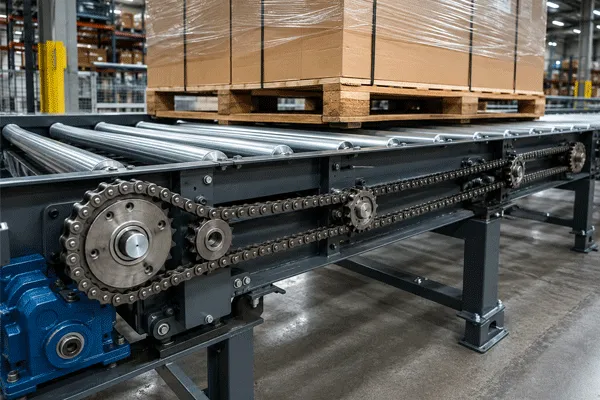
Explicação sobre transportadores de rolos acionados por corrente vs. acionados por correia
The Hardware Difference, Not Just the Marketing Term
In a chain driven live roller conveyor, each roller carries a sprocket on one or both ends, and a continuous drive chain loops from sprocket to sprocket down the line. Every roller receives power directly and turns at the same speed as every other roller on that chain run — this is what’s called positive drive, because there’s no slip point between the drive source and the load-bearing surface.
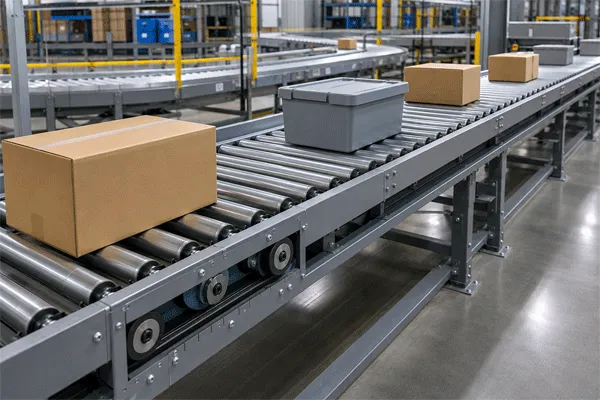
A belt driven live roller conveyor works differently. A flat belt or V-belt runs underneath the rollers, held against them by pressure rollers or a tensioned track. Friction between belt and roller surface — not a mechanical link — is what turns the roller. Remove that friction (a wet roller, a slack belt, an overloaded zone) and the roller stops turning even while the belt keeps moving underneath it. That slip is a design feature in accumulation zones and a limitation everywhere else.
CDLR vs BDLR at a Glance
| Fator |
Chain Driven (CDLR) |
Belt Driven (BDLR) |
| Drive mechanism |
Sprocket-per-roller with continuous chain loop |
Pressure belt/pulley friction against roller underside |
| Typical load ceiling |
Higher — suited to pallets, drums, heavy unit loads |
Moderate — cartons, totes, light-to-medium unit loads |
| Nível de ruído |
Louder; chain and sprocket contact generates mechanical noise |
Quieter; friction drive has fewer metal-on-metal contact points |
| Zero-pressure accumulation |
Requires added clutch/torque-limiting hardware per zone |
Built into the friction principle — belt slips under a stopped load without added parts |
| Maintenance items |
Chain lubrication, sprocket wear checks, chain tension adjustment |
Belt tension and tracking, pressure roller wear, belt replacement interval |
| Curve sections |
Handles curves with additional tapered rollers and guide hardware |
Straight runs typically; curves need a different drive approach |
| Reversibility |
Straightforward — chain drive runs either direction |
Possible but belt tracking needs more attention when reversed |
Load Capacity: Why Positive Drive Wins on Heavy Pallets
Because every roller is mechanically tied to the same chain, a chain driven conveyor doesn’t lose drive torque at any single roller regardless of how the load is distributed across the line. A friction belt, by contrast, has a slip threshold — push past it with an overweight or unevenly loaded pallet, and the belt continues moving while some rollers stall under it, which can shift or drag the load rather than convey it cleanly. This is the reason pallet handling, drum transport and heavy unitized freight default to sprocket-driven rollers rather than pressure belt systems.
Noise and Accumulation: Where Belt Wins
Chain and sprocket contact is inherently noisier than a belt running against a roller surface, and in facilities running multiple parallel conveyor lines near workstations, that noise difference is audible over an eight-hour shift. Belt driven systems also get zero-pressure accumulation essentially for free: when a downstream roller stops turning because product is backed up against it, the belt keeps moving but simply slips beneath the stalled roller instead of forcing it to continue turning. A chain driven line needs added mechanical accumulation hardware — torque-limiting clutches or zone-control modules built into specific rollers — to get the same stop-without-jam behavior, since a chain has no natural slip point of its own.
Explicação sobre transportadores de rolos acionados por corrente vs. acionados por correia
Maintenance Cost: What Actually Wears
The parts that fail aren’t the same parts, so a maintenance budget built around one drive type doesn’t transfer cleanly to the other.
- Chain driven linesneed periodic chain lubrication, sprocket tooth-wear inspection (see our companion guide on sprocket wear checks), and chain tension adjustment as the chain elongates over service life. Sprockets and chain wear together — replacing one without checking the other shortens the life of whichever part is newer.
- Belt driven linesneed belt tension and tracking checks, since a belt that walks off-center wears unevenly and can shred against the conveyor frame. Pressure rollers that hold the belt against the driven rollers also wear and need periodic replacement, and the belt itself has a finite service life tied to hours run and load exposure rather than a wear-visible failure mode like a hooked sprocket tooth.
Neither system is categorically cheaper to maintain — chain driven trades more frequent small adjustments for fewer catastrophic failures, while belt driven trades quieter running for a belt replacement bill that arrives with less visual warning than sprocket wear does.
Um equívoco que vale a pena corrigir
“Chain driven is always the heavier-duty option” oversimplifies a decision that depends on more than raw weight capacity. Modern motorized roller conveyor (MDR) designs using O-ring or Poly-V belt drive between rollers can now handle moderate-to-heavy carton and tote loads that would once have defaulted to a chain drive by habit, particularly in zoned accumulation applications where the accumulation behavior matters more than the absolute weight ceiling. The right question isn’t “how heavy is the load” in isolation — it’s whether the line needs zero-pressure accumulation, how loud the environment can tolerate running, and whether curves are part of the layout, alongside load weight.
Matching Roller Hardware to Your Drive Type
Sourcing the roller itself needs to match the drive mechanism it’s paired with, not just the conveyor frame it sits in.
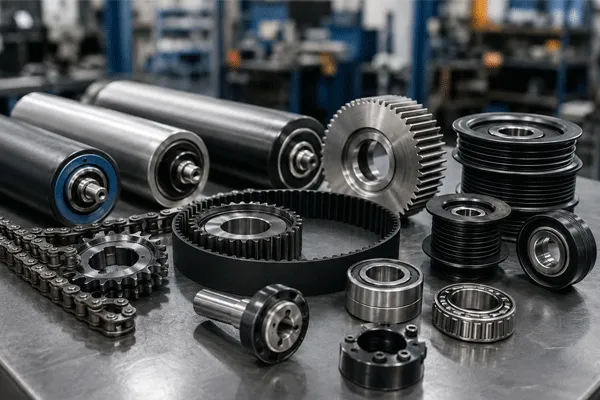
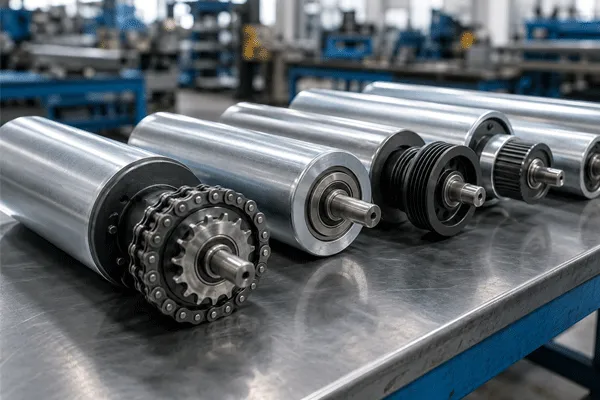
Sprocket Driven Conveyor Rollers are built with a sprocket fixed to one or both shaft ends to engage the drive chain directly. Tube materials run carbon steel, 304/316 stainless steel, aluminum or PVC depending on load and environment, with standard tube diameters around 38 mm, 50 mm, 60 mm and 89 mm and lengths built to the specific conveyor frame width. Shaft-end configuration (spring-loaded, female-threaded or milled-flat) determines how the roller mounts into the frame and how the sprocket aligns with the chain run.
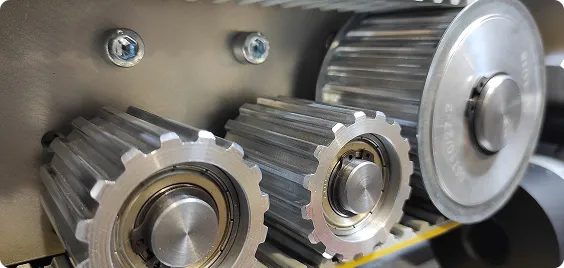
Pulley-Driven Rollers, used in belt driven and Poly-V configurations, drop the sprocket in favor of a grooved or smooth section the drive belt rides against. Bearing options across both roller types include precision ball bearings, stamped bearings and polymer bearing housings, and load range spans lightweight parcel handling up to heavy-duty systems moving multi-ton pallet loads — the deciding factor being which drive mechanism the rest of the line is built around, not the roller tube itself.
Compared with system-level buying guides that stop at “chain is heavy-duty, belt is quiet,” sourcing decisions at the component level come down to shaft-end configuration, bearing type and tube diameter matching the frame — details that determine whether a replacement roller actually fits the existing drive without reworking the line.
Explicação sobre transportadores de rolos acionados por corrente vs. acionados por correia
Manufacturing Quality Behind Either Option
Roller and sprocket components for either drive type are only as consistent as the quality system producing them. KTD’s stated manufacturing quality management system is certified to ISO 9001:2015, the internationally recognized standard for quality management systems, which is a reasonable baseline question to ask any conveyor hardware supplier regardless of which drive type a project settles on.
Perguntas frequentes
Q: Can I switch an existing chain driven line to belt driven without replacing the rollers?
A: Usually not directly — sprocket driven rollers have a sprocket fixed to the shaft end, while pulley-driven rollers have a plain or grooved section for belt contact. Converting drive types typically means resourcing the rollers to match the new drive mechanism.
Q: Which option handles curves better?
A: Chain driven lines handle curves more readily with tapered rollers and guide hardware built into the curve section. Belt driven systems are more commonly built for straight runs, with curves typically requiring a different drive approach.
Q: Is belt driven always quieter?
A: In most cases, yes — friction-belt contact generates less mechanical noise than chain and sprocket engagement. The margin narrows if the chain driven line is well-lubricated and properly tensioned, and widens if either system is poorly maintained.
Q: Do both drive types support stainless steel rollers for washdown environments?
A: Yes — 304/316 stainless steel tube options are available for both sprocket driven and pulley-driven roller configurations.
Q: What roller diameters are typically stocked?
A: Standard tube diameters around 38 mm, 50 mm, 60 mm and 89 mm cover most parcel-to-pallet applications, with custom lengths built to the conveyor frame.












 13:38
13:38