A pulley is a simple but powerful mechanical component used in lifting, power transmission, and industrial machinery. However, choosing the wrong type of pulley can reduce efficiency, increase wear, and create unexpected maintenance problems. Understanding different types of pulleys helps engineers select the right solution for their application.
The four main types of pulleys are fixed pulleys, movable pulleys, compound pulley systems, and belt pulleys. Fixed pulleys change the direction of force, movable pulleys reduce the force needed to lift loads, compound pulley systems combine multiple pulleys for greater mechanical advantage, and belt pulleys transmit rotational power between shafts.
What Are the 4 Types of Pulleys? Types of Pulleys Explained With Applications and Selection Guide
What Is a Pulley and How Does It Work?
A pulley is a type of simple machine consisting of a rotating wheel mounted on an axle with a groove designed for a rope, cable, belt, or chain. The basic purpose of a pulley is to transfer force, change the direction of force, or make lifting and power transmission easier.
In simple lifting applications, a pulley works together with a rope. When a user pulls one end of the rope, the pulley rotates around the axle and helps move the connected load.
Modern industrial applications use more advanced pulley designs. Instead of only lifting objects, industrial pulleys transfer mechanical power between rotating components.
Por exemplo:
- A belt pulley transfers power from a motor to another shaft.
- A polia de distribuição synchronizes movement between machines.
- A polia de transportador drives conveyor belts in material handling systems.
- A custom pulley is designed for special industrial requirements.
At KTD, we manufacture precision transmission components including timing pulleys, Poly-V pulleys, and customized pulley solutions for automation equipment, machinery manufacturers, and industrial applications.
A pulley is a simple machine, but industrial pulley design requires careful consideration of material, load capacity, machining accuracy, and operating conditions.
What Are the 4 Types of Pulleys?
There are several types of pulleys used in mechanical systems, but four main categories cover most applications:
| Tipo de roldana |
Working Principle |
Aplicações Típicas |
| Polia fixa |
Rotates in a fixed position and changes force direction |
Cranes, lifting systems |
| Polia móvel |
Moves with the load and reduces required force |
Heavy lifting equipment |
| Polia composta |
Combines fixed and movable pulleys |
Industrial lifting systems |
| Belt pulley |
Transfers rotational power through a belt |
Machinery and automation |
Understanding these pulley types helps engineers choose the correct design according to load, speed, precision, and transmission requirements.
What Is a Fixed Pulley and How Does It Work?
A fixed pulley is one of the simplest pulley types. It is attached to a fixed point, allowing the wheel to rotate while staying in the same position.
The main function of a fixed pulley is to change the direction of the force rather than significantly reduce the amount of force required.
For example, when lifting a bucket from a well, pulling downward on the rope feels easier because the fixed pulley changes the direction of the applied force.
A fixed pulley includes several basic parts:
- Wheel
- Axle
- Groove
- Rope or cable
- Estrutura de suporte
In industrial settings, fixed pulleys are commonly used in:
- Guindastes
- Hoisting equipment
- Sistemas de manuseamento de materiais
- Construction sites
A fixed pulley does not provide a major mechanical advantage, but it improves operator control by allowing force to be applied in a more convenient direction.
For example, instead of pulling upward to lift a load, workers can pull downward while the pulley redirects the movement.
What Is a Movable Pulley and Why Does It Reduce Force?
A movable pulley works differently from a fixed pulley because the pulley itself moves with the load.
The pulley is attached directly to the object being lifted. When the rope moves, the pulley moves together with the load.
The biggest advantage of a movable pulley is mechanical advantage.
A movable pulley can:
- Reduce the input force needed
- Make heavy objects easier to lift
- Support heavier loads with less effort
In a simple movable pulley system, part of the load weight is supported by the rope sections around the pulley.
This means the operator needs less force to lift the object compared with using only a fixed pulley.
Entre as aplicações mais comuns contam-se:
- Construction lifting equipment
- Rescue systems
- Industrial hoists
- Warehouse lifting devices
For heavy-duty lifting operations, engineers often combine movable and fixed pulleys to create more efficient lifting solutions.
What Is a Compound Pulley System?
A compound pulley system combines fixed and movable pulleys to achieve greater mechanical advantage.
This design uses multiple pulleys working together, allowing operators to lift very heavy loads with much less force.
A common example is a block and tackle pulley system.
A block and tackle system contains:
- Multiple pulleys
- Supporting blocks
- Rope arrangement
- Fixed attachment points
The more supporting rope sections connected to the load, the greater the mechanical advantage.
Compound pulley systems are widely used in:
- Guindastes
- Ship equipment
- Industrial lifting systems
- Heavy construction machinery
Compared with a single pulley, a compound system can significantly reduce the force needed to lift heavy objects.
However, more pulleys also increase system complexity. Engineers must consider friction, rope strength, maintenance requirements, and safety factors.
What Is a Belt Pulley and How Is It Used in Industry?
A belt pulley is different from lifting pulleys because its main purpose is power transmission rather than lifting.
A belt pulley uses a belt to transfer rotational movement from one shaft to another.
The system usually includes:
- Polia motriz
- Polia motriz
- Cinto
- Eixo
- Rolamentos
When the driving pulley rotates, the belt transfers mechanical energy to the driven pulley.
Belt pulleys are widely used because they provide:
- Smooth power transmission
- Low operating noise
- Flexible installation
- Easy maintenance
As aplicações típicas incluem:
- Máquinas industriais
- Fãs
- Bombas
- Compressores
- Sistemas de transporte
- Automation equipment
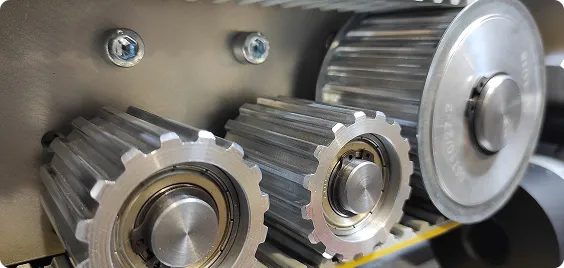
In precision machinery, timing pulleys are used instead of standard belt pulleys because they prevent slipping and maintain accurate movement.
KTD supplies customized belt pulley and timing pulley solutions manufactured according to customer drawings, including different materials, tooth profiles, bore designs, and surface treatments.
What Are the Different Types of Industrial Pulleys?
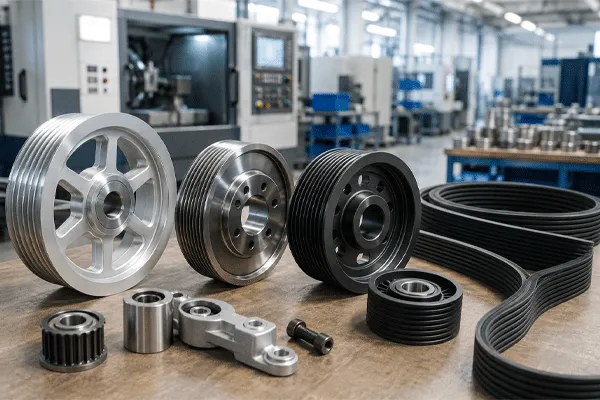
Beyond the basic lifting designs, modern industries use various types of pulleys for mechanical power transmission. Industrial pulleys are designed according to load requirements, speed, accuracy, operating environment, and machine structure.
Unlike simple lifting pulleys that mainly work with a rope, industrial pulley systems often use belts to transmit rotational movement between components.
Common industrial pulley types include:
| Tipo de roldana |
Função principal |
Aplicações Típicas |
| Polia de distribuição |
Provides synchronized motion without slipping |
Automation equipment, CNC machines |
| Belt pulley |
Transfers power through friction belts |
Fans, pumps, machinery |
| Flat belt pulleys |
Used with flat belts for smooth transmission |
Traditional industrial machines |
| Polia cónica |
Provides variable speed adjustment |
Machine tools, older transmission systems |
| Conveyor pulley |
Drives or supports conveyor belts |
Sistemas de manuseamento de materiais |
| Custom pulley |
Designed for special engineering requirements |
OEM machinery |
Each pulley design has specific advantages. Selecting the correct pulley depends on whether the system requires precise positioning, high torque transmission, speed adjustment, or simple mechanical movement.
For example, a timing pulley is preferred when accurate synchronization is required, while a belt pulley may be better for general power transmission where slight belt movement is acceptable.
What Are the 4 Types of Pulleys? Types of Pulleys Explained With Applications and Selection Guide
What Are the Main Parts of a Pulley?
Compreender o parts of a pulley helps engineers evaluate performance, maintenance needs, and manufacturing quality.
A basic pulley consists of several important components:
| Parte |
Função |
| Wheel |
Rotates and supports the belt or rope |
| Groove |
Guides the rope or belt position |
| Axle |
Supports rotation |
| Eixo |
Transfers rotational force |
| Rolamento |
Reduces friction |
| Hub |
Connects the pulley to the shaft |
For lifting applications, the groove must match the rope size and material. A poor groove design can increase wear and reduce safety.
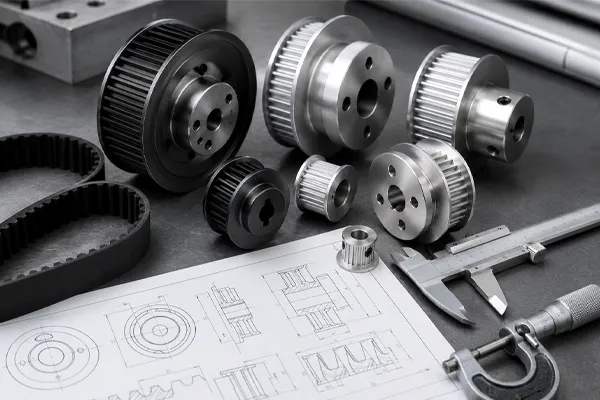
For industrial transmission systems, pulley accuracy becomes even more important. The bore size, keyway, tooth profile, and balance directly affect machine performance.
A precision pulley requires:
- Accurate machining
- Proper material selection
- Correct surface treatment
- Stable dimensional tolerance
For example, timing pulleys used in automation equipment require accurate tooth geometry because even small errors can affect positioning accuracy.
At KTD, custom pulley production focuses on engineering details such as bore design, tooth profile, material selection, and application requirements to ensure reliable transmission performance.
What Are Flat Belt Pulleys and Cone Pulleys Used For?
Flat Belt Pulleys
Flat belt pulleys are designed for use with flat belts. They transfer rotational power through friction between the belt and pulley surface.
Traditional industrial machines used flat belt systems extensively because they were simple and easy to maintain.
Advantages include:
- Simple structure
- Easy replacement
- Smooth operation
- Suitable for long-distance transmission
Entre as aplicações mais comuns contam-se:
- Maquinaria têxtil
- Equipamento agrícola
- Workshop machines
- Older industrial transmission systems
However, flat belt pulleys usually provide less precise movement compared with modern timing pulley systems.
Cone Pulleys
A cone pulley uses multiple pulley diameters arranged in a stepped design.
By moving the belt between different steps, operators can change the transmission speed.
Cone pulleys were commonly used in:
- Máquinas-ferramentas
- Drilling machines
- Industrial equipment
A similar design is called a step pulley, which provides multiple speed options without changing the motor.
Although modern variable-speed drives have replaced many cone pulley applications, they remain useful in certain machines because of their simple mechanical structure.
What Is a Block and Tackle Pulley System?
A block and tackle pulley system is one of the most effective methods for lifting heavy loads.
It combines several fixed and movable pulleys to create a large mechanical advantage.
The basic working principle is simple:
- Multiple pulleys are connected together.
- A rope passes through the pulley arrangement.
- The load is supported by several rope sections.
- The required input force is reduced.
This allows operators to lift heavy loads that would otherwise require much greater effort.
Examples of block and tackle applications include:
- Guindastes
- Equipamento marítimo
- Construction lifting systems
- Industrial hoists
A block and tackle system does not remove the weight of the object. Instead, it distributes the load across multiple rope sections, reducing the force needed to lift the object.
What Is a Swivel Eye Pulley?
A swivel eye pulley is a specialized pulley designed with a rotating attachment point.
The swivel function allows the pulley to move freely and adjust direction during operation.
This design is useful when the pulling direction changes frequently.
Entre as aplicações mais comuns contam-se:
- Equipamento marítimo
- Rescue systems
- Outdoor lifting equipment
- Utility applications
The main advantages of a swivel eye pulley include:
- Flexible installation
- Reduced rope twisting
- Better movement control
- Easier positioning
When selecting this type of pulley, engineers should consider the working load, rope diameter, material strength, and environmental conditions.
How Do You Choose the Right Type of Pulley?
Choosing the correct pulley requires understanding the actual working conditions.
The wrong pulley selection can cause:
- Excessive wear
- Belt slipping
- Reduced efficiency
- Higher maintenance costs
Important selection factors include:
1. Application Purpose
First determine whether the pulley is designed for:
- Lifting
- Transmissão de potência
- Controlo de velocidade
- Synchronization
- Conveyor movement
A lifting pulley and a transmission pulley may look similar, but they perform completely different functions.
2. Load Requirements
The working load determines pulley size, material, and structure.
Heavy load applications may require:
- Steel pulleys
- Reinforced shafts
- Strong bearings
- Larger diameter designs
Light applications may use aluminum or engineering plastic components.
3. Speed and Accuracy
High-speed industrial machines require precise pulley designs.
Por exemplo:
- Timing pulleys provide accurate synchronization.
- Belt pulleys provide smooth transmission.
- Cone pulleys provide mechanical speed adjustment.
4. Operating Environment
Environmental conditions affect material selection.
Considere o seguinte:
- Temperatura
- Humidade
- Pó
- Chemical exposure
- Continuous operation time
For harsh industrial environments, manufacturers may recommend stronger materials and surface treatments.
What Are the 4 Types of Pulleys? Types of Pulleys Explained With Applications and Selection Guide
Why Are Custom Pulleys Important for Industrial Equipment?
Many machines cannot use standard pulley designs.
A custom pulley allows engineers to create a solution based on exact requirements.
Customization may include:
- Special diameter
- Custom bore size
- Different keyway designs
- Specific tooth profiles
- Special materials
- Surface treatment options
Custom pulleys are commonly used in:
- Automation equipment
- Maquinaria de embalagem
- Robotics
- Industrial production lines
- Special OEM machines
For manufacturers, a customized pulley can improve:
- Transmission efficiency
- Machine reliability
- Space utilization
- Maintenance performance
KTD provides OEM and custom transmission solutions for industrial customers requiring precision pulleys, polias de distribuição, and other power transmission components.
Examples of Pulleys in Industrial Applications
Pulleys are used across many industries because they provide efficient force transfer and motion control.
Entre os exemplos mais comuns contam-se:
| Industry |
Pulley Application |
| Automation |
Timing pulley systems |
| Logistics |
Conveyor pulley systems |
| Produção |
Belt transmission systems |
| Construction |
Crane lifting pulleys |
| Agriculture |
Machine drive pulleys |
| Textile |
Flat belt pulleys |
In automated factories, pulleys often work together with motors, gears, and belts to create complete motion systems.
For example, a conveyor system may use a conveyor pulley to drive movement, while a timing pulley ensures accurate synchronization between machine components.
How Does a Pulley System Improve Mechanical Efficiency?
A well-designed pulley system improves efficiency by controlling how force is transferred.
The benefits include:
- Reducing the force needed to move loads
- Changing the direction of force
- Increasing mechanical advantage
- Improving motion control
- Transmitting power efficiently
A simple pulley may only change movement direction, while complex pulley systems using multiple pulleys can significantly improve lifting ability.
In industrial machinery, pulley design focuses not only on reducing effort but also on achieving stable, reliable operation.
The combination of pulley design, material selection, and accurate manufacturing determines the final performance of the system.
Frequently Asked Questions About Pulley Types
Quais são os 4 tipos de polias?
The four main types of pulleys are fixed pulleys, movable pulleys, compound pulley systems, and belt pulleys. Each type has different functions, from changing force direction to transmitting mechanical power.
What type of pulley is used for industrial machines?
Industrial machines commonly use belt pulleys, polias de distribuição, conveyor pulleys, and custom pulleys. The correct choice depends on speed, torque, precision, and application requirements.
What is the difference between a fixed pulley and a movable pulley?
A fixed pulley stays attached to one position and mainly changes the direction of force. A movable pulley moves with the load and reduces the amount of force required to lift heavy objects.
Why are timing pulleys used in automation?
Timing pulleys prevent slipping by using toothed belts and matching pulley teeth. They provide accurate synchronization, making them suitable for CNC machines, robotics, and automation systems.
Can pulleys be customized for special machines?
Yes. Custom pulleys can be manufactured according to specific requirements such as diameter, bore size, materials, tooth profiles, and operating conditions.
What materials are used for industrial pulleys?
Industrial pulleys can be manufactured from aluminum, steel, stainless steel, cast iron, and other engineering materials depending on load, speed, and environmental requirements.
Key Takeaways: Types of Pulleys Explained
- A pulley is a simple machine that transfers force or mechanical power through a wheel, axle, rope, cable, or belt.
- The four main pulley categories are fixed pulley, movable pulley, compound pulley system, and belt pulley.
- Fixed pulleys mainly change the direction of force.
- Movable pulleys reduce the force needed to lift heavy objects.
- Compound pulley systems use multiple pulleys to create greater mechanical advantage.
- Belt pulleys are widely used for industrial power transmission.
- Timing pulleys provide accurate motion synchronization for automation systems.
- Cone pulleys and flat belt pulleys remain useful in specific mechanical applications.
- Custom pulleys help manufacturers solve special engineering challenges.
- Choosing the right pulley requires considering load, speed, environment, material, and operating requirements.
- Working with an experienced pulley manufacturer ensures better performance, reliability, and long-term transmission efficiency.












 09:32
09:32