Инженерная команда KTD | Application Engineering & DFM Team | Updated 28,August 2026
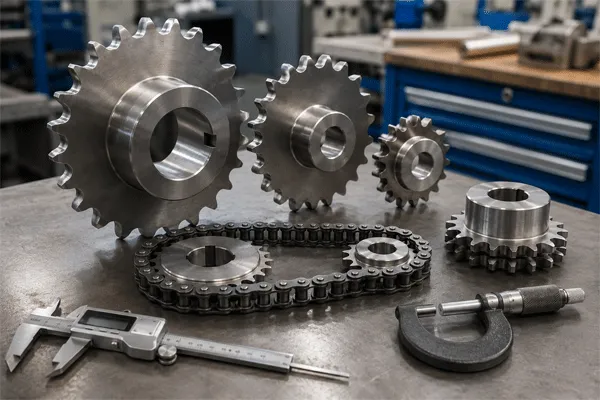
A roller chain sprocket must match the chain’s full designation, not the pitch alone. ANSI #40 and ISO 08B both run a 12.7 mm pitch, yet roller diameter and inner width differ, so the tooth gap differs with them. Confirm the standard first, then select bore, hub and strand count.
Звездочки для роликовых цепей: руководство по шагу, внутреннему диаметру и стандартам
What the number on the chain is telling you
ANSI numbering is compact and easy to misread. The digits before the last one give the pitch in eighths of an inch. The last digit describes the construction: 0 for a standard roller chain, 1 for the lightweight series, 5 for a rollerless bushing chain.
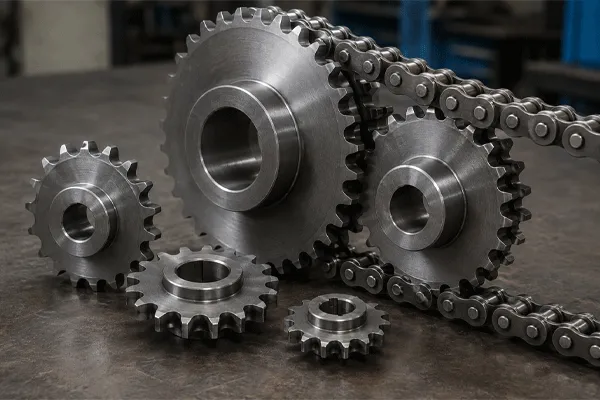
So #60 is a 6/8 inch, or 19.05 mm, pitch standard roller chain. #35 is a 3/8 inch pitch rollerless chain, which is why a #35 sprocket has a different tooth profile from a #40 despite both looking similar on a shelf. A trailing H marks the heavy series with thicker link plates, and a trailing -2 or -3 marks the strand count.
| ANSI number |
Тон |
Диаметр ролика |
Typical torque band |
| 25 |
6.35 mm (1/4″) |
3.30 mm |
Light instrumentation, small indexing drives |
| 35 |
9.525 mm (3/8″) |
Rollerless bushing |
Light machinery, low speed |
| 40 |
12.70 mm (1/2″) |
7.92 mm |
General machine drives, packaging equipment |
| 41 |
12.70 mm (1/2″) |
7.77 mm, narrow plates |
Light duty, agricultural and OEM subassemblies |
| 50 |
15.875 mm (5/8″) |
10.16 mm |
Mid-range machinery drives |
| 60 |
19.05 mm (3/4″) |
11.91 mm |
Heavier machine drives, mixers, conveyors |
| 80 |
25.40 mm (1″) |
15.88 mm |
Heavy industrial drives |
| 100 |
31.75 mm (1-1/4″) |
19.05 mm |
Heavy low-speed drives |
| 120 |
38.10 mm (1-1/2″) |
22.23 mm |
Bulk handling, process equipment |
| 140 |
44.45 mm (1-3/4″) |
25.40 mm |
Heavy process machinery |
| 160 |
50.80 mm (2″) |
28.58 mm |
Very high torque, low speed |
ASME B29.1-2011 (R2022), published by ASME and available through ANSI, is the governing reference for these dimensions and for the associated sprocket tooth form in the North American market.
Звездочки для роликовых цепей: руководство по шагу, внутреннему диаметру и стандартам
Where ISO 606 and DIN 8187 part company with ANSI
ISO 606:2015 covers dimensions, tolerances and strength for short-pitch precision ролик and bush chains together with their associated sprockets. It defines two families. The A series maps closely to ANSI sizes. The B series is the European lineage that DIN 8187 also describes, and it does not interchange with ANSI at the same pitch.
| ISO B series |
Тон |
Диаметр ролика |
Внутренняя ширина |
| 05B |
8.00 mm |
5.00 mm |
3.00 mm |
| 06B |
9.525 mm |
6.35 mm |
5.72 mm |
| 08B |
12.70 mm |
8.51 mm |
7.75 mm |
| 10B |
15.875 mm |
10.16 mm |
9.65 mm |
| 12B |
19.05 mm |
12.07 mm |
11.68 mm |
| 16B |
25.40 mm |
15.88 mm |
17.02 mm |
| 20B |
31.75 mm |
19.05 mm |
19.56 mm |
| 24B |
38.10 mm |
25.40 mm |
25.40 mm |
Put 08B next to ANSI #40 and the problem shows itself:
| |
ANSI #40 |
ISO 08B |
| Тон |
12.70 mm |
12.70 mm |
| Диаметр ролика |
7.92 mm |
8.51 mm |
| Внутренняя ширина |
7.95 mm |
7.75 mm |
| Interchangeable? |
Нет |
Нет |
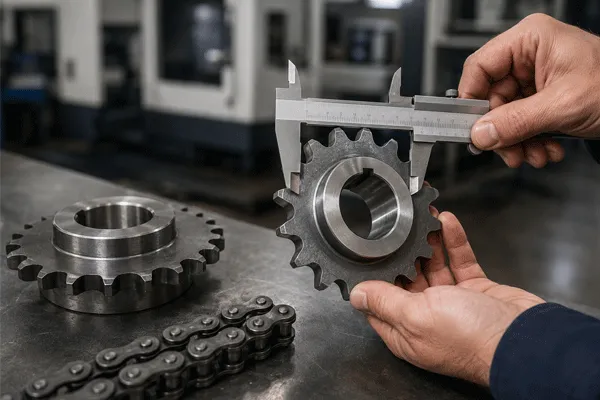
The 08B roller is 0.59 mm larger and the inner width is 0.20 mm narrower. A #40 sprocket will accept an 08B chain long enough to look like it works, then wear the tooth flanks unevenly because the roller never seats correctly in the pocket. This is the single most common sourcing error we see on machines built with a European gearbox and a North American drive package, or the reverse.
The 16B case is worse in the other direction: 16B inner width is 17.02 mm against 15.88 mm for #80, so the tooth thickness that fits one will rattle in the other.
Звездочки для роликовых цепей: руководство по шагу, внутреннему диаметру и стандартам
Choosing pitch by application, not by what is on the shelf
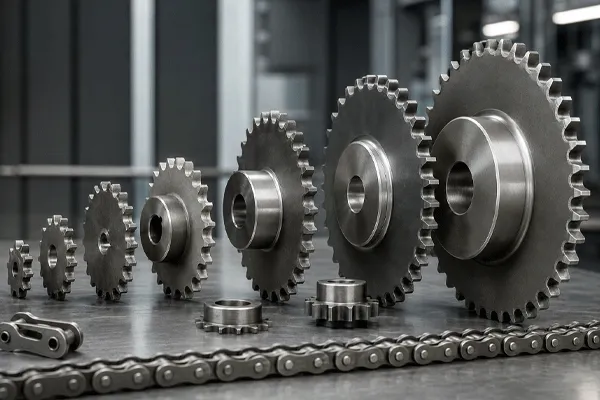
A larger pitch carries more load per strand and costs less per unit of torque. It also runs rougher, because chordal action grows with pitch and shrinks with tooth count. Machine builders who select on catalogue price alone tend to land one size too coarse and then chase vibration.
| Application condition |
Sensible pitch band |
Reasoning |
| High speed, low torque, smooth motion required |
25 to 40 |
Small chordal rise; lower dynamic load |
| General machine drive, moderate speed |
40 to 50 |
Widest availability of bore and hub options |
| Conveyor headshaft, moderate load |
50 to 60 |
Tolerates misalignment and contamination better |
| Heavy low-speed drive, high torque |
80 to 120 |
Load capacity per strand; slow enough that chordal action is tolerable |
| Space-constrained but high torque |
40 to 60, multi-strand |
Adding strands raises capacity without raising pitch diameter |
| Shock loading or reversing duty |
One size above the calculated requirement |
Peak torque, not average torque, drives plate fatigue |
That last row deserves emphasis. A drive sized on nameplate motor power with no service factor applied will run correctly on a test bench and fail in a plant where the machine jams twice a shift.
Single, double or triple strand
Adding a strand does not double capacity. The load does not distribute evenly across strands because of manufacturing variation in the sprocket tooth alignment and in the chain itself. The multi-strand factors used in drive calculations reflect that:
| Пряди |
Multi-strand factor |
Notes |
| 1 |
1.00 |
— |
| 2 |
1.70 |
Most common upgrade path |
| 3 |
2.50 |
Requires tighter shaft alignment |
| 4 |
3.30 |
Diminishing return; consider a larger pitch instead |
Multi-strand sprockets carry a transverse pitch, the centre distance between strands, which determines overall hub width and the space your machine frame must allow:
| ANSI size |
Transverse pitch |
| 35 |
10.13 mm |
| 40 |
14.38 mm |
| 50 |
18.11 mm |
| 60 |
22.78 mm |
| 80 |
29.29 mm |
| 100 |
35.76 mm |
| 120 |
45.44 mm |
Two decisions follow from this. First, a duplex sprocket needs its two tooth rows cut in one setup to hold row-to-row alignment; that is a manufacturing requirement, and it is worth confirming on a quotation rather than assuming. Second, replacement practice changes. Multi-strand chain is supplied as a matched set, and replacing one strand of a duplex drive puts a stretched strand next to a new one, which loads the new strand almost alone.
Tooth count and pitch diameter
The pitch diameter follows directly from pitch and tooth count:
PD = P ÷ sin(180° ÷ N)
For a #50 sprocket (15.875 mm pitch) with 19 teeth: sin(180 ÷ 19) = sin(9.4737°) = 0.16459, giving PD = 15.875 ÷ 0.16459 = 96.45 mm.
Practical limits on N:
- Below 17 teeth, chordal action becomes significant and articulation angle rises; acceptable at low speed, punishing at high speed.
- Below 15 teeth, expect audible speed variation and shortened chain life in most industrial drives.
- Above roughly 120 teeth, chain elongation causes the chain to ride up the teeth before wear limits are reached elsewhere, so large sprockets tolerate less stretch than small ones.
- An odd tooth count paired with an even number of chain pitches distributes wear across more tooth-and-roller combinations before the same pairing repeats.
Point 4 is cheap to apply at design stage and impossible to retrofit without changing the whole drive geometry.
Звездочки для роликовых цепей: руководство по шагу, внутреннему диаметру и стандартам
KTD roller chain sprocket configurations
The parameters below come from KTD’s published sprocket range.
| Параметр |
Диапазон |
| Тон |
Approximately 1/4 inch to 2 inches for ANSI configurations, plus metric equivalents |
| Strand configurations |
Simplex, duplex, triplex, custom multi-strand |
| Body types |
Plate type, hub type, bore type |
| Bore options |
Pilot bore, finished bore with keyway and set screw, taper-bushed and QD-style configurations |
| Материалы |
1045 carbon steel, alloy steel, 304 and 316 нержавеющая сталь, specialised custom materials |
| Обработка поверхностей |
Black oxide, zinc plating, specialised anti-corrosion finishes |
| Ссылки на стандарты |
ANSI/ASME B29.1, ISO 606, DIN 8187 |
| Количество по индивидуальному заказу |
От 20 штук до более 10 000 штук за партию |
| Поддерживаемые форматы чертежей |
STEP, IGES, DWG, DXF, SLDPRT, PDF |
Matching body type to how the machine gets built
| Body type |
What it is |
When it is the right choice |
| Plate type |
Flat sprocket, no hub, usually bolted or welded |
Bolting to a flange, a drum end or a fabricated hub already in the assembly |
| Hub type, one side |
Hub extended on a single face |
Standard shaft-mounted drive with a keyway; hub gives thread depth for set screws and axial location |
| Hub type, both sides |
Hub extended on both faces |
Wide keyway engagement needed, or the sprocket must sit centrally on a bearing span |
| Bore type / finished bore |
Machined to final bore and keyway |
Direct fit where shaft size is fixed and known at order time |
| Taper-bushed / QD |
Split taper bushing clamps the sprocket |
Frequent removal, field bore changes, or when hub concentricity matters more than cost |
The taper-bushed option is underrated by machine builders and overrated by nobody. It costs more up front and adds axial length. It also lets a service technician pull the sprocket without a puller and without heating the hub, and it lets you stock one sprocket against several shaft diameters. On a machine with a documented service interval, it usually pays back.
Pilot bore is the opposite trade. It ships fast and cheap, and it moves the finish-boring and keyseating operation into your shop, along with responsibility for the concentricity between bore and pitch diameter. That is fine if you have the fixture. It is a hidden cost if you do not.
Bore tolerance follows the ISO limits-and-fits system in the same way as our other shaft-mounted components: H7 as the working default, H6 where a precision ground shaft and controlled runout are part of the accuracy budget.
Material and finish, tied to environment
| Окружающая среда |
Материал |
Finish |
| Dry indoor machinery, general duty |
1045 carbon steel |
Black oxide |
| Higher torque, shock loading |
Легированная сталь |
Black oxide, or specify hardened teeth at enquiry |
| Humid, outdoor, occasional washdown |
1045 carbon steel |
Zinc plating or specialised anti-corrosion finish |
| Food, pharmaceutical, chemical washdown |
Нержавеющая сталь марки 304 или 316 |
As-machined or passivated |
| High chloride exposure |
316 stainless steel |
As-machined |
Stainless carries a cost people expect and a strength penalty they often do not. 304 has lower yield strength than 1045 carbon steel, so a stainless sprocket in a high-torque drive may need a larger pitch or an extra strand to reach the same capacity. Specify the environment and the torque together, or the material selection will optimise for one and quietly compromise the other.
Tooth hardening is a specification worth raising at enquiry rather than assuming. It matters most on the smaller sprocket of a drive, which sees every chain articulation far more often than the larger one.
Compared with the size charts and numbering explanations that dominate this search — most of which stop at the dimensional table — the connection between standard designation, body type and material environment is where sourcing errors actually occur.
Specifying a sprocket so it arrives correct
- State the standard and the full designation: “ANSI #50” or “ISO 10B”, not “5/8 inch pitch.”
- State strand count and confirm whether the chain is a matched multi-strand set.
- State tooth count, and check the small sprocket against the minimum tooth guidance above.
- State body type: plate, single-side hub, double-side hub, or taper-bushed with the bushing series.
- State bore nominal, tolerance grade, and keyway dimensions with their own tolerance, or specify pilot bore explicitly if you will machine it.
- State the material and the environment separately; the environment is what lets a DFM review challenge the material.
- State the surface treatment and whether the bore is masked or treated.
- Send the 3D model alongside the dimensioned PDF so the review catches conflicts between them before tooling.
- For multi-strand, state the required row-to-row alignment tolerance if your drive is speed-sensitive.
Manufacturing then runs through DFM review, prototype, First Article Inspection, series production and CMM plus material inspection before shipment, under KTD’s stated ISO 9001:2015 quality management system. The International Organization for Standardization identifies ISO 9001 as the internationally recognised quality management system standard.
Часто задаваемые вопросы
Q: Can I use an ANSI #40 sprocket with an 08B chain in an emergency?
A: It will engage and run. Roller diameter differs by 0.59 mm, so the roller seats incorrectly and tooth flank wear accelerates on both parts. Treat it as a get-the-line-moving measure with a scheduled replacement, not a substitution.
Q: What is the difference between DIN 8187 and DIN 8188?
A: DIN 8187 covers the B series described above. DIN 8188 covers the A series, which corresponds to ANSI dimensions. If a European drawing calls out DIN 8188, the ANSI equivalent is usually a direct match; if it calls out DIN 8187, it is not.
Q: How many teeth should the small sprocket have?
A: 17 or more for general industrial drives. Fewer is acceptable at low speed with a shorter expected life, and 15 is a practical floor for most roller chain work.
Q: Does a duplex sprocket double the drive capacity?
A: No. The standard multi-strand factor for two strands is 1.70, because load does not share evenly between strands.
Q: Should I order pilot bore or finished bore?
A: Finished bore if you do not have a boring and keyseating fixture, because concentricity between bore and pitch diameter is what controls runout. Pilot bore if shaft sizes change late in your build and you can hold that concentricity in-house.
Q: What do custom sprockets cost?
A: Pricing is project-specific and provided upon quotation based on material, dimensions, machining complexity, quantity, surface treatment and other technical requirements. Strand count, body type and stainless material all move the number, which is why quotations are issued against a drawing rather than a size description.












 13:37
13:37