A slow or poorly matched conveyor can create product jams, wasted labor, damaged goods, and production delays. Those problems become costly when material must move all day. A properly designed flat belt conveyor gives manufacturers and warehouses a simple, controlled way to keep products moving.
A flat belt conveyor is a conveyor system that uses a continuous flat belt running around two or more pulleys to transport products horizontally or on a slight incline. Flat belt conveyors are widely used for cartons, components, packaged goods, food products, and other unit loads because they provide a smooth belt surface, flexible speed control, and efficient material handling.
What Is a Flat Belt Conveyor? How Flat Belt Conveyor Systems Work
Article Outline
- How does a flat belt conveyor work?
- What components make up a flat belt conveyor system?
- What types of flat belt and belt material are available?
- Where are flat belt conveyors commonly used?
- How do flat belt conveyors compare with modular belt conveyors?
- What is the difference between flat, cleated, curved, and troughed conveyors?
- How do you choose the right belt conveyor?
- What causes belt wear, misalignment, and belt slippage?
- How can proper maintenance increase belt life?
- How should conveyor safety be managed?
- How do conveyor systems connect with warehouse and transport operations?
- FAQs and key takeaways
How Does a Flat Belt Conveyor Work?
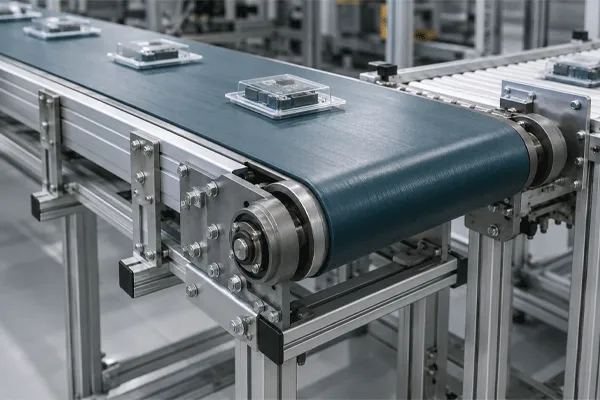
A flat belt conveyor works with a continuous belt stretched around at least two pulleys. One pulley normally acts as the drive pulley. A motor and gearbox rotate it, and friction between the drive pulley and the conveyor belt moves the continuous loop. The opposite pulley redirects the belt and helps maintain proper tension.
The upper belt section carries the product. Depending on the conveyor design, the belt may run over a flat slider bed or a series of support rollers. After reaching the discharge end, it travels underneath the conveyor frame and returns to the drive section.
A basic system can be shown like this:
Product Flow  ───────────────────────────►

         Product     Product      Product
           ▼            ▼            ▼
     =====================================  ← Flat Belt
        ○                              ○
   Drive Pulley                   Tail Pulley
        ↘                              ↙
         ======== Return Belt =========
This simple arrangement is one reason flat belt conveyors remain common in material handling. The system can move boxes, bags, components, containers, packaged food, parcels, and many other product sizes in a controlled direction.
The Conveyor Equipment Manufacturers Association publishes ANSI/CEMA 402 for belt conveyors as part of its conveyor standards, showing how established this equipment category is within industrial material handling.
What Components Make Up a Flat Belt Conveyor System?
Although a small conveyor may look simple, a reliable flat belt conveyor system depends on several parts working together.
| Component |
Main function |
Why it matters |
| Conveyor belt |
Carries the product |
Must match load, surface, temperature, and environment |
| Drive pulley |
Transfers motor power to the belt |
Influences traction and belt slippage |
| Tail pulley |
Redirects the returning belt |
Helps maintain stable belt travel |
| Motor |
Provides driving power |
Must match speed and load |
| Gearbox |
Adjusts torque and speed |
Important for controlled movement |
| Frame |
Supports the system |
Must remain rigid and aligned |
| Slider bed or rollers |
Supports the loaded belt |
Affects friction and energy use |
| Take-up device |
Controls belt tension |
Reduces slipping and poor tracking |
| Bearings |
Support rotating shafts |
Require correct selection and maintenance |
| Guards |
Protect dangerous moving areas |
Essential for safe operation |
The pulley, motor, frame, and belt must be treated as one system. Installing a stronger motor alone does not fix poor tracking. Likewise, selecting a premium belt does little good if the frame is twisted or the pulleys are out of alignment.
Correct belt tension is especially important. Too little tension can cause belt slippage. Too much can increase bearing load, belt wear, and stress on the conveyor structure.
An efficient conveyor therefore begins with system engineering, not just belt selection.
What Types of Flat Belt and Belt Material Are Available?
There are many types of flat belt, and the right choice depends on the product, environment, speed, and required grip.
Common belt material options include:
- PVC
- PU or TPU
- Rubber
- Fabric-reinforced synthetic belt
- Silicone-coated belt
- Monolithic thermoplastic belt
- Anti-static belt
- High-friction belt
- Low-friction belt
- Food-grade belt
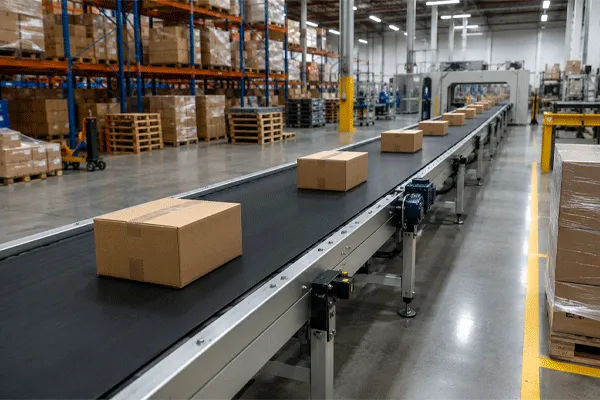
The belt surface can also vary. A smooth surface works well for stable cartons and packaged products. A rougher texture gives better grip. Other surfaces help release sticky products, prevent sliding, or withstand oil, abrasion, moisture, and cleaning chemicals.
For example, monolithic flat belts are used in light conveying and are particularly useful in some food processing, cutting, separating, weighing, and material-handling operations. Habasit notes that homogeneous monolithic belt construction can support hygienic applications because it avoids exposed fabric edges.
| Application |
Typical belt priority |
| Carton transport |
Smooth running and abrasion resistance |
| Food processing |
Hygiene and wash-down resistance |
| Small components |
Stable tracking and smooth transfers |
| Packaging line |
Speed and positioning |
| Warehouse sorting |
Durability and low maintenance |
| Inclined transport |
Higher-friction surface or cleats |
| Oily products |
Oil-resistant belt material |
| Electronics |
Anti-static properties |
Selecting the right belt requires more than choosing a material by name. You should also consider thickness, tensile strength, width, surface texture, splice design, operating temperature, cleaning method, and environmental conditions.
What Is a Flat Belt Conveyor? How Flat Belt Conveyor Systems Work
Where Are Flat Belt Conveyors Commonly Used?
Flat belt conveyors have a wide range of applications because their smooth carrying surface handles many unit loads without complex product support.
They are common in:
- Manufacturing plants
- Warehouses
- Distribution centers
- Packaging facilities
- Food processing plants
- Electronics factories
- Parcel sorting operations
- Automotive component production
- Pharmaceutical packaging
- Appliance assembly
- E-commerce fulfillment centers
In a production line, one belt conveyor may transfer components between assembly stations. Another may carry finished cartons toward inspection or palletizing. In a warehouse, a conveyor system may connect packing areas with loading zones.
Flat conveyors are also widely used in food processing, although the actual belt material and conveyor design must meet the applicable hygiene requirements. Food operations may face water, oils, fats, sanitation chemicals, temperature changes, and direct food contact, so belt selection becomes much more specialized.
Why are they so widely used?
A correctly designed belt system offers several practical benefits:
- Continuous product transport
- Predictable material flow
- Reduced manual handling
- Flexible conveyor length and width
- Adjustable operating speed
- Easy integration with sensors
- Compatibility with automated equipment
- Handling of a wide range of products
The objective is straightforward: move products consistently while reducing unnecessary handling steps.
How Do Flat Belt Conveyors Compare With Modular Belt Conveyors?
A flat belt and a modular conveyor can perform similar jobs, but their construction is different.
Traditional flat belts are generally manufactured as continuous or joined flexible belt sections. Modular belt conveyors use interconnected plastic modules, usually driven positively by sprockets.
| Feature |
Flat belt conveyor |
Modular belt conveyor |
| Belt structure |
Flexible continuous belt |
Interlocking plastic modules |
| Drive |
Often pulley friction drive |
Usually positive sprocket drive |
| Surface |
Very smooth options available |
Many molded patterns available |
| Repair |
Often requires belt repair/replacement |
Damaged modules can often be replaced |
| Cleaning |
Depends strongly on belt type |
Open modular structures can aid cleaning |
| Curves |
Requires specialized design |
Certain modular designs handle curves well |
| Tracking |
Requires good alignment |
Positive sprocket drive can simplify tracking |
| Common use |
Packaging, assembly, cartons |
Food, wet areas, complex layouts |
Neither design is automatically better.
A flat belt conveyor may be the better choice when you need a smooth product surface, simple structure, quiet operation, or precise small-product transfer. A modular conveyor can be attractive when wash-down capability, positive drive, repairability, or special layouts matter more.
Plastic modular belts can also reduce some friction-drive problems because sprockets positively engage the belt. Habasit describes positive-drive modular systems as avoiding the belt slippage associated with some friction-driven arrangements.
The right answer depends on the job
What Is the Difference Between Flat, Cleated, Curved, and Troughed Conveyors?
The phrase types of belt conveyors covers several different configurations. Each solves a different material-flow problem.
Flat belt conveyors
These use a relatively flat carrying surface and are ideal for boxes, parcels, trays, components, and stable packaged goods.
Cleated belt conveyors
A cleated belt has raised sections attached or formed across the carrying surface. These cleats help stop products from sliding backward on an incline.
Cleated belt conveyors often handle:
- Small parts
- Bags
- Loose packaged goods
- Food items
- Inclined product transfer
Curved belt conveyors
Curved belt conveyors change the direction of product flow without requiring a separate transfer point. They can help make better use of factory floor space, although tracking and belt design are more complex than on a straight unit.
Troughed conveyors
Troughed conveyors use angled rollers or a shaped carrying surface to form the belt into a trough. They are much more suitable for bulk material handling such as grain, minerals, aggregates, and some powders.
Modular conveyors
A modular belt uses connected sections instead of a conventional continuous fabric belt. It suits many wet, food, industrial, and accumulation applications.
The choice is therefore based on the material type, not simply the conveyor’s appearance.
Unit products generally favor flat conveying surfaces. Loose bulk materials often need containment, cleats, sidewalls, or a troughed profile.
How Do You Choose the Right Belt Conveyor?
Choosing the right belt conveyor starts with the load.
Before contacting a conveyor manufacturer or system integrator, prepare basic operating data.
1. What are you moving?
Specify:
- Product type
- Dimensions
- Weight
- Shape
- Bottom surface
- Temperature
- Moisture
- Abrasiveness
- Oil or chemical exposure
A conveyor carrying dry cardboard cartons has very different belt needs from one carrying oily metal parts.
2. How much material must move?
Calculate the expected throughput.
For unit loads, provide:
- Units per minute
- Product spacing
- Maximum product weight
- Peak operating periods
For continuous materials, engineers may need mass flow per hour.
3. What is the route?
Measure:
- Conveyor length
- Conveyor width
- Elevation change
- Incline angle
- Required curves
- Transfer heights
- Loading and discharge points
4. What is the operating environment?
Consider:
- Indoor or outdoor operation
- Dust
- Water
- Wash-down
- Temperature
- Humidity
- Chemicals
- Food hygiene
- Hazardous areas
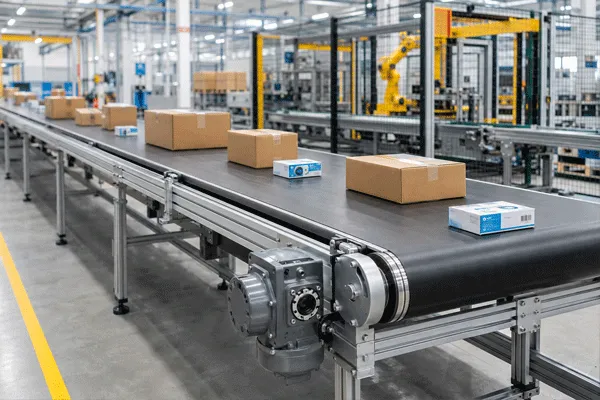
5. How will it integrate with the workflow?
The best conveyor solutions fit the surrounding material handling system.
Ask whether the conveyor must communicate with:
- Robots
- Packaging machines
- Scales
- Metal detectors
- Barcode scanners
- Palletizers
- Sorters
- Warehouse management systems
- Loading equipment
A custom conveyor becomes worthwhile when standard equipment cannot handle your product sizes, load pattern, space limits, or automation requirements.
What Is a Flat Belt Conveyor? How Flat Belt Conveyor Systems Work
What Causes Belt Wear, Belt Misalignment, and Belt Slippage?
Many conveyor problems come from installation or operating conditions rather than the belt itself.
Belt misalignment
Belt misalignment occurs when the conveyor belt moves toward one side instead of tracking in the center.
Common causes include:
- Misaligned pulleys
- Uneven loading
- Twisted conveyor frames
- Product buildup
- Damaged rollers
- Poor belt splicing
- Incorrect tension
Ignoring tracking problems can damage the belt edges and shorten belt life.
Belt slippage
Belt slippage occurs when the drive pulley rotates but cannot transfer enough traction to the belt.
Possible causes include:
- Insufficient belt tension
- Contaminated pulley surfaces
- Excessive load
- Low friction
- Worn pulley lagging
- Incorrect drive design
Simply increasing tension is not always the right solution. Excessive tension creates its own problems.
Belt wear and belt damage
Belt wear may come from abrasive products, sharp edges, poor transfers, trapped debris, incorrect scrapers, damaged frames, or incorrect belt material.
If operators keep replacing the belt without correcting the root cause, belt replacement becomes a recurring expense instead of a solution.
How Can Proper Maintenance Increase Belt Life?
Preventive maintenance usually costs less than an unexpected shutdown.
A practical inspection routine should check:
- Belt tracking
- Belt tension
- Surface condition
- Belt edges
- Splice condition
- Drive pulley
- Tail pulley
- Bearings
- Rollers
- Guards
- Motor and gearbox
- Sensors
- Product buildup
- Frame alignment
Operators should also watch for unusual noise, heat, vibration, or changes in product movement.
Simple maintenance schedule
| Interval |
Suggested inspection |
| Every shift |
Visual tracking and product-flow check |
| Weekly |
Clean conveyor and inspect belt surface |
| Monthly |
Inspect rollers, bearings, tension, and alignment |
| Periodically |
Check motor, gearbox, structure, guards, and controls |
| As required |
Repair damaged parts before secondary damage develops |
The correct schedule varies by load and operating environment.
A lightly loaded packaging conveyor may need far less attention than an industrial conveyor operating continuously around abrasive material.
Do not wait until visible belt damage stops production. Small alignment or contamination problems are easier to fix early.
How Should Conveyor Safety Be Managed?
A conveyor moves automatically, so workers can underestimate its hazards.
Danger zones may exist at:
- Pulleys
- Rollers
- Nip points
- Drives
- Chains
- Sprockets
- Transfers
- Moving belts
- Loading points
Good operating practice can include:
- Fit suitable guards around dangerous moving components.
- Provide accessible emergency stops where required.
- Never reach into a moving conveyor.
- Isolate power before maintenance or jam removal.
- Train operators and maintenance staff.
- Keep floors and access routes clear.
- Inspect equipment after repairs.
- Follow applicable local safety codes.
Safety should be part of belt design and system layout from the beginning, not something added after installation.
How Do Flat Belt Conveyor Systems Connect With Warehouses and Heavy-Duty Transport?
A conveyor moves goods inside the facility. Trucks and trailers move them between facilities. Efficient logistics depends on making those two stages work together.
For example, a warehouse may use flat belt conveyors for carton sorting and packing. Products then move to pallets, loading bays, trucks, or trailers. A manufacturing plant may use industrial conveyors to feed components through production before finished machines are loaded onto a flatbed, lowbed, or other heavy-duty trailer.
This is where our own experience is relevant.
We are a professional semi trailer manufacturer in China rather than a conveyor manufacturer. Our core work is the design, production, customization, and export of flatbed semi trailers, skeleton container trailers, side curtain trailers, sidewall and fence trailers, lowbed and lowboy trailers, removable gooseneck trailers, tankers, dump semi trailers, car carriers, trucks, and trailer parts.
Working with fleet owners, logistics companies, ports, factories, construction contractors, mining operations, and international projects gives us a practical view of a larger problem: material flow does not end when the product reaches the end of the conveyor.
Conveyor-to-transport logistics example
Consider an industrial plant producing heavy components:
Production
    ↓
Flat Belt Conveyor
    ↓
Inspection
    ↓
Packaging / Palletizing
    ↓
Warehouse
    ↓
Loading Dock
    ↓
Flatbed / Lowbed / Container Trailer
    ↓
Customer or Project Site
Inside the plant, an efficient conveyor reduces handling time. Outside the plant, the correct trailer must safely carry the cargo across real roads, ports, construction routes, or mining sites.
For industrial buyers, these systems should therefore be planned around the complete workflow.
If your project also requires heavy-duty trailers for container logistics, bulk cargo, construction machinery, liquid transport, powder transport, mining, or infrastructure operations, our engineering team can support OEM/ODM trailer configuration based on cargo, axle requirements, road conditions, and local transport regulations.
Illustrative Case: Improving Material Flow From Production to Dispatch
Imagine a factory producing boxed industrial components. Workers originally use forklifts to move small batches between assembly, inspection, packing, and the warehouse. The process works, but vehicle traffic grows as production increases.
The facility introduces a flat belt conveyor between assembly and packing. Products now move in a continuous loop at a controlled speed. Forklifts remain necessary for pallet transport, but they no longer need to handle every small production batch.
The result is a simpler workflow:
- Conveyor handles repetitive internal movement.
- Workers concentrate on inspection and packing.
- Forklifts move completed pallet loads.
- Warehouse staff stage loads by order.
- Flatbed or side curtain trailers handle outbound transport.
This is an illustrative example, not a claimed customer result, but it shows why efficient material handling often requires different equipment for different stages.
A conveyor is good at continuous internal transport. A trailer is good at long-distance freight movement. Using each where it works best creates a more efficient logistics chain.
Frequently Asked Questions
What is a flat belt conveyor used for?
A flat belt conveyor moves products along a continuous flat belt. Common applications include packaging, assembly lines, warehouses, food processing, inspection stations, sorting, and general material handling.
What is the difference between a belt conveyor and a flat belt conveyor?
“Belt conveyor” is the broader category. A flat belt conveyor is a type of conveyor that uses a relatively flat carrying surface. Other belt conveyors include cleated, troughed, inclined, and curved designs.
What materials are used for conveyor belts?
Common belt options include PVC, polyurethane, rubber, silicone-coated materials, fabric-reinforced composites, and monolithic thermoplastics. The right belt material depends on the load, temperature, hygiene requirements, chemicals, abrasion, and environmental conditions.
Are flat belt conveyors suitable for heavy loads?
They can carry substantial loads when properly engineered, but very heavy loads may require reinforced belts, heavy-duty frames, larger pulleys, roller support, or a different type of conveyor. Load weight and distribution should always be checked during selection.
What causes a conveyor belt to move sideways?
Common causes include pulley misalignment, uneven product loading, poor frame alignment, contamination, damaged rollers, incorrect belt tension, or an improperly installed splice.
Are modular belt conveyors better than flat belt conveyors?
Not always. Modular belt conveyors are useful for positive drive, wash-down, repairability, and some complex applications. Flat belts can offer smoother surfaces, quiet movement, simple construction, and excellent product transfer. Choose based on the application.
Key Things to Remember
- A flat belt conveyor uses a continuous belt running around pulleys to move products.
- The drive pulley, motor, frame, support bed, belt, and tensioning system must work together.
- Flat belt conveyors are common in manufacturing plants, packaging lines, warehouses, and food processing.
- PVC, PU, rubber, fabric-reinforced, and monolithic belts are among the common belt options.
- The right belt depends on product weight, surface, temperature, speed, chemicals, hygiene, and environmental conditions.
- Flat belt, modular, cleated, curved, and troughed conveyors solve different material-handling problems.
- Correct belt tension and pulley alignment reduce belt wear, belt misalignment, and belt slippage.
- Regular inspection can extend belt life and reduce unexpected downtime.
- Conveyor guards and safe maintenance procedures are essential around moving equipment.
- Efficient conveyor systems improve internal material flow, but trucks and trailers remain essential for outbound transport.
- For projects that require flatbed, container, lowbed, tanker, dump, or other customized semi trailers, we can provide factory-direct OEM/ODM solutions based on cargo, loading conditions, road requirements, and fleet operations.












 14:27
14:27