When cartons jam, workers carry loads too far, or products stop between workstations, material handling becomes slower and more expensive. A correctly selected roller conveyor can create a smoother flow, reduce repeated lifting, and make movement between production, storage, packing, and dispatch easier to control.
Conveyor rollers work by supporting a load on rotating cylindrical tubes mounted on fixed axles. In a gravity roller conveyor, slope or manual force moves the load. In a powered conveyor, a motor transfers torque through chains, belts, line shafts, or motorized rollers, moving products through the conveyor system at a controlled speed and direction.
How Do Conveyor Rollers Work? Roller Conveyor Systems, Types, and Applications Explained
What Is a Conveyor Roller and How Does a Roller Conveyor Work?
A conveyor roller is a cylindrical component mounted inside a supporting frame. A series of rollers forms a surface for cartons, totes, pallets, drums, trays, and other unit loads. As the tubes rotate around their axles, they reduce sliding friction and let the load travel with less effort than dragging it across a fixed surface.
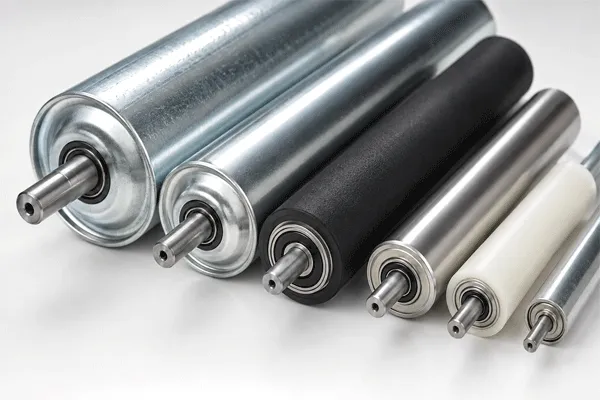
Most conveyor rollers are cylindrical, but their construction varies. Steel rollers are common where strength and impact resistance matter. Stainless steel rollers suit wet, corrosive, or hygienic environments. Plastic rollers, nylon conveyor rollers, and rubber-coated rollers can be useful for lower noise, corrosion resistance, product protection, or special operating conditions.
The basic principle is simple: a load rests across several rollers at once. As each cylinder turns, the load advances. Movement can come from a slope, a manual push, or a motor. In short, roller conveyors work because each roller works as a low-friction support while an external force provides motion. That is essentially how conveyor rollers work in most unit-load material handling systems.
How Do Gravity Roller Conveyors Work?
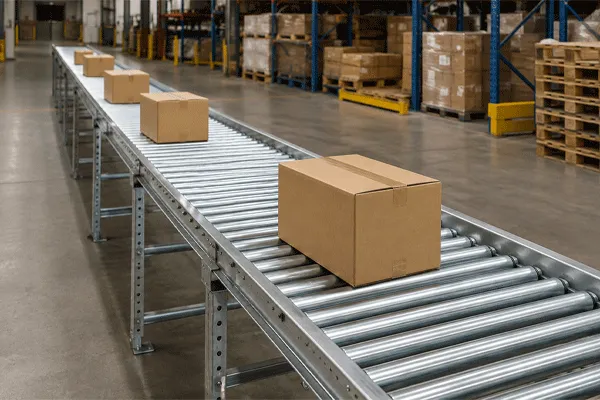
A gravity roller conveyor has no main drive motor. The line is installed with a small decline, or an operator pushes the load by hand. The rollers turn freely, allowing boxes, totes, trays, and other products with firm bottoms to travel with relatively little resistance.
This type of gravity conveyor is mechanically simple and usually economical. It typically contains a frame, supports, a set of rollers, and optional stops, guides, curves, or braking devices. Interroll notes that goods on such systems can differ in weight, size, material, and base condition, so product behavior still has to be evaluated before selecting the layout.
These systems work best when the product base can span several rollers without sagging. Rigid cartons and totes are good examples. Loose bags or products with uneven feet may need tighter spacing, a different type of roller, or another conveyor solution.
How Do Powered Roller Conveyors Work?
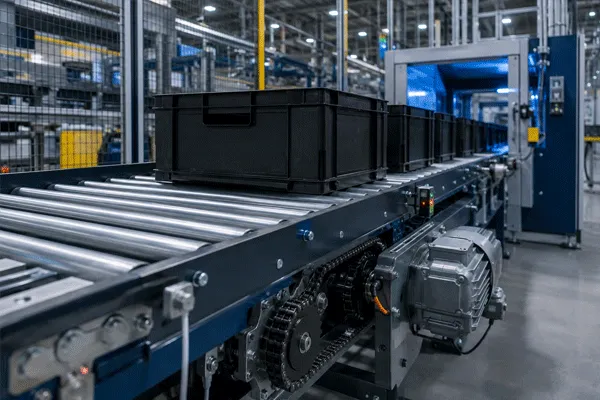
A powered roller conveyor uses a motor to move products without relying on slope or continuous manual force. Depending on the design, an electric motor may transmit power through chains, belts, O-rings, a line shaft, or a motorized roller with the drive integrated inside its tube.
In chain-driven roller conveyors, sprockets and chains transfer torque to multiple rollers. A belt-driven live roller arrangement uses friction from a belt. Modern motorized systems can also create independent conveyor sections or zones. Interroll explains that its RollerDrive uses a low-voltage drive inside the tube and can power neighboring rollers through transmission media such as PolyVee belts.
This type of powered conveyor is valuable when operators need consistent speed, uphill movement, accumulation, scanning, sorting, or automated transfer between machines. Because the motor can drive the rollers, products can move through longer and more controlled processes than on a basic free-running line.
What Are the Different Types of Roller Conveyors?
There are several different types of roller conveyors. The best choice depends on load weight, product shape, speed, environment, controls, and layout.
| Type of Roller Conveyor |
How Goods Move |
Typical Conveyor Applications |
Main Advantage |
| Gravity roller conveyor |
Slope or manual push |
Cartons, totes, packing areas |
Simple, low energy use |
| Powered roller system |
Motor-driven rollers |
Warehousing, assembly, distribution |
Controlled movement |
| Chain-driven roller conveyor |
Chain and sprockets |
Pallets, drums, heavy loads |
High torque |
| Belt-driven live roller |
Belt drives rollers |
Cartons and accumulation |
Smooth transfer |
| Motorized conveyor |
Internal drive roller |
Zoned automation |
Modular control |
| Tapered roller conveyor |
Tapered rollers guide loads |
Curves and corners |
Better orientation |
| Cross transfer conveyor |
Longitudinal plus lateral movement |
Sorting and production |
Changes load direction |
The type of conveyor roller matters as much as the overall layout. Rollers are available in steel, stainless steel, aluminum, PVC, plastic, and coated versions. Current Interroll product information, for example, groups units according to load class, environment, power transmission method, and roller diameter, showing how specifications change between light-duty and heavy-duty applications.
Two systems with the same general name can therefore perform very differently. Bearing design, axle style, tube thickness, spacing, load rating, and drive method all affect real-world conveyor performance.
How Do Conveyor Rollers Work? Roller Conveyor Systems, Types, and Applications Explained
Which Roller Material and Roller Diameter Should You Choose?
The material used for conveyor rollers should match the load and operating environment. Metal rollers, especially carbon steel, are widely used in factories and warehouses because they offer good strength and wear resistance. Steel and stainless steel rollers are often selected for demanding industrial operations.
Stainless steel is especially useful around moisture, sanitation processes, chemicals, or regular washdown. Plastic conveyor rollers and nylon conveyor rollers can reduce weight and noise while resisting many corrosive conditions. Rubber-coated rollers add grip and may also protect finished surfaces from scratching.
The best material depends on product weight, operating speed, temperature, hygiene requirements, and exposure to water, oil, dust, or chemicals.
Roller diameter is also important. Larger tubes generally offer greater stiffness for demanding loads, while smaller diameters can support compact products. The number of rollers beneath each item matters too. Designers should keep enough support points under the load to prevent tipping, sagging, or dropping between gaps.
For example, if a carton is too short compared with the roller spacing, it may become unstable between two rollers. Increasing the number of rollers or reducing spacing can create smoother travel.
What Are the Benefits of Roller Conveyors?
The benefits of roller conveyors come from turning repeated material movement into a defined process. A roller conveyor system can link receiving, storage, production, inspection, packing, staging, and dispatch areas. Workers spend less time carrying loads by hand, while the line provides a predictable route.
Many systems are modular. Straight conveyor sections, curves, stops, transfer modules, and motorized zones can be combined or expanded as operations change. This can be more flexible than building a process around only forklifts and manual carts.
The right design can improve throughput, reduce unnecessary handling, and make production or loading schedules easier to manage. A motorized line can maintain controlled speed, while a simple free-running arrangement can provide economical movement over short distances.
Roller conveyors can also support:
- Faster repetitive product movement
- Reduced manual lifting
- More organized production flow
- Easier connection between workstations
- Controlled accumulation of cartons or totes
- Flexible warehouse layouts
- Integration with scanners and sensors
- Easier expansion as capacity grows
The goal is not simply to install more equipment. The purpose of roller conveyors is to move the correct load, at the correct speed, through the correct process with fewer unnecessary handling steps.
Where Are Conveyor Roller Applications Most Common?
Conveyor roller applications appear wherever unit loads repeatedly travel between fixed points. Warehouses commonly use a roller conveyor for boxes to streamline picking, packing, and shipping. Distribution centers commonly use conveyor rollers for cartons and totes, while manufacturing plants install conveyor lines between machining, assembly, inspection, and packaging stations.
Other conveyor applications include parcel handling, e-commerce fulfillment, airports, food and beverage plants, automotive production, appliance factories, ports, and industrial logistics.
Heavy-duty systems can also move:
- Pallets
- Steel containers
- Drums
- Wheels
- Industrial components
- Crates
- Equipment assemblies
Interroll lists boxes, trays, drums, wheels, pallets, and steel containers among applications for its heavy-duty Series 1450, with capacity depending on the selected roller model and configuration.
From our perspective as a China-based manufacturer of heavy-duty semi trailers for container logistics, construction, mining, bulk transport, infrastructure projects, and fleet operations, internal material flow is closely connected to outbound transportation.
A well-planned conveyor line can move unitized cargo toward inspection, staging, or loading. The correct trailer then handles the next part of the transportation process. For logistics companies, port operators, fleet owners, and industrial buyers, these two stages should support each other rather than operate as disconnected systems.
How Do You Choose the Right Conveyor for a Material Handling Line?
Choosing the right conveyor starts with the product rather than the equipment catalog.
Before comparing systems, buyers should define the load dimensions, minimum and maximum weight, bottom surface, center of gravity, required throughput, travel distance, working height, temperature, contamination level, and desired level of automation.
A practical selection checklist includes:
- Load type: carton, tote, pallet, drum, tray, component, or irregular product
- Weight: average, maximum, and possible impact load
- Product base: rigid, soft, ribbed, uneven, or protruding
- Roller spacing: enough support points beneath every load
- Diameter of the rollers: matched to product dimensions and duty
- Material: steel, stainless steel, plastic, nylon, or coated
- Drive: free-running, chain, belt, line shaft, or motor roller
- Speed: fixed or variable
- Environment: dry, wet, corrosive, cold, hot, dusty, or washdown
- Layout: straight, curve, merge, incline, accumulation, or cross transfer conveyor
- Controls: sensors, PLC, scanners, stops, or zero-pressure accumulation
- Maintenance: bearing access, chain tension, roller replacement, and spare parts
The length of the conveyor and the configuration of the conveyor line also affect cost.
Over-specifying every section wastes budget. Under-specifying the rollers, conveyor frame, motor, or controls can create bottlenecks and downtime.
A better approach is to calculate requirements from real loads and real operating cycles. If your heaviest pallet weighs far more than the average load, for example, the system still has to safely handle that maximum condition.
What Makes a Roller Conveyor System Reliable?
Reliable conveyor performance comes from matching mechanical design with operating conditions.
Rollers are designed for defined loads, speeds, temperatures, and drive methods. The conveyor frame must remain square and rigid, bearings should turn freely, and motorized components must maintain proper tension and torque.
Roller conveyors require routine inspection. Maintenance teams should check for:
- Bearing noise
- Loose fasteners
- Damaged tubes
- Worn chains
- Worn belts
- Dirty sensors
- Bent shafts
- Misalignment
- Abnormal vibration
- Product jams
A seized roller used in a frequently loaded area may increase resistance and accelerate wear elsewhere along the system.
Housekeeping matters too. Packaging film, broken pallet pieces, dust, labels, or other debris between rollers can stop products or damage components. Preventive inspection usually costs far less than an emergency shutdown after a jam or drive failure.
The operating environment should also influence maintenance intervals. A clean warehouse may require less frequent attention than a dusty factory, wet food-processing line, mining environment, or outdoor transfer point.
What Safety Rules Matter for Gravity and Powered Conveyors?
Safety should be designed into the system from the beginning.
Workers may be exposed to pinch points, chains, sprockets, rotating rollers, falling loads, jams, or unexpected startup. OSHA requires conveyor danger zones to be guarded, rollers and wheels to be secured, and gravity conveyor sections to be firmly positioned so they do not shift or fall.
Powered equipment creates additional risks. OSHA requirements address emergency stopping, warning before startup, guarding, and lockout/tagout during maintenance and repair. OSHA’s warehousing guidance also recommends regular conveyor inspection and adequate guarding of pinch points.
Buyers and facility managers should therefore review:
- Guards around chains, gears, and pinch points
- Emergency-stop locations
- Startup warning devices
- Access around loading and unloading areas
- Procedures for clearing jams
- Lockout/tagout procedures
- Worker training
- Equipment inspection schedules
- Safe crossings and walkways
Safety should never be treated as an optional accessory added after installation.
Standards also differ between countries and industries. A system intended for the United States, European Union, Middle East, Southeast Asia, or another market should be evaluated according to the regulations that apply at its actual installation site.
How Do Conveyor Rollers Work? Roller Conveyor Systems, Types, and Applications Explained
How Can Roller Conveyors Improve Logistics and Loading Efficiency?
The strongest reason to use roller conveyors is not simply that the rollers turn. A properly designed system creates flow.
When a conveyor for boxes feeds products toward inspection, palletizing, staging, or loading, the wider logistics process becomes easier to schedule. Products spend less time waiting between operations, and workers perform fewer repetitive transfers.
More advanced systems can support accumulation, bidirectional movement, barcode scanners, sensors, transfer units, and automated controls. A production line may use a motorized section for controlled movement, while another area uses a simple unpowered section because automation is not needed everywhere.
This mixed approach often provides better value than using the same technology throughout the complete facility.
For global logistics operators, it is useful to examine the entire product journey:
Production → Internal Material Handling → Inspection → Packing → Staging → Loading → Road Transport → Unloading → Final Delivery
This is also where conveyor planning connects naturally with heavy-duty transportation.
As a professional semi trailer manufacturer in China, we design, manufacture, customize, and export equipment including flatbed semi trailers, skeleton container trailers, side curtain trailers, sidewall trailers, lowbed and lowboy trailers, tanker trailers, bulk cement tankers, dump semi trailers, car carriers, trucks, and trailer parts.
Our customers include fleet owners, logistics companies, container transport operators, construction contractors, mining companies, distributors, port logistics operators, and international project buyers.
For these businesses, efficient transport does not begin when a truck starts moving. It begins with efficient material flow and correct equipment selection.
The same principle applies to both conveyor and trailer specification: capacity, durability, configuration, operating environment, and local requirements must match the real job.
FAQs About Conveyor Rollers
How do conveyor rollers work?
Conveyor rollers rotate around fixed axles while supporting a product across several contact points. Slope or manual force can move goods on an unpowered system, while a motor and drive mechanism move them on a powered system.
What is the purpose of roller conveyors?
The purpose of roller conveyors is to speed up repetitive movement of cartons, totes, pallets, drums, trays, and other unit loads. They reduce unnecessary manual handling and create a defined route between production, storage, packing, loading, or distribution areas.
What products can a gravity roller conveyor handle?
A gravity roller conveyor works best with products that have a firm, reasonably flat base, including cartons, totes, trays, and some rigid containers. Soft bags or items with uneven bottoms may require tighter spacing or a different conveyor solution.
What is the difference between gravity and powered roller conveyors?
A gravity system uses slope or manual push. A motor-driven system uses an external power source to drive the rollers. Powered designs provide greater control over speed, direction, accumulation, and automation.
Are steel rollers better than plastic rollers?
Not always. Steel rollers are strong and widely used for industrial loads. Stainless steel rollers suit wet or corrosive environments. Plastic rollers can be lighter, quieter, and corrosion-resistant. The best choice depends on load, environment, speed, hygiene, and service-life requirements.
How many rollers should support a product?
There is no universal number. A load should remain supported by enough rollers to avoid tipping or dropping between gaps. Product length, weight, base rigidity, center of gravity, roller diameter, spacing, and individual roller capacity all matter.
Key Things to Remember
- A roller conveyor moves goods across a series of rotating cylindrical rollers.
- A gravity roller conveyor uses slope or manual force, while a motorized system uses a drive mechanism.
- Common designs include gravity, chain-driven, belt-driven live roller, motorized roller, tapered roller, and heavy-duty pallet systems.
- Roller material, diameter, spacing, bearings, load capacity, speed, and environment all influence performance.
- Steel, stainless steel, plastic, nylon, and rubber-coated rollers each serve different operating needs.
- Select the system from actual product and process data rather than a generic equipment label.
- Consider the complete material journey from production and warehousing through staging, loading, road transport, and final delivery.
- Guarding, emergency stops, inspection, operator training, and lockout/tagout procedures are essential for safe operation.
- For B2B logistics projects, equipment should always be matched to actual load capacity, working conditions, local regulations, and long-term operating needs.












 09:02
09:02