KTD Engineering Team | Application Engineering & DFM Team | Published: August 14, 2026
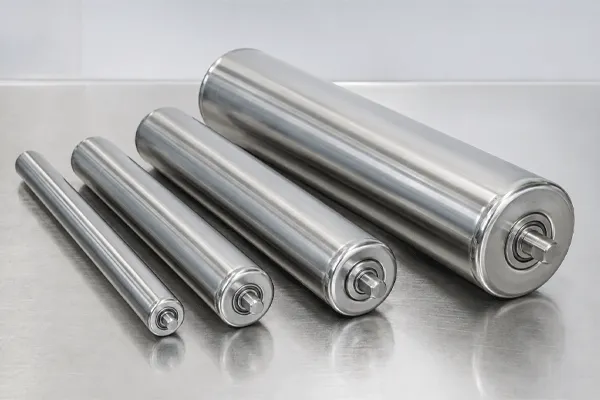
A stainless steel conveyor roller for washdown duty is defined by four numbers: tube grade, tube diameter, the sealing rating at the bearing housing, and surface roughness. KTD builds these with 304 or 316 stainless tube in 38, 50, 60 and 89 mm diameters, with length cut to the conveyor frame.
Compared with the light-duty marketplace listings and conveyor-system dealer pages that fill the first page of results for this term, which describe hygiene benefits without publishing a tube grade, a sealing rating or a roughness figure, this guide works from the component side. What goes on the drawing, and what happens to the roller when the sanitation crew turns the hose on.
Stainless Steel Conveyor Rollers: Specs & Washdown Guide
304 or 316: The Chloride Question Settles It
Both grades are offered as standard tube materials on KTD conveyor rollers, alongside carbon steel, aluminium and PVC for non-washdown zones. The choice between them is rarely about strength. It is about what the roller gets sprayed with.
| Decision dimension |
304 stainless tube |
316 stainless tube |
| Distinguishing alloy content |
Chromium-nickel |
Chromium-nickel with a molybdenum addition |
| Behaviour under chloride exposure |
Passive film is vulnerable where chlorides concentrate and dry |
Molybdenum raises resistance to chloride-driven pitting |
| Line chemistry it suits |
Neutral detergents, potable rinse water, intermittent wet cleaning |
Brine, chlorinated sanitizers, acid descalers, salt-laden or coastal air |
| Typical placement |
Dry packaging, carton and tote handling, secondary packaging |
Meat and seafood processing, dairy wash zones, chemical handling |
| Relative unit cost |
Lower |
Higher |
| KTD availability |
Standard tube option |
Standard tube option |
The misconception that costs the most money is treating “stainless” as one material. A 304 roller in a chlorinated washdown zone does not fail by rusting evenly across the tube. It fails at pinpoint sites where sanitizer residue evaporated overnight and left concentrated chloride sitting on a horizontal surface, usually near the end of the tube where drainage is worst. By the time it is visible, the pit is already through the passive layer.
There is a second, quieter mistake. Specifying 316 tube and then accepting whatever end cap, shaft and bearing housing the supplier normally fits. A conveyor roller is an assembly, and the corrosion story is written by its weakest joint rather than by the grade stamped on the purchase order.
What Sits Behind the Tube: End Caps, Bearings and Housings
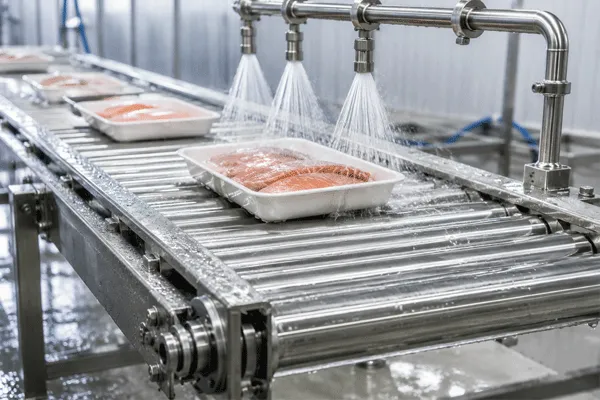
KTD’s stainless washdown configuration uses fully welded end caps, IP67-rated sealing as described by KTD, and a polished tube surface at Ra 0.4 μm. Bearing options across the conveyor roller line include precision ball bearings, stamped bearings and polymer bearing housings.
Those three bearing choices are not interchangeable in a wet environment. Stamped bearings keep unit cost down and suit gravity roller sections in dry areas. Polymer housings avoid a corroding steel interface at the bearing seat, which matters where the roller sits below a drip line, but they carry temperature and load limits that need checking against hot-water sanitation cycles. Precision ball bearings with sealed housings are the configuration to discuss when the roller is driven and the line runs continuously.
End-cap construction deserves its own line on the drawing. A pressed-in cap leaves a crevice at the tube wall. Crevices are where washdown water sits after the line drains, and a stagnant film of sanitizer inside a crevice is a harsher environment than the same sanitizer flowing across an open surface. A fully welded cap closes that path, which is why it is the washdown configuration rather than a premium upsell.
Stainless Steel Conveyor Rollers: Specs & Washdown Guide
One thing IP67 does not tell you
IP67 describes dust-tight construction and resistance to temporary immersion. It is not a statement about high-pressure hot-water jetting, which is a different test regime entirely. If the sanitation procedure on your line involves lances at elevated pressure and temperature, raise that duty explicitly at inquiry rather than assuming an immersion rating covers it. Suppliers that publish a rating and then explain its limits are giving you more usable information than suppliers who write “waterproof.”
Surface Finish: Ra 0.4 μm, Not “Polished”
“Polished,” “mirror finish” and “hygienic finish” are adjectives. Ra 0.4 μm is a number a quality inspector can check.
Surface roughness matters on washdown rollers because cleanability is a function of the surface valleys that cleaning chemistry has to reach. Rougher surfaces hold residue in profile valleys, and residue is what a biofilm anchors to. A smoother surface also sheds water faster, which shortens the period each shift when the roller is sitting wet.
Specify the roughness value on the drawing rather than the word. If a supplier cannot state the finish as a measured figure, the finish is whatever the polishing wheel happened to produce that week.
Tube Diameters, Length and Where Each Size Lands
KTD’s standard tube diameters are 38 mm, 50 mm, 60 mm and 89 mm, with lengths customised to the conveyor frame. The published load range for the conveyor roller line runs from lightweight parcel conveyors through to heavy-duty systems handling multi-ton pallets.
| Tube diameter |
Typical placement (engineering guidance, not a rated figure) |
What to confirm on the drawing |
| 38 mm |
Light cartons, totes, trays, tight roller pitch on curves |
Face length, shaft type, bearing selection |
| 50 mm |
General case and carton handling, most food packaging lines |
Wall thickness, drive method, sealing configuration |
| 60 mm |
Heavier cases, higher-throughput driven sections |
Deflection over span, bearing rating |
| 89 mm |
Pallet handling and heavy unit loads |
Load per roller, shaft diameter, frame interface |
Load capacity per roller is confirmed against the actual span, pitch and unit load during DFM review rather than read off a diameter. Two rollers with the same outside diameter and different wall thicknesses behave differently over a 1,200 mm face.
Steel and Custom Conveyor Rollers: The Configuration Fields That Matter
This is the part of the specification where standard catalogue tables stop being useful, because most washdown rollers are built to a frame rather than picked off a shelf.
Tube materials: carbon steel, 304 or 316 stainless steel, aluminium, PVC.
Standard tube diameters: 38 / 50 / 60 / 89 mm; length customised to frame.
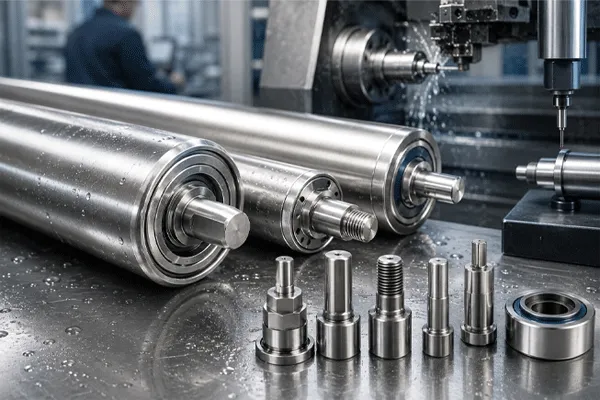
Shaft options: spring-loaded, female-threaded, milled-flat.
Bearing options: precision ball bearings, stamped bearings, polymer bearing housings.
Drive configurations available across the line: gravity, powered and pulley-driven, sprocket-driven, and motorized rollers.
Surface options for stainless washdown builds: polished finish specified as an Ra value; fully welded end caps; sealed bearing housings.
On the custom manufacturing side, KTD states tolerance capability to H6, custom orders from 20 pieces scaling to 10,000+ pieces per production run, and accepted drawing formats of STEP, IGES, DWG, DXF, SLDPRT and PDF. The stated production route runs DFM review, prototype, First Article Inspection, mass production, then CMM and material inspection before shipment. Annual production capacity across the component range is stated at 100,000+ units.
Shaft choice is where frame integration usually goes wrong. Spring-loaded shafts drop into an existing frame quickly and suit gravity and light powered sections. Female-threaded ends give a bolted, repeatable location that survives repeated removal for cleaning. Milled-flat ends resist rotation where the roller carries a driven load. Deciding this after the frame is welded costs more than deciding it before.
Specify in This Order: Six Decisions
- Write down the actual cleaning procedure.Chemistry, concentration, temperature, pressure and frequency per shift. Everything downstream follows from this, and it is the single item most inquiries omit.
- Fix the tube grade.Chlorides, brine or acid cleaners in the procedure from step 1 push the specification to 316. Neutral detergent and potable rinse usually does not.
- Set diameter and face length from the frame.Between-frame dimension, roller pitch and unit load, not the diameter used on the previous line.
- Choose the drive method.Gravity, pulley-driven, sprocket-driven or motorized. This determines shaft ends and bearing class together, so decide it before either.
- Call out end-cap construction and sealing separately.Fully welded caps and a stated sealing rating, written as two distinct line items so neither gets substituted.
- State surface finish as a number.Ra value on the drawing, with the inspection method you expect at First Article.
Send the drawing in one of the accepted CAD formats with these six items resolved and the DFM feedback comes back on the component. Send a photograph of an existing roller and the first three exchanges are spent reconstructing what you already knew.
Stainless Steel Conveyor Rollers: Specs & Washdown Guide
Trade-offs Worth Pricing In
316 costs more, and not only in material.
The unit price gap is visible on the quotation. The less visible part is machining time on stainless compared with carbon steel, which shows up in lead time on larger runs.
Fully welded end caps are not field-serviceable.
Closing the crevice also closes the service path. When the bearing reaches end of life, the practical response is roller replacement rather than bearing replacement. On a line with hundreds of rollers, that changes the spare-parts strategy from a bearing bin to a roller bin, and it is a genuine cost that should be modelled before the construction is approved.
Polymer bearing housings solve a corrosion problem and introduce a thermal one.
They remove a corroding metal interface, but hot-water sanitation cycles and continuous driven load are exactly the conditions where their limits appear. Confirm the temperature the housing will actually see, not the ambient temperature of the room.
A smoother finish costs polishing time. Ra 0.4 μm is not free, and on a dry secondary-packaging line it may be buying cleanability that the application never draws on.
Quality Documentation and What It Covers
KTD states that its quality management system is certified to ISO 9001:2015. The International Organization for Standardization identifies ISO 9001 as the internationally recognised quality management system standard, which is a statement about process control and traceability rather than about any individual roller’s performance in a wash zone. Ask for the certificate at supplier qualification and read the scope on it.
For export shipments, KTD states that its wooden crating meets ISPM 15, the International Plant Protection Convention measure covering raw-wood packaging in international trade. That matters at customs clearance, not on the conveyor.
What It Costs
Pricing is project-specific and provided upon quotation based on material, dimensions, machining complexity, quantity, surface treatment and other technical requirements.
In practice the variables that move a stainless roller quotation most are tube grade, face length, the sealing and end-cap construction, and the specified surface finish. Custom orders start from 20 pieces, so prototype and pilot-line quantities do not have to be ordered at production volume.
FAQ
Q: Do I need 316 for every food-contact line?
A: No. The determining factor is chloride exposure, not the word “food.” Lines cleaned with neutral detergent and rinsed with potable water are commonly served by 304. Lines using chlorinated sanitizers, brine contact or acid descaling are where the molybdenum addition in 316 earns its cost. Send the actual cleaning chemistry and concentration when you inquire, and the grade recommendation follows from it.
Q: Does an IP67 sealing rating mean I can pressure-wash the roller?
A: Not automatically. IP67 addresses dust ingress and temporary immersion. High-pressure, high-temperature jetting is a separate duty. If lances are used on your line, state the pressure and temperature at inquiry so the sealing configuration is selected against that condition rather than against an immersion rating.
Q: What tube diameters and lengths are available in stainless?
A: Standard tube diameters are 38, 50, 60 and 89 mm, with 304 and 316 both offered as standard tube materials. Length is customised to the conveyor frame rather than sold in fixed increments.
Q: Can motorized and sprocket-driven rollers be supplied in stainless?
A: Motorized rollers, sprocket-driven rollers, powered and pulley-driven rollers and gravity rollers are all part of the conveyor roller line, and 304/316 tube is a standard material option across it. Whether a specific driven configuration can be built in stainless with the sealing and finish you need is a per-project question, so confirm the combination at inquiry rather than assuming it from the catalogue.
Q: What is the minimum order for a custom stainless roller?
A: Custom orders start from 20 pieces and scale to 10,000+ pieces per production run. Drawings are accepted in STEP, IGES, DWG, DXF, SLDPRT and PDF.
Q: How is the finish verified before shipment?
A: The stated production route includes First Article Inspection ahead of mass production, with CMM and material inspection before delivery. Specify the roughness value and the inspection expectation on the drawing so both appear in the FAI report rather than being agreed verbally.












 17:37
17:37