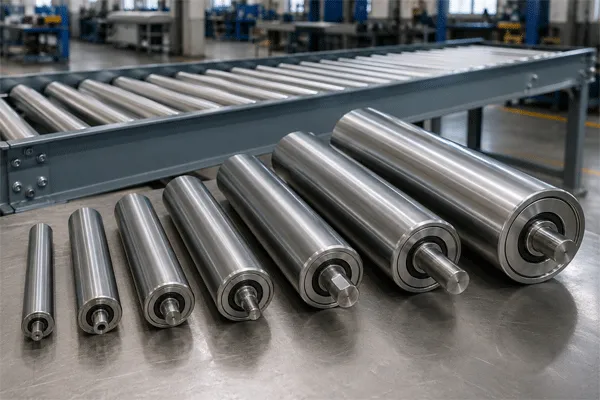
Gravity conveyor roller sizing works backwards from the load: the shortest item on the line sets roller spacing, the weight per roller sets tube wall and bearing class, and diameter follows both. Standard tube diameters are 38, 50, 60 and 89 mm, cut to frame width.
Most pages ranking for this term are catalogue and distributor listings quoting frame widths and roller centres for pre-built 5 ft and 10 ft sections. That is the right format for buying a section off a shelf and the wrong format for specifying rollers into a frame you are welding yourself. This guide sits on the component side of that line.
Gravity Conveyor Rollers: Sizing, Load and Spacing Guide
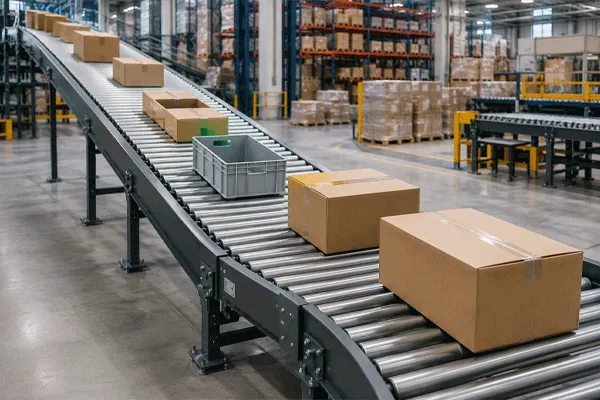
Spacing Is Decided by Your Smallest Item, Not Your Heaviest
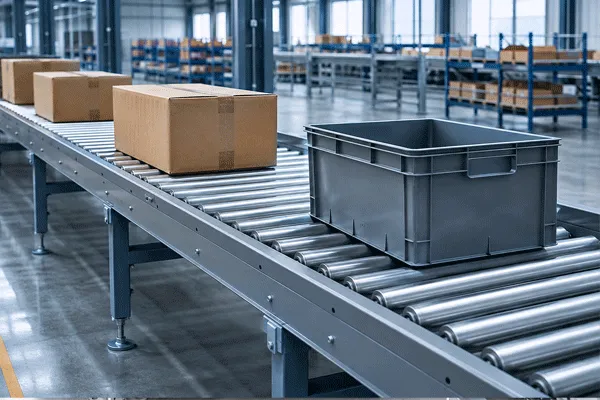
The governing design convention on gravity conveyor is that a minimum of three rollers stay under the load at all times. Two rollers let a package rock and stall at every joint. The arithmetic that follows is unglamorous and it settles most of the specification:
Roller centres ≤ shortest load length ÷ 3
A 300 mm carton gives 100 mm centres. A 600 mm tote gives 200 mm. Nothing about the heaviest pallet on the line enters this calculation, which is where most first-pass drawings go wrong, because weight is the number people arrive with.
Two consequences follow immediately. Tighter centres mean more rollers per metre, so the cost of a gravity bed is driven by the smallest item it must carry rather than the largest. And if the line handles a mix, the shortest item governs the whole section, not the average.
The edge case that breaks the rule: loads with soft, uneven or recessed bottoms. Bagged goods, shrink-wrapped bundles and totes with deep recessed bases do not sit on three rollers just because three rollers are underneath them. They bridge, contact two, and stall. When the product base is not rigid and flat, tighten centres beyond the calculated figure or move to a different conveying surface, and test with the actual product rather than a cardboard stand-in.
Load per Roller: The Number That Actually Sizes the Tube
Divide the heaviest unit load by the number of rollers under it, then apply the three-roller convention rather than the count you get on a good day. A 600 kg pallet on 150 mm centres does not distribute across every roller it spans. Size on the smallest number of rollers that will ever carry it.
Load per roller then drives three things that catalogue pages rarely separate:
- Tube wall thickness, which resists deflection across the frame width
- Bearing class, which handles the radial load and determines rolling resistance
- Shaft diameter and end configuration, which transfers that load into the frame
Diameter is the last of the four to be decided, not the first. Two rollers at the same 50 mm outside diameter with different wall thicknesses have different capacities across a 1,200 mm face, and the outside diameter tells you nothing about which one you received. Specify wall on the drawing.
Frame width matters more than most sizing tables admit. Deflection across a span grows quickly with width, and a tube that is adequate at 600 mm between frames may sag under the same load at 1,000 mm. On wide beds carrying centred loads, span is the constraint rather than the load figure itself.
Gravity Conveyor Rollers: Sizing, Load and Spacing Guide
Specification Fields for Gravity Rollers
| Field |
Published options |
| Tube material |
Carbon steel, 304 or 316 stainless steel, aluminium, PVC |
| Standard tube diameter |
38 mm, 50 mm, 60 mm, 89 mm |
| Length |
Customised to conveyor frame requirements |
| Shaft ends |
Spring-loaded, female-threaded, milled-flat |
| Bearings |
Precision ball bearings, stamped bearings, polymer bearing housings |
| Load range served |
Lightweight parcel conveyors through heavy-duty systems handling multi-ton pallets |
| Tolerance capability |
To H6 |
| Custom order quantity |
From 20 pieces, scaling to 10,000+ per production run |
| Accepted drawing formats |
STEP, IGES, DWG, DXF, SLDPRT, PDF |
| Production route |
DFM review, prototype, First Article Inspection, mass production, CMM and material inspection |
Diameter by placement
| Tube diameter |
Typical placement (engineering guidance, not a rated figure) |
Confirm on drawing |
| 38 mm |
Cartons, totes, trays, tight centres where the load is short |
Wall thickness, centres, bearing class |
| 50 mm |
General case handling and most parcel and packaging lines |
Wall, face length, shaft end |
| 60 mm |
Heavier cases, wider frames, higher throughput |
Deflection over span, bearing rating |
| 89 mm |
Pallets and heavy unit loads |
Load per roller, shaft diameter, frame interface |
Capacity per roller is confirmed against the actual span, centres and unit load during DFM review. Reading it off a diameter column is the habit this table is trying to break.
Tube material, and when the default is wrong
Carbon steel is the default and it is the right default for dry indoor beds. Stainless in 304 or 316 belongs where washdown chemistry or corrosive atmosphere is present, and the grade choice there is driven by chloride exposure rather than by the word “food.” Aluminium is worth its cost premium where the rollers are handled — portable sections, flexible expandable beds, anything an operator repositions by hand — because rotating mass and section weight both drop. PVC suits light packaging, quiet operation and mildly corrosive environments, and it stops being suitable the moment loads carry sharp edges or point loads.
Bearings Decide Whether the Line Moves at All
On a powered bed, a stiff bearing costs energy. On a gravity bed, it costs function. Rolling resistance is the entire mechanism, so bearing choice is not a durability decision here, it is a performance decision.
| Bearing option |
Where it fits |
What you give up |
| Precision ball bearings |
Low starting resistance, light loads that must move on shallow slope, higher cycle counts |
Higher unit cost |
| Stamped bearings |
Cost-driven builds, moderate loads, shorter beds |
Higher and less consistent rolling resistance |
| Polymer bearing housings |
Wet, washdown and corrosive zones where a steel bearing seat corrodes |
Temperature and load limits that need checking against the application |
Consistency between rollers matters as much as the absolute figure. On a 15-metre gravity run, a handful of stiff rollers do not slow the line proportionally. They stop packages at those points, and downstream flow becomes intermittent in a way that looks like a slope problem and is not.
The common misconception: adding slope to fix a sluggish line. More decline does move stalled product, and it also raises arrival speed at the stop, the curve and the operator. A line that needs excessive slope to run has a rolling-resistance problem, an alignment problem or a spacing problem, and the extra degrees hide it rather than solve it, right up until something arrives at the end fast enough to damage itself.
Slope, and Why This Guide Will Not Give You a Number
Required decline depends on load weight, base material, contact area, bearing resistance, ambient temperature and how clean the rollers stay. Any single figure published as a universal rule is either a narrow case presented as general, or it is guesswork.
The reliable procedure is a short physical test:
- Build a test section at the intended centres, using the exact rollers and bearings specified.
- Set it at a shallow starting decline, below what you expect to need.
- Run the lightest item that must travel, since light product needs more slope than heavy product on the same bed.
- Increase decline in small increments until the lightest item moves reliably from a standing start, not just when nudged.
- Run the heaviest item at that setting and measure arrival speed at the end stop.
- If the heaviest item arrives too fast at the slope the lightest item requires, the answer is a brake roller, a shallower slope with powered assistance, or splitting the product mix across sections. It is not a compromise angle that serves neither.
Step 6 is where mixed-product lines are decided, and skipping it is why gravity sections get rebuilt.
Shaft Ends: The Drawing Line That Determines Installation Time
Spring-loaded shafts compress for insertion and drop into a slotted frame without tools, which is the reason they dominate gravity applications. On beds where rollers are removed regularly for cleaning or product changeover, that convenience compounds.
Female-threaded ends bolt through the frame for a repeatable, positive location. This suits heavier loads, frames where roller position must not drift, and installations where vibration would gradually work a spring-loaded roller out of its slot.
Milled-flat ends resist rotation of the shaft itself. On a pure gravity bed the shaft carries no torque, so this is generally the wrong choice unless the same roller design is shared with a driven section of the same line, which is a real and frequent reason to standardise on it.
Where a gravity section feeds a driven section, decide whether the two use a common roller design before either drawing is released. Sharing tube, wall and shaft end across both halves reduces the spares inventory to one part number, and the small premium on the gravity half is usually cheaper than carrying two.
Gravity Conveyor Rollers: Sizing, Load and Spacing Guide
Curves, Skewed Sections and Where to Ask Before Assuming
Straight runs are the easy part. Curve sections need rollers whose surface speed varies across the width, which is a different component from a straight cylindrical roller and a specification worth raising explicitly at inquiry rather than assuming from a straight-roller catalogue. The same applies to skewed roller arrangements used to hold product against a side guide before a transfer.
Say what the section does, not only what the roller looks like. A component supplier can build to a curve-section requirement when it is stated; nobody can infer it from a tube diameter and a face length.
Seven Steps to a Specification You Can Send
- Measure the shortest load, not the average.Divide by three for maximum roller centres.
- Divide the heaviest load by the minimum rollers under it.That is your load per roller.
- Fix frame width and face length.Then check deflection at that span before choosing wall thickness.
- Choose tube material from the environment, not from the previous project’s part list.
- Choose bearing class from rolling-resistance needs first, load second, on gravity beds specifically.
- Pick the shaft end from installation and interchange requirements, including any driven section sharing the design.
- Test slope physicallywith the real product mix before committing quantity.
Send the result as a drawing in STEP, IGES, DWG, DXF, SLDPRT or PDF and the DFM feedback comes back on the component. Custom orders start from 20 pieces, which covers a test section comfortably, so step 7 does not have to wait for a production run.
What Gravity Costs You
No energy, no controls, and no throughput guarantee. Product moves at whatever speed physics and slope produce, which varies with weight, temperature and how dusty the bearings have become. Where cycle time must be predictable, gravity is the wrong tool no matter how attractive the capital cost is.
Maintenance is low but not zero. Bearings collect dust, and a gravity bed degrades gradually rather than failing visibly. The line does not stop; it just runs worse each quarter until someone measures it.
Slope consumes vertical space and floor length. A long gravity run needs meaningful elevation change, which constrains the layout around it and sometimes costs more in mezzanine or floor area than the powered alternative would have cost in equipment.
Mixed product weights are a genuine limitation. The slope that moves a 2 kg carton reliably will deliver a 30 kg case at a speed that damages it. This is a design constraint rather than a tuning problem.
Quality Documentation, Packing and Pricing
KTD states that its quality management system is certified to ISO 9001:2015. The International Organization for Standardization identifies ISO 9001 as the internationally recognised quality management system standard, which addresses process control and traceability rather than the performance of any individual roller. Request the certificate and read its scope during supplier qualification.
Gravity rollers ship in quantity, so packing is a practical concern. KTD states that its export wooden crating meets ISPM 15, the International Plant Protection Convention measure covering raw-wood packaging in international trade, which is a customs clearance matter rather than a technical one.
Pricing is project-specific and provided upon quotation based on material, dimensions, machining complexity, quantity, surface treatment and other technical requirements. On gravity beds specifically, the variables that move a quotation most are bearing class, tube material and total quantity, since roller count on a gravity section is usually high.
FAQ
Q: What roller spacing should I use?
A: Maximum centres equal the shortest load length divided by three, so at least three rollers stay under the load. A 300 mm carton gives 100 mm centres. Products with soft or recessed bases need tighter centres than that calculation returns, because they bridge instead of resting on all three.
Q: Does a heavier load mean a larger diameter roller?
A: Not directly. Load per roller sizes tube wall thickness, bearing class and shaft first. Diameter is chosen alongside those, and two rollers of identical outside diameter can differ substantially in capacity depending on wall. Specify wall on the drawing rather than relying on the diameter.
Q: How much slope does a gravity conveyor need?
A: It depends on load weight, base material, bearing resistance and how clean the rollers stay, so a single universal figure is not reliable. Build a test section at the intended centres with the specified rollers, then increase decline until the lightest item moves reliably from a standing start, and check the heaviest item’s arrival speed at that same setting.
Q: Which bearing should I choose for a gravity bed?
A: Precision ball bearings where low rolling resistance matters, which on gravity is most of the time. Stamped bearings where cost governs and the run is short. Polymer housings where washdown or corrosion would attack a steel bearing seat, subject to their temperature and load limits.
Q: Can gravity rollers be supplied in stainless steel?
A: Yes. 304 and 316 are standard tube material options across the conveyor roller line, alongside carbon steel, aluminium and PVC. Grade selection follows chloride exposure in the cleaning chemistry rather than the general presence of food.
Q: What is the minimum order quantity?
A: Custom orders start from 20 pieces and scale to 10,000+ per production run, so a test section can be built and evaluated before the full bed is committed.












 18:01
18:01