KTD Engineering Team | Application Engineering & DFM Team | Published: August 19, 2026
Open-ended timing belts are cut from a roll and clamped at both ends, which suits linear axes and lengths no mold produces. Endless belts close into a loop and carry continuous torque in rotational drives. The deciding question is whether your belt travels around a loop or reciprocates along an axis.
That question sounds simple until a machine does both. A gantry that indexes a carriage on one axis and drives a takeaway conveyor on another needs two different belt constructions in the same frame, and specifying one for both is where automation builders lose service life.
Open-Ended vs Endless Timing Belts: How to Choose
Three Constructions, Not Two
The keyword pairs two options. Production reality has three, and the middle one is where most specification errors happen.
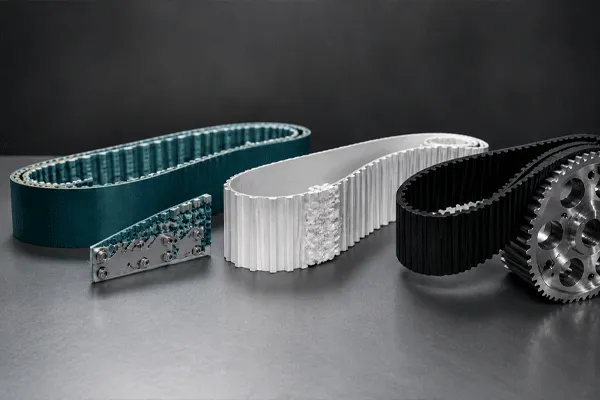
Open-ended. Supplied on continuous rolls, cut to length, both ends terminated in clamp plates. The belt never closes. Load runs from one clamp, through the tooth mesh at the drive pulley, to the other clamp.
Truly endless (molded). Formed as a single seamless loop over a tooth mold. No joint exists anywhere in the tensile layer. Length is fixed by the mold, so you select from a pitch-length table rather than specifying a number.
Welded / spliced endless. An open-ended length is cut, the ends are finger-spliced, and the joint is welded into a closed loop. This is how you get a loop at a length no mold produces. <cite index=”10-1″>Because the finger splice is a weak point, spliced and welded belts cannot handle the torque or stress levels that truly endless belts can, which makes them better suited to conveying than to high-torque drives.</cite>
Material sets the boundary here. Cast polyurethane can be thermally welded; EPDM rubber cannot, because the compound is vulcanized rather than thermoplastic. A rubber timing belt is therefore available open-ended or truly endless, with no welded option between them. Every welded-endless belt in KTD’s catalog — ATG10, ATK10, K13 — is polyurethane for exactly this reason.
Side-by-Side: What Actually Differs
| Dimension |
Open-Ended |
Welded Endless |
Truly Endless (Molded) |
| Motion type |
Reciprocating / linear |
Rotational, moderate torque |
Rotational, high torque |
| Length control |
Any length, cut from roll |
Any length, one-tooth increments |
Fixed mold pitch lengths only |
| Tensile layer continuity |
Continuous, terminated at clamps |
Interrupted at the splice |
Continuous, uninterrupted |
| Weakest point |
Clamp termination |
Weld / finger splice |
Tooth root under peak torque |
| Material options |
Cast PU (steel, aramid, fiberglass cord) |
Cast PU only |
EPDM rubber or cast PU |
| Profile cleats / backing |
Added along any section |
Added along any section |
Limited by mold and joint |
| Tensioning |
Adjust clamp position or carriage stop |
Idler or center-distance adjust |
Idler or center-distance adjust |
| Typical duty |
Gantries, actuators, pick-and-place |
Synchronized conveying, indexing |
Continuous power transmission |
| Field replacement |
Cut and re-clamp on machine |
Requires re-weld or spare loop |
Swap complete loop |
The row that changes decisions most often is weakest point. Open-ended belts fail at the clamp, not in the span. Welded belts fail at the splice. Molded belts fail at the tooth root. Each failure mode has a different early warning, and maintenance teams that inspect for the wrong one miss it.
Where the Joint Fails, and Why
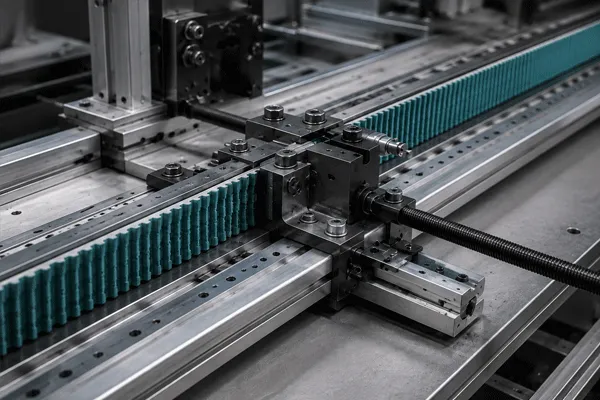
An open-ended belt’s clamp is a mechanical grip on a body designed to be flexible. Three termination styles dominate:
- Toothed clamp plates.A machined plate with the mating tooth profile compresses the belt against a flat backing plate. Load transfers through tooth shear across several engaged teeth, not through friction alone. This is the only termination that reliably holds steel-cord belts.
- Flat friction clamps.Two plain plates and bolts. Cheap, and adequate for light aramid or fiberglass belts. Under load the belt creeps out of the clamp in small increments, which shows up as progressive loss of home-position accuracy rather than sudden failure.
- Cast or bonded terminations.The belt end is encapsulated in a fitting. Common on long-span applications where clamp hardware would add reciprocating mass.
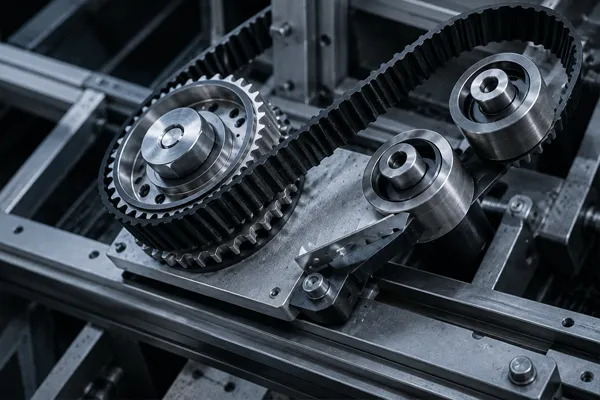
Welded joints fail differently. The finger splice runs at an angle across the belt width so that no single cross-section carries the full discontinuity, but the tensile cords are still cut. Under reverse bending — a back-side idler, or an S-wrap layout — the splice sees cyclic peel loading that a straight-through span never sees. If a welded-endless belt is going into a layout with back bending, the idler diameter and wrap angle need checking before the belt is quoted, not after.
A common misconception worth naming: engineers sometimes assume a welded loop can substitute for a molded loop anywhere, since the length is arbitrary and the profile identical. It cannot. The substitution works for conveying and indexing; it fails on high-torque drives, on high-frequency reversing drives, and anywhere the splice passes over a small-diameter pulley thousands of times per hour.
Open-Ended vs Endless Timing Belts: How to Choose
Tensile Cord: The Choice That Outranks Construction
Cord material governs elongation, minimum pulley diameter, and clamp compatibility. KTD supplies aramid (Kevlar), steel wire, and fiberglass cord across its polyurethane and rubber belt lines.
Steel wire gives the lowest elongation under load, which is what positioning accuracy actually depends on. It also sets the highest minimum pulley diameter, and it demands a toothed clamp — a friction clamp will let steel-cord belts slip because the cords carry load the plate never grips. Standard choice for linear gantries and CNC positioning tables.
Aramid carries high tensile strength at low mass, useful where the belt itself is a large fraction of the reciprocating load on long-stroke axes. It tolerates smaller pulley diameters than steel and resists shock loading better. The trade-off is lower resistance to repeated compressive flexing, so aramid belts degrade faster in layouts with back-side idlers.
Fiberglass sits between the two on elongation and is the usual cord in rubber timing belts. It is brittle under sharp bending and under-performs where a belt is repeatedly installed and removed by hand, since installation kinks break filaments that no inspection catches.
Compared with the vendor category pages that dominate this search — which list open-ended belting by width and pitch and leave cord selection to a dropdown — the cord decision is upstream of the construction decision. Pick the cord to match elongation and minimum pulley diameter, then confirm which constructions that cord is available in.
KTD Pitch and Profile Ranges
The construction options above only matter if the profile you need exists in both. KTD’s timing belt catalog covers:
- HTD:3M, 5M, 8M, 14M, 20M
- Imperial:MXL, XL, L, H, XH, XXH
- T-series:5, T5, T10, T20
- S-series:S2M through S14M
- P-series:P2M through P14M
Materials are EPDM rubber and cast polyurethane, with aramid, steel, or fiberglass cord. Food-grade polyurethane versions are available for washdown and direct-contact packaging lines.
Specific catalog references map to the construction split directly. The Open-Ended PU Timing Belt covers linear duty. ATG10, ATK10, and K13 are welded-endless polyurethane constructions. T5 and T10 PU belts are available with cleats, which is the configuration that suits synchronized conveying where product needs positive retention on an incline. S5M-360 is a representative rubber endless specification.
KTD lists ISO 9563, DIN 7721, and RMA IP-24 as applicable belt standards. Two clarifications matter when writing specifications against these. <cite index=”10-1″>ISO 9563</cite>, published by the International Organization for Standardization, addresses electrical conductivity and antistatic testing of endless and open-ended synchronous belts — it is not the general dimensional standard for every timing belt, and a specification that cites it for tooth geometry cites the wrong document. DIN 7721 covers synchronous belt drive dimensions and is the appropriate reference for metric profile geometry.
Six Steps to the Right Construction
- Establish the motion path.Does the belt return to its starting point by continuing around a loop, or by reversing direction? Reversing means open-ended. Everything else stays open.
- Fix the pitch and profile from the drive requirements.Torque, speed, and available pulley diameter set this. Do this before considering length, because profile availability constrains what comes next.
- Select cord material against elongation tolerance.Positioning accuracy specification drives this. Note the minimum pulley diameter each cord imposes, then check it against step 2.
- Check whether your length exists as a molded belt.If yes and duty is rotational, molded endless is the lowest-risk option. If no, you are choosing between a welded loop and a redesigned center distance.
- Map every reverse bend in the layout.Back-side idlers, S-wraps, and serpentine routing eliminate welded-endless from consideration on high-cycle drives and penalize aramid cord.
- Specify the termination or joint before quoting.Clamp style, splice angle, and cleat positions change tooling and lead time. Sending a belt length without them produces a quotation that will be revised.
Run steps 1 through 3 in that order. Teams that start from an existing belt length and work backward end up with a construction that fits the frame and not the duty cycle.
Open-Ended vs Endless Timing Belts: How to Choose
What Each Construction Costs You
Open-ended belting reduces SKU count. One roll covers multiple machine lengths, which matters for builders shipping configurable equipment. What it costs is assembly labor and a clamp interface that has to be designed into the carriage.
Welded endless buys arbitrary length without clamp hardware. It costs peak torque capacity and rules out aggressive back bending.
Truly endless gives the highest torque density and the cleanest failure prediction. It costs design freedom, because center distance now has to accommodate the belt rather than the reverse, and it means holding a distinct spare for each length in the machine.
Pricing is project-specific and provided upon quotation based on material, dimensions, machining complexity, quantity, surface treatment and other technical requirements.
FAQ
Q: Can I cut an endless timing belt open and use it as an open-ended belt?
A: For a polyurethane belt with a welded joint, physically yes, but the resulting length includes the old splice, and the cut ends have no clamp geometry. For a molded rubber endless belt, cutting exposes cords that were never designed to terminate. Both cases produce a belt with unknown load rating. Order open-ended belting from roll stock instead.
Q: Do open-ended and endless belts of the same profile run on the same pulleys?
A: <cite index=”8-1″>Yes — open-end belts use the same tooth profiles and pitches as standard endless belts, so no pulley change is needed when switching between the two at the same profile and pitch.</cite> Minimum pulley diameter can still change if you also change cord material.
Q: How much accuracy does a welded joint cost on an indexing conveyor?
A: The joint adds a local variation in belt pitch and stiffness that repeats once per revolution. On indexing applications the practical effect is a repeatable position error at one point in the cycle. It can be compensated in the controller if the joint’s position is known, which is one reason to mark joint location at installation.
Q: Which construction suits food processing washdown?
A: Cast polyurethane in food-grade formulation, in either welded-endless or open-ended form. Rubber is generally not preferred for direct-contact washdown. Cleated T5 and T10 configurations handle product retention on inclined transfer.
Q: What is the shortest length available as a welded endless belt?
A: The limit is set by splice length relative to belt circumference — the joint has to occupy a small enough fraction of the loop that it does not sit on two pulleys at once. Short loops below that threshold should be specified as molded endless.
Q: Can I add cleats after the belt is joined?
A: On open-ended and welded-endless polyurethane, yes, and cleat position is specified as a pitch count from a datum. On molded endless the joint-free surface limits where profiles can be welded without compromising the tooth structure. Specify cleats at quotation.












 14:29
14:29