Choosing the wrong gearbox can leave a vehicle short of pulling power, waste fuel, or make heavy-load driving harder than it should be. The problem is that “how many gears?” has no single answer. The right transmission depends on its design, application, required torque, speed, and operating conditions.
A gearbox can have anywhere from a few fixed gears to 18 or more forward ratios. Most modern light vehicles use about 5–10 forward speeds, while heavy-duty truck transmissions may provide 10, 12, 16, or 18 forward ratios. A continuously variable transmission does not use a fixed number of conventional ratios. The advertised speed count also does not always equal the physical gear count inside the gearbox.
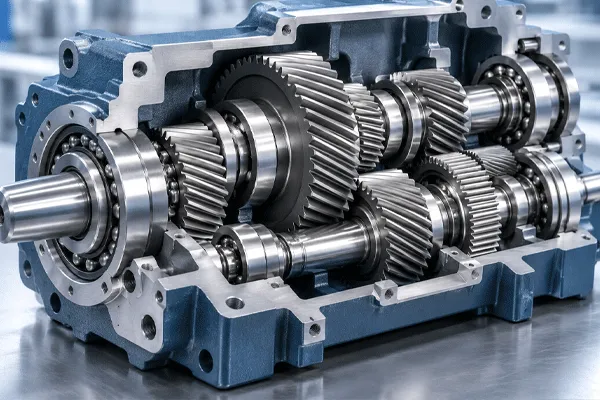
How Many Gears Are in a Gearbox? Transmission Gear Ratios Explained
How Many Gears Are in a Gearbox?
The simple answer is: it depends on the type of transmission and what the vehicle needs to do.
A traditional passenger-car manual transmission often has five or six forward speeds plus a reverse gear. Modern automatic units may use six, eight, nine, or ten forward ratios. Heavy commercial trucks can use even more because they must move a heavy load while keeping the engine within a useful RPM range.
The U.S. Department of Energy has noted that modern light-duty vehicles commonly use transmissions with multiple speeds and that adding more transmission ratios can help match vehicle speed more closely to an efficient engine operating range.
| Transmission Type |
Typical Forward Ratios |
Common Application |
| Manual gearbox |
5–6 |
Cars, pickups, light commercial vehicles |
| Conventional automatic gearbox |
6–10 |
Cars, SUVs, light trucks |
| Heavy-duty manual/AMT |
10–18 |
Tractor trucks and heavy transport |
| ZF TraXon AMT |
12 or 16 |
Heavy commercial vehicles |
| Eaton RT-18 |
18 |
Heavy-duty and vocational trucks |
| CVT |
Continuously variable |
Mainly passenger and light vehicles |
The table gives useful examples rather than a universal rule. Always check transmission models and manufacturer specifications before comparing two vehicles.
For example, Eaton lists its RT-18 as an 18-speed transmission, while its published specification shows 18 forward and four reverse ratios.
What Does the Number of Gears in a Transmission Actually Mean?
When someone says a vehicle has a “six-speed” or “ten-speed” transmission, they normally mean the number of usable forward gear ratios, not the exact number of physical gears hidden inside the housing.
This distinction matters.
A gearbox may use several shafts, gears, synchronizers, range sections, splitter systems, clutches, or a planetary gear arrangement to create a much larger number of available ratios than you might expect from simply counting visible gear wheels.
A good heavy-duty example is a 10-speed Eaton transmission. Eaton explains that its front section mechanically provides five forward positions, while a high/low range system allows those positions to be reused to produce ten forward ratios.
So:
Transmission speed count ≠ physical gear count.
This is especially important when comparing manual and automatic transmissions, automated manuals, and planetary automatic designs.
A transmission advertised with ten forward ratios does not necessarily contain ten separate simple gear pairs lined up next to each other.
How Does a Gear Ratio Work?
A gear ratio describes the relationship between the rotational speeds of two connected gears.
In a simple gear pair, you can calculate the ratio using the number of teeth:
Gear Ratio = Teeth on Driven Gear ÷ Teeth on Driving Gear
Suppose the driving gear has 10 teeth and the driven gear has 40 teeth:
40 ÷ 10 = 4
The result is a 4:1 ratio.
This means the small gear must rotate four times for the larger driven gear to make approximately one full turn. Ignoring mechanical losses, the arrangement reduces output speed while multiplying available output torque.
Simple Gear Ratio Example
| Driving Gear |
Driven Gear |
Ratio |
Basic Effect |
| 10 teeth |
40 teeth |
4:1 |
Lower speed, higher torque |
| 20 teeth |
20 teeth |
1:1 |
Similar input/output speed |
| 40 teeth |
20 teeth |
0.5:1 |
Higher output speed, lower torque multiplication |
This basic relationship helps explain why 1st gear feels powerful but slow while a high gear supports higher road speed with lower engine RPM.
The exact ratio between the engine and drive wheels also depends on final-drive gearing, tire size, and other driveline components.
How Do Gear Ratios Work in 1st, 2nd and 3rd Gear?
A vehicle needs very different combinations of speed and torque at different moments.
When starting from rest, the engine needs mechanical advantage. That is why first gear usually uses a relatively higher gear ratio. The engine can turn several times while the transmission output shaft turns more slowly.
For example:
- 1st gear: strong pulling force for starting
- 2nd gear: less torque multiplication but more vehicle speed
- 3rd gear: moves further toward road-speed efficiency
- Higher gears: lower engine RPM for cruising
As the driver or control system shift gears, the selected ratio changes.
A lower gear ratio in higher road gears usually allows the output shaft to rotate faster relative to engine speed. This helps a vehicle travel efficiently at high speeds without forcing the car engine to run at excessive revolutions per minute.
This is one reason a transmission needs different gear ratios rather than just one gear.
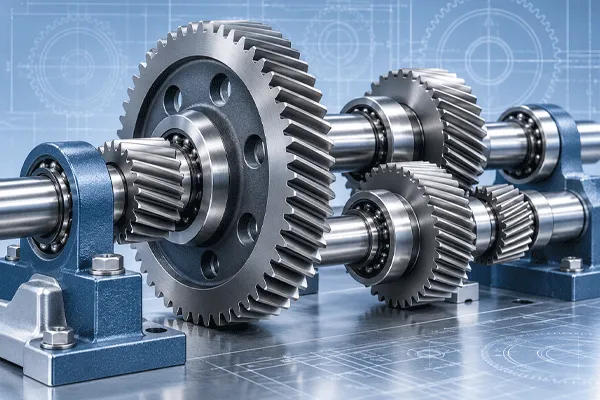
How Many Gears Are in a Gearbox? Transmission Gear Ratios Explained
How Many Gears Does a Manual Gearbox Have?
A modern passenger-car manual gearbox commonly provides five or six forward speeds. Some vehicles use different arrangements, so the actual number depends on the design.
With a conventional manual transmission, the driver controls gear selection using the gear lever and clutch. Pressing the clutch pedal and gear selection process disconnects engine power long enough for the driver to engage the desired gear.
The basic sequence may include:
1st → 2nd → 3rd → 4th → 5th → 6th
plus reverse.
A manual transmission gives the driver direct control over gear selection, which can be useful when pulling, descending, climbing, or working under changing road conditions.
However, heavy commercial vehicles may use a more complex manual gearbox with range and splitter mechanisms. Instead of fitting a completely independent gear set for every ratio, the gearbox can combine sections to provide different gear ratios.
That is why physical construction and advertised gear speeds should not be treated as the same thing.
How Many Gears Does an Automatic Gearbox Have?
A conventional automatic gearbox can have six, eight, nine, ten, or another number of forward ratios depending on its design.
Unlike a basic manual system, a modern automatic transmission can use planetary gearsets, clutches, hydraulic systems, and electronic control to select the appropriate specific gear without requiring normal manual clutch operation.
A typical planetary set may include:
- A sun gear
- Planet gears
- A planet carrier
- A ring gear
By holding, driving, or connecting different members of the planetary system, the transmission can create different ratios without needing one completely independent gear pair for every speed.
This is why asking, “How many physical gears are inside this automatic?” can produce a very different answer from asking, “How many forward speeds does it have?”
Modern transmission design has also changed the old idea that manuals must always provide better fuel efficiency. The U.S. Department of Energy reported that improvements in automatic transmissions, including a growing number of ratios, helped modern automatics become more fuel efficient on average than comparable manuals beginning with model year 2016.
Why Do Heavy-Duty Truck Gearboxes Have So Many Gears?
Heavy trucks operate across an enormous range of conditions.
A tractor may start with a heavy load, climb a steep road, move slowly through a construction or mining site, accelerate onto a highway, and then cruise for hundreds of kilometers.
One transmission ratio cannot handle all these jobs efficiently.
More ratios let the driver or transmission controller keep the engine closer to a useful operating range while balancing torque and speed.
Consider an Eaton 18-speed transmission. Eaton specifies models with 18 forward speeds and four reverse ratios, with ratios extending from very low starting gears to highway-oriented overdrive ratios.
ZF provides another useful example. Its TraXon heavy commercial vehicle transmission platform is available with 12 or 16 forward gears. A published 12-speed TraXon specification lists ratios from 12.92 in first to 0.77 in twelfth, illustrating the broad range of gear ratios available for heavy-duty operation.
Heavy Transport Example
Imagine two tractor-trailer operations:
| Operating Condition |
Transmission Need |
| Lowbed carrying construction equipment |
Strong starting torque and close lower ratios |
| Mining transport |
Low-speed pulling capability and durability |
| Container highway logistics |
Efficient cruising ratios |
| Fuel tanker transport |
Smooth acceleration and controlled operation |
| Long-distance freight |
Efficient engine RPM and fewer unnecessary speed changes |
As a professional semi trailer manufacturer, we consider this relationship when discussing a complete transport application with buyers.
The semi trailer itself normally does not contain the tractor’s propulsion gearbox. The engine and transmission belong to the truck or tractor powertrain. However, trailer type, payload, road conditions, gradient, axle configuration, tire choice, and operating speed influence what tractor and transmission specification makes sense.
A lowbed transporting machinery through mountainous terrain creates very different driveline demands from a container chassis running mainly between a port and logistics center.
What Is an Automated Manual Transmission and How Many Gears Can It Have?
An automated manual transmission, often called an AMT, is mechanically related to a manual transmission but automates clutch and gear shifting functions.
In simple terms, an AMT is a manual transmission architecture with electronic or electro-pneumatic controls doing much of the shifting work.
This gives fleet operators an interesting combination: the mechanical layout and potential efficiency of a manual gearbox with easier operation and automated gear changes.
Older terminology may also describe systems such as an intelligent manual transmission.
Heavy commercial AMTs commonly use many ratios because trucks benefit from close steps between gears. ZF’s TraXon, for example, is an AMT platform for heavy vehicles with 12- and 16-speed configurations.
Some transmission architectures effectively divide operation into ranges or odd and even gear sets, while other systems use splitters, range boxes, or different clutch arrangements.
The important point for fleet buyers is not simply whether the vehicle can shift gears automatically. You should examine:
- Available torque capacity
- Starting ratio
- Top ratio
- Ratio spacing
- Final-drive ratio
- Vehicle gross weight
- Road gradient
- Cruise speed
- Operating duty cycle
- Service support
A transmission with more speeds is not automatically better. The ratios must suit the job.
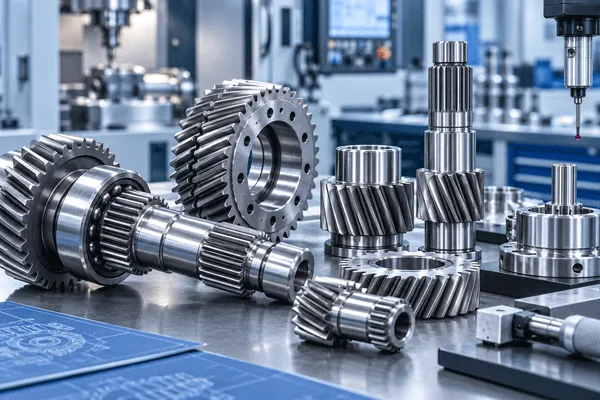
Does a Continuously Variable Transmission Have Gears?
A continuously variable transmission, or CVT, changes the transmission ratio continuously instead of selecting only from a fixed group of conventional ratios.
So asking “How many gears does a CVT have?” is slightly misleading.
Nissan explains that its CVT can move through an effectively continuous range of ratios by changing the working diameter of adjustable pulleys connected by a belt. This allows the system to choose a suitable ratio without traditional stepped gear changes.
You may sometimes see a CVT described as having simulated “gears.” Those are programmed steps designed to give the driver a familiar feeling. They do not necessarily represent the same physical architecture as conventional fixed gear systems.
This is another reason physical gear count and advertised transmission speeds should not be confused.
For heavy tractor-trailer work, fixed-ratio manual, automatic, and AMT systems remain much more relevant than passenger-car-style CVTs.
Why Can More Gears Improve Torque, Performance and Fuel Efficiency?
Adding more ratios gives engineers smaller steps between one selected gear and the next.
Imagine climbing a hill where one gear leaves the engine turning too fast, but the next leaves it turning too slowly. Another ratio between those two positions can help the transmission keep the engine closer to its efficient or high-torque operating range.
The same principle helps at highway speed.
The U.S. Department of Energy notes that increasing the number of transmission speeds can improve performance and fuel economy because the vehicle can more closely match wheel speed with an efficient engine speed.
The General Relationship
Lower road gear
→ Higher ratio
→ More torque multiplication
→ Lower output speed
Higher road gear
→ Lower numerical ratio
→ Less torque multiplication
→ Higher vehicle speed at a suitable engine RPM
This does not mean bigger gears automatically create better efficiency. Gear design involves tooth geometry, lubrication, bearing losses, control strategy, overall ratio spread, engine characteristics, final-drive gearing, and vehicle weight.
The ratios affect the whole driving system.
For a loaded tractor pulling a dump semi trailer from a quarry, low-speed pulling capability may matter most.
For a tractor pulling a side curtain trailer on a long highway route, the highest ratios and engine operating speed may have a greater influence on fuel use.
How Do Gear Trains and Planetary Gears Create Many Gears?
A simple transmission can use two gears. Real vehicle transmissions are much more complex.
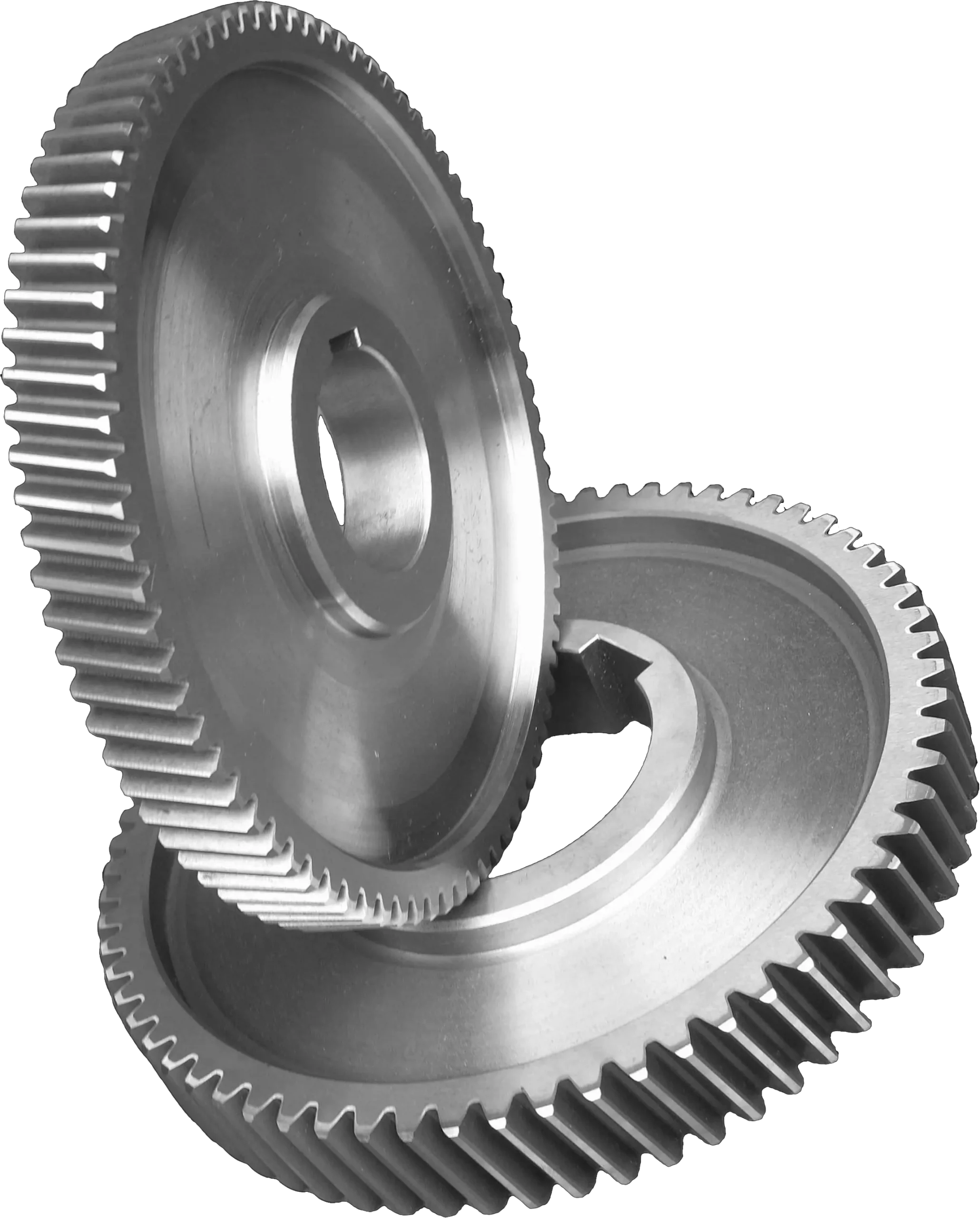
Gear trains allow several gears and shafts to work together. One gear drives another, which may then transfer motion to another shaft or transmission section.
If a small gear drives a larger gear, output speed falls while torque can increase. Reverse the relationship and output behavior changes.
The rotation of the smaller gear, the number of gear teeth, and which shaft acts as input or output determine the final result.
A conventional manual may use parallel shafts and several meshing gears. An automatic can use planetary arrangements where the sun, planets, carrier, and large gear or ring interact.
In a planetary system, changing which component:
- receives input,
- remains stationary,
- or provides output
changes the resulting ratio.
That gives engineers several fixed gear ratios from a compact assembly.
This is why simply opening a gearbox and counting individual wheels will not necessarily tell you whether it is described as a six-, eight-, or ten-speed unit.
How Should You Choose the Right Transmission Gear Ratio for Heavy Transport?
For commercial transportation, start with the job rather than the advertised number of gears.
A tractor pulling a flatbed semi trailer may have different needs from one pulling a loaded fuel tanker, removable gooseneck lowboy, bulk cement tanker, or mining dump trailer.
When we discuss heavy-duty transport configurations with international buyers, we recommend evaluating the complete vehicle operating condition.
Check These Factors
- Cargo weight
Greater gross weight usually increases starting and climbing demands.
- Terrain
Mountain roads need different gearing from flat highway routes.
- Typical operating speed
Long-haul fleets need suitable cruising ratios.
- Engine torque curve
The transmission should keep the engine working efficiently.
- Axle ratio
Transmission and drive axle ratios work together.
- Tire size
Tire circumference influences actual road speed at a given RPM.
- Trailer application
Container, tanker, lowbed, dump, mining, and construction duties are not identical.
- Local regulations
Gross combination weight and axle-load regulations may affect vehicle configuration.
- Service conditions
Dust, heat, steep grades, stop-start work, and long-distance operation change the duty cycle.
- Replacement parts and maintenance
Parts availability matters for commercial fleets operating far from the original supplier.
For OEM/ODM heavy transportation projects, a buyer should therefore evaluate the truck, trailer, payload, route, axle system, braking system, and driveline as one operating package.
Choosing a trailer only by payload or choosing a gearbox only by its number of speeds misses the bigger engineering picture.
What Happens When the Wrong Gear Ratio Is Selected?
Using an unsuitable ratio can put the engine outside its efficient operating range.
A ratio that is too high for the load may cause the vehicle to struggle, lose speed, or require frequent downshifts. A ratio that is too low at cruising speed can leave the engine running at unnecessarily high RPM.
Incorrect operation can also create excess heat and stress.
That does not mean an inconvenient gear ratio automatically causes gearbox failure. Transmission life also depends on lubrication, temperature, loading, driver behavior, clutch condition, maintenance, bearing condition, and design limits.
For fleet operators, the goal should be smooth gear transitions and correct load matching rather than simply chasing the highest possible gear count.
A well-matched 12-speed system may perform better in a specific operation than an unsuitable 18-speed system.
The gear must fit the application.
Frequently Asked Questions About Gearboxes and Gear Ratios
How many gears does a normal gearbox have?
There is no universal number. A passenger-car manual transmission commonly has five or six forward speeds, while modern automatics often have six to ten. Heavy-duty commercial transmissions can have 10, 12, 16, or 18 forward ratios.
Does a six-speed gearbox contain exactly six physical gears?
Not necessarily. The advertised number normally describes available forward ratios. Internal gears, shafts, clutches, planetary sets, range sections, and other components may create those ratios in different ways. The physical gear count can therefore differ from the advertised speed count.
Why do trucks need more gears than cars?
Heavy trucks carry much more weight and work over a wider range of speeds and gradients. Extra ratios let the transmission keep the engine closer to its useful RPM and torque range during starting, climbing, acceleration, and highway cruising.
What is the difference between a gear and a gear ratio?
A gear is a mechanical component with teeth. A gear ratio describes the speed relationship between connected rotating components. If a driving gear has 10 teeth and a 20-tooth driven gear is connected to it, the simple ratio is 2:1. The driven gear turn rate is therefore slower than the driving gear.
Is an 18-speed transmission better than a 10-speed transmission?
Not automatically. An 18-speed system gives the operator more ratio choices, which can be useful for heavy haul, steep terrain, and changing operating conditions. A 10- or 12-speed transmission may be more suitable for another fleet. The best transmission depends on engine output, vehicle weight, route, speed, and duty cycle.
Does a semi trailer have a gearbox?
A conventional non-powered semi trailer does not use the main propulsion gearbox found in the tractor. The tractor contains the engine and main road transmission. However, the trailer’s load, axle configuration, tires, payload, and application directly influence the tractor and driveline specification needed to move it safely and efficiently.
Final Takeaways: What You Need to Know About Gearboxes
If you only remember a few things, remember these:
- There is no single answer to how many gears are in a gearbox.
- A normal manual may have five or six forward speeds.
- Modern automatic transmissions commonly provide several more ratios.
- Heavy-duty truck transmissions can offer 10, 12, 16, or 18 forward ratios.
- Eaton’s RT-18 is an example of an 18-forward-speed heavy-duty transmission.
- ZF TraXon is available with 12 or 16 forward gears for heavy commercial vehicle applications.
- The advertised transmission speed count does not necessarily equal the number of physical gears inside the gearbox.
- A simple gear ratio compares the rotation of driving and driven components and determines how speed and torque are changed.
- Lower gears provide greater torque multiplication for starting and climbing.
- Higher gears support efficient cruising at suitable engine RPM.
- A CVT does not rely on a conventional fixed number of ratios.
- More transmission gears can help keep an engine closer to an efficient operating range, but more gears do not automatically mean a better vehicle.
- For heavy-duty transport, select the tractor transmission according to payload, trailer type, road gradient, cruising speed, engine torque, axle ratio, and real operating conditions.
- For OEM and ODM transportation projects, the truck, semi trailer, braking system, axle configuration, tires, and driveline should be considered as one complete heavy-duty transport system.












 09:09