A worn pulley groove can make even a new belt slip, run hot, or fail too soon. Replacing the belt alone may not solve the problem. To protect the drive, you need to inspect the groove, confirm the belt fit, check alignment, and measure wear before restarting the machine.
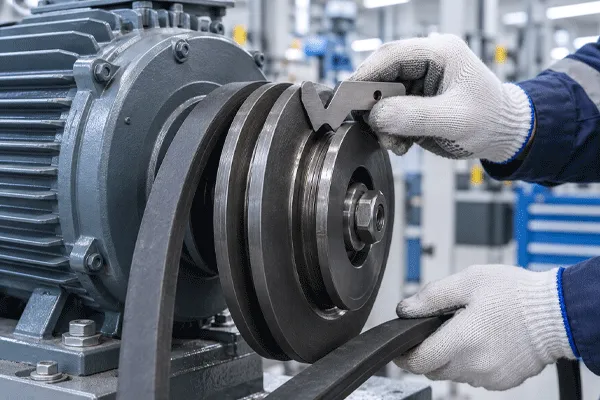
To check a pulley groove, shut down the drive, clean the groove, inspect it for wear or damage, and place the correct sheave gauge into the groove. The gauge should match the sidewalls closely. Also check pulley alignment, groove consistency, belt fit, and pulley diameter. Replace a pulley when wear exceeds the equipment or gauge manufacturer’s allowable limit.
How to Check a Pulley Groove: V-Belt Sheave Inspection and Measurement Guide
Why Should You Check a Pulley Groove Before Replacing a V-Belt?
A V-belt does not transmit power by simply sitting at the bottom of the groove. Its sidewalls contact the angled sides of the pulley groove. This contact creates the friction needed to transmit torque from the motor to the driven machine.
That means the condition of both the belt and pulley matters.
If a sheave becomes worn, the groove may become wider or change shape. A new belt can then sit too deeply in the groove. The contact area becomes wrong, slippage can increase, and the belt may wear faster than expected.
Gates recommends checking pulley grooves for smoothness, nicks, debris, dimensional mismatch, and wear. Its maintenance guidance specifically recommends a belt and sheave gauge when a V-belt-to-pulley groove mismatch is suspected.
Common warning signs include:
- repeated belt replacement;
- polished or shiny groove surfaces;
- cracking or glazing on the belt;
- black rubber dust around the drive;
- unusual squealing;
- excessive heat;
- uneven belt wear;
- loss of transmitted power;
- premature belt failure.
If these problems keep returning, do not assume the replacement belt is the cause. The pulley may be telling you something.
What Tools Do You Need to Check a Pulley Groove?
You do not need a complicated inspection station for a basic check.
For most industrial V-belt drive inspections, a practical tool kit includes:
| Tool |
Main Purpose |
| Sheave or pulley groove gauge |
Checks groove profile and wear |
| Straight edge |
Basic pulley alignment check |
| Laser alignment tools |
More accurate shaft and pulley alignment |
| Caliper |
Measures outside diameter and basic dimensions |
| Tape measure |
Checks approximate belt length or center distance |
| Flashlight |
Helps inspect groove surfaces |
| Stiff brush |
Removes dirt and compacted debris |
| Manufacturer drawing/specification |
Confirms groove and pulley dimensions |
A dedicated sheave gauge is especially useful. Gates describes its sheave gauge as a tool for identifying worn or damaged V-belt sheaves.
SKF also recommends pulley gauges as part of V-belt pulley inspection. Its power transmission guidance notes that unequal groove wear can cause belts to operate at different effective diameters, leading to slip and uneven loading.
Terminology note: “sheave” is the correct mechanical term for a grooved pulley used with a belt or rope. “Sheaf” is sometimes entered in online searches, but in power transmission engineering, sheave is the correct word.
How Do You Visually Check a V-Belt Pulley Groove?
Start only after the machine is safely shut down and isolated according to your site’s maintenance procedure.
Remove or release the belt if necessary so you can see the whole pulley groove. Then use a stiff brush to remove rubber dust, dirt, oil residue, rust, and packed material.
Look closely along the pulley surface.
A healthy groove should normally have smooth, consistent sidewalls without severe scoring, deformation, chips, or obvious uneven wear.
Check for these conditions
- polished areas caused by belt slip;
- sharp damage or burrs;
- rust and corrosion;
- uneven groove width;
- cracked pulley material;
- worn sidewalls;
- contamination;
- damaged pulley flanges, where applicable;
- one groove that looks different from adjacent grooves.
SKF identifies shiny wear inside sheave grooves as one possible sign of pulley wear and recommends checking groove profile with a pulley gauge.
A quick visual inspection will not give you every dimension, but it often tells you whether further measurement is necessary.
How Do You Use a Gauge to Check a V-Belt Sheave Groove?
A pulley or sheave gauge is one of the simplest ways to check pulley wear.
First, select the gauge profile that corresponds to the intended belt section. Insert the gage into the groove without forcing it.
The gauge should seat against the correct groove surfaces.
You are looking for unwanted gaps between the gauge and groove sidewalls.
If the pulley is severely worn, the gauge may show that the groove has opened up or lost its intended geometry.
Basic inspection sequence
- Identify the correct belt type.
- Select the matching gauge.
- Clean the groove.
- Place the gauge into the groove.
- Inspect the contact between gauge and sidewalls.
- Compare all grooves on a multi-groove pulley.
- Compare the result with the manufacturer’s allowable wear limit.
SKF training material gives one useful example: it recommends pulley replacement when more than 0.8 mm is detected between its template and groove. That figure should be treated as SKF-specific guidance rather than a universal limit for every pulley design. Always follow the applicable pulley, belt, or gauge manufacturer’s specification.
This point is important. There is no single wear number that should be blindly applied to every v-belt pulley.
How to Check a Pulley Groove: V-Belt Sheave Inspection and Measurement Guide
How Should a V-Belt Fit Inside the Groove?
A proper belt should make effective contact with the groove sidewalls.
It should not simply rest on the bottom.
If the belt bottoms out, the friction relationship changes and the belt may slip. At the other extreme, if it rides too high because the belt size or groove type is wrong, the system may also operate poorly.
Correct versus incorrect fit
| Condition |
What You May See |
Possible Result |
| Correct belt and groove |
Sidewall contact with proper seating |
Stable power transfer |
| Belt sits too deep |
Belt approaches or contacts groove bottom |
Slippage and heat |
| Belt sits too high |
Incorrect belt profile or groove mismatch |
Poor tracking |
| Worn groove |
New belt sinks deeper than expected |
Premature wear |
| Different groove depths |
Multiple belts run at different effective diameters |
Unequal belt loading |
The goal is to match the pulley with the correct belt profile.
Gates notes that correct belt-to-sheave contact supports uniform loading and wear.
Never choose a belt only because its outside width appears close. A standard V-belt is designed around a defined cross-section, and the matching groove geometry matters.
How Do Groove Angle and Belt Profile Affect Power Transmission?
The groove angle is a critical part of V-belt operation.
A V-belt wedges into the pulley and creates sidewall contact. This wedging effect helps increase friction between the belt and groove.
If the profile changes because of wear, the system may lose some of this intended contact.
The belt profile must therefore correspond to the pulley design.
Common industrial drives may use different V-belt cross-sections, while Poly V systems use several narrow ribs instead of one conventional V-shaped section.
KTD’s own power transmission portfolio includes Poly V pulleys in PH, PJ, PK, PL, and PM profiles, illustrating why groove or rib geometry must be matched to the specified belt system rather than estimated visually.
In a correctly selected system:
motor → driving pulley → belt → driven pulley → machine
Each component influences the efficiency of the power transmission.
Even a high-quality belt cannot fully compensate for badly worn grooves.
How Do You Check Pulley Alignment After Inspecting the Groove?
Do not stop after inspecting the groove.
Pulley alignment is another major factor in belt life.
A good pulley can still destroy a belt quickly when the drive pulleys are offset or angularly misaligned.
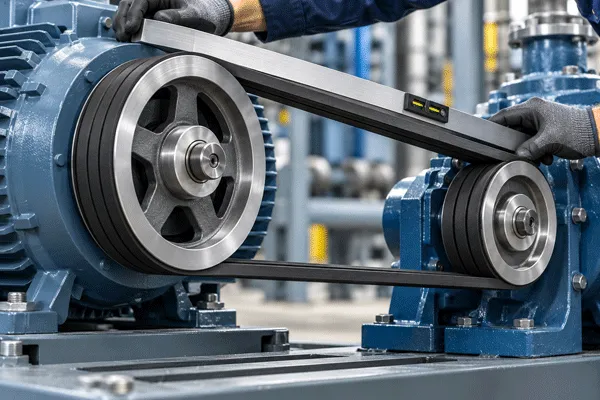
For a basic check, place a long straight edge across the pulley faces and compare the contact points.
Gates recommends a straight edge as a practical method for checking drive alignment, while SKF notes that pulley misalignment can accelerate wear and increase operating temperature.
For critical industrial machinery, laser alignment tools provide a more precise approach.
Common forms of misalignment
- parallel offset;
- horizontal angular misalignment;
- vertical angular misalignment;
- combinations of the above.
Misalignment can cause:
uneven belt loading → heat → edge wear → vibration → reduced belt life → downtime
It can also lead to belt slippage and may place extra load on a bearing.
After adjusting the system, ensure that the pulleys remain properly aligned under working tension because shaft movement or frame deflection can sometimes change alignment.
How Do You Measure the Pulley Diameter and Belt Drive Dimensions?
Sometimes groove inspection reveals that you also need to confirm the pulley’s size.
The easiest dimension to check is normally the outside diameter.
Use a caliper for small pulleys or an appropriate tape measure and calculated circumference method for larger units when high precision is not required.
If you measure around the outside, remember that circumference and diameter are related by:
Diameter = Circumference ÷ π
However, do not confuse outside diameter with pitch diameter.
The pitch diameter relates more closely to the effective running position of the belt. Depending on the pulley type, it may not be directly measurable in the same way as the outside diameter.
The diameter of the pulley affects belt speed and bending.
A smaller pulley forces the belt to bend more sharply. For this reason, belt manufacturers often specify minimum pulley diameters for different belt sections.
The full drive also depends on:
- driving pulley diameter;
- driven pulley diameter;
- motor speed;
- belt length;
- distance between the two shafts;
- wrap angle;
- transmitted power.
If you need to measure the center distance, measure from the centerline of one shaft to the centerline of the other rather than estimating from pulley edges.
How to Check a Pulley Groove: V-Belt Sheave Inspection and Measurement Guide
How Do Pulley Diameter, Wrap Angle, and Tension Affect Belt Life?
Groove condition is only one part of a complete belt drive system.
Three other factors deserve attention: pulley diameter, wrap angle, and tension.
A smaller drive pulley can increase belt bending cycles. Too little belt contact around the pulley can reduce traction. Incorrect belt tension can cause either slip or excessive mechanical loading.
The wrap angle is the amount of pulley circumference contacted by the belt. More useful contact can increase the area available for force transfer.
However, simply adding more tension is not the answer to every slipping problem.
Over-tensioning may increase load on shafts and bearings. Under-tensioning may allow slippage, heating, vibration, and rapid belt deterioration.
A practical inspection should therefore look at the entire pulley system:
Pulley Groove
      ↓
Correct Belt Profile
      ↓
Pulley Alignment
      ↓
Correct Tension
      ↓
Adequate Belt Contact
      ↓
Stable Power Transmission
If one part is wrong, overall performance suffers.
What Causes Premature V-Belt and Pulley Wear?
When a belt fails early, technicians sometimes install another belt and restart the machine.
That can become expensive.
Premature wear often has a root cause somewhere else in the system.
Typical causes include:
- worn pulley grooves;
- wrong V-belt size;
- pulley misalignment;
- low tension;
- excessive tension;
- contamination;
- insufficient wrap;
- unsuitable pulley diameter;
- rough groove surfaces;
- mismatched multiple belts;
- damaged bearings;
- incorrect installation;
- a pulley designed for a different belt section.
Gates notes that operators should inspect pulley grooves for smooth surfaces, nicks, and debris when diagnosing belt-drive problems.
SKF likewise warns that once drive belts start to slip, they can wear quickly and consume more energy.
The cost is not limited to the belt wear itself.
Repeated belt failure can cause production interruption, labor costs, wasted replacement components, bearing stress, and unplanned downtime.
For industrial buyers, a slightly more careful inspection is usually cheaper than repeatedly treating the symptom.
How Do Different Pulley Types Change the Inspection Method?
Not every pulley has the same groove.
That matters.
Common pulley types
| Pulley Type |
Belt Contact |
Main Inspection Focus |
| Conventional V-belt pulley |
Angled groove sidewalls |
Groove wear, angle, belt seating |
| Double groove / multi-groove V pulley |
Several V-belts |
Equal groove wear |
| Poly V pulley |
Multiple narrow ribs |
Rib wear and profile consistency |
| Timing pulley |
Belt teeth engage pulley teeth |
Tooth profile and wear |
| Flat belt pulley |
Flat surface |
Surface condition and alignment |
| Serpentine pulley |
Multi-rib belt |
Rib profile and alignment |
A double groove or multi-groove drive needs special attention because all belts should operate at compatible effective diameters.
If one groove wears more than the others, one belt can take more load.
SKF specifically warns that uneven groove wear can cause belts to run at different diameter levels within the same pulley.
A timing pulley, however, requires a different inspection approach because it transmits motion through tooth engagement rather than V-belt wedging.
Likewise, a serpentine belt or Poly V drive uses narrow ribs and should be inspected according to the correct rib profile.
This is why pulley selection and inspection should always begin with the actual drive design.
When Should You Replace a Worn Pulley Rather Than Just the Belt?
Replace the pulley when inspection shows that its groove or other functional surfaces are outside the acceptable specification.
Typical reasons include:
- excessive groove wear;
- visible cracks;
- severe corrosion;
- damaged ribs or teeth;
- deformation;
- groove dimensions outside tolerance;
- persistent belt fit problems;
- irreparable bore or keyway damage.
A belt is a consumable part, but pulleys may also wear over time.
Installing a new belt into a badly worn groove can shorten the new belt’s service life.
For maintenance teams, a good rule is simple:
When changing the belt, check for wear on the pulley too.
SKF recommends inspecting pulleys whenever a new belt is installed, with more detailed inspection or replacement considered as service cycles accumulate and operating severity increases.
If a standard replacement pulley does not fit the required shaft, groove configuration, material, or installation space, a custom solution may be more practical.
For industrial equipment manufacturers and OEM buyers, this is where precise drawings become important.
Dimensions such as:
- bore diameter;
- keyway;
- pulley diameter;
- groove or rib profile;
- width;
- hub geometry;
- flange configuration;
- pulley material;
- surface treatment
should be confirmed before production.
What Should Industrial Buyers Specify When Ordering a Custom Pulley?
For a custom project, “I need a pulley this size” is rarely enough.
At KTD, our work in industrial power transmission includes standard and non-standard pulley components for automation, machinery, conveyor equipment, and other industrial applications. The company supports pulley manufacturing in materials including aluminum alloy, steel, stainless steel, nylon, and copper, depending on the specific product and design requirements.
For an accurate quotation or DFM review, provide as much information as possible:
- drawing or sample;
- application;
- pulley type;
- belt specification;
- groove or tooth profile;
- diameter;
- bore and keyway;
- shaft interface;
- operating speed;
- load;
- material;
- surface treatment;
- quantity;
- required tolerance.
For example, KTD’s Poly V pulley range includes PH, PJ, PK, PL, and PM rib profiles, while its timing pulley portfolio includes multiple metric and imperial tooth systems.
The goal is not simply to make a modern pulley that looks correct.
The real goal is to manufacture a component that works correctly with the right belt, shaft, operating speed, and load.
Frequently Asked Questions About Pulley Groove Inspection
How can I tell whether a V-belt pulley groove is worn?
Clean the groove and inspect the sidewalls for polishing, widening, scoring, or irregular wear. Then place the correct pulley or sheave gauge into the groove. Visible gaps between the gauge and groove can indicate wear. Always compare the result with the gauge or pulley manufacturer’s allowable limits.
Should a V-belt touch the bottom of the pulley groove?
Normally, a V-belt should transmit force through contact with the groove sidewalls rather than running primarily against the bottom. If the belt fits too deeply and bottoms out, the groove may be worn or the belt section may be incorrect.
Can a worn pulley damage a new belt?
Yes. Worn grooves can change the way a belt sits and transfers force. This can produce slippage, heat, uneven loading, and premature wear and tear, shortening the life of a newly installed belt.
How often should I check pulley grooves?
Inspect the pulley whenever you replace a belt and whenever you see abnormal belt wear, vibration, heat, noise, slipping, or dust. The exact maintenance interval depends on operating hours, load, environment, and manufacturer recommendations.
Can I use a ruler to check a V-belt groove?
A ruler can help with some basic dimensional checks, but it cannot accurately evaluate the full groove profile. A dedicated sheave or groove gauge is a better tool when you need to learn how to measure pulley groove wear correctly.
Is a sheave the same as a pulley?
The words are often used interchangeably in belt-drive applications. More precisely, a sheave is a pulley with a groove designed to guide a belt or rope. “Sheaf” is not the preferred engineering term for this component.
Key Things to Remember When Checking a Pulley Groove
Before you return a machine to service, remember:
- Clean the pulley groove before inspecting it.
- Look for polished surfaces, scoring, deformation, debris, and corrosion.
- Use the correct sheave gauge to evaluate groove profile and wear.
- Make sure the belt contacts the groove sidewalls correctly.
- Do not let the belt run primarily against the bottom of the groove.
- Confirm that the belt type and groove profile match.
- Compare every groove on multi-belt drive pulleys.
- Check pulley alignment with a straight edge or suitable alignment tool.
- Verify belt tension rather than increasing tension to hide a slipping problem.
- Check pulley diameter, center distance, and belt length when troubleshooting the complete drive.
- Remember that belt life depends on the whole system, not the belt alone.
- Inspect the pulley whenever installing a new belt.
- Replace a damaged or excessively worn pulley instead of repeatedly replacing belts.
- For non-standard equipment, confirm the drawing, belt profile, bore, material, groove geometry, and operating conditions before ordering a custom pulley.
- A correctly designed and maintained pulley helps improve drive stability, reduce unwanted maintenance, and support efficient industrial power transmission.
For OEM equipment, automation systems, conveyor machinery, and other industrial projects, the best pulley is not simply the largest, strongest, or cheapest option. It is the pulley whose dimensions, profile, material, bore, and manufacturing accuracy match the complete drive system.
That is why careful inspection and accurate component selection matter.












 11:37