A weak roller choice can slow a conveyor, damage products, and raise repair costs. In busy factories and warehouses, small friction problems become big delays. The solution is simple: understand the drive roller before you design or buy a conveyor system.
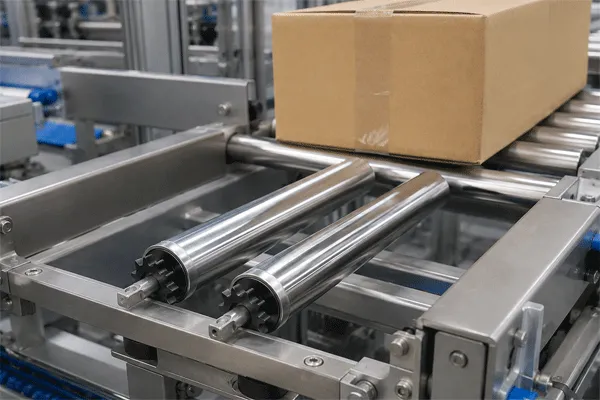
A driven roller is a conveyor roller that receives power from a motor, belt, chain, pulley, or internal motor to move goods along a conveyor. In modern conveyor systems, driven rollers may use external drives or MDR technology, where the motor is built inside the roller for compact, controlled, and energy-efficient material handling.
What Is a Driven Roller? Drive Roller, Conveyor Roller, MDR, and Roller Conveyor Guide
Article Outline
- What is a driven roller in a conveyor system?
- How does a drive roller work?
- What is the difference between a drive roller and a conveyor roller?
- What are the different types of conveyor rollers?
- What is an MDR motor driven roller?
- How does a motorized drive roller improve automation?
- Where are driven roller conveyors used?
- What materials are used to make conveyor rollers?
- How do steel quality and surface treatment affect roller systems?
- How should B2B buyers choose a conveyor roller supplier?
- FAQs about driven rollers and conveyor systems
What Is a Driven Roller in a Conveyor System?
A driven roller is a roller that receives power and helps move products. It is not just sitting there. It turns with force. That force may come from an electric motor, chain, belt, pulley, gear unit, or a built-in electric motor. In a conveyor system, this roller creates the driving force that moves cartons, pallets, panels, pipes, or other materials forward.
A normal conveyor roller may only support the load. A drive roller does more. It transfers power into motion. In a roller conveyor, some rollers are powered, while others may turn freely as the product moves over them. This mix helps reduce cost while still giving the conveyor enough movement and control.
In simple words: the driven roller is the roller that makes the conveyor move. Without it, many conveyor lines would need manual pushing or gravity flow. That may work for some short lines, but it is not enough for fast warehouse automation, distribution centers, or manufacturing plants.
How Does a Drive Roller Work?
A drive roller works by receiving torque from a motor or other drive unit. Torque is turning force. When the roller turns, its surface contacts the product, belt, or nearby rollers. This contact creates movement along the conveyor.
There are several common ways to power a drive roller:
| Drive Method |
How It Works |
Common Use |
| Belt-driven roller |
A belt turns the roller or roller group |
Light to medium conveyor lines |
| Chain-driven roller |
A chain transfers power between rollers |
Heavy-duty material handling |
| Lineshaft roller |
A rotating shaft powers multiple rollers |
Packaging and warehouse systems |
| Motorized roller |
Motor sits inside the roller tube |
MDR conveyor and modular automation |
| Drive pulley |
A pulley drives a conveyor belt |
Belt conveyor systems |
In a conveyor belt system, the drive pulley pulls the conveyor belt. In a roller system, the drive roller may directly turn the load or transfer motion to other rollers. Both methods use power transmission, but they work in different ways.
A drive roller can be driven by an external power source, such as a separate motor and gearbox. It can also be powered by an internal electric motor. This is where MDR becomes important.
What Is the Difference Between a Drive Roller and a Conveyor Roller?
A conveyor roller is a round tube or cylinder used in a conveyor to support and move items. Some conveyor rollers are powered. Some are not. The term is broad.
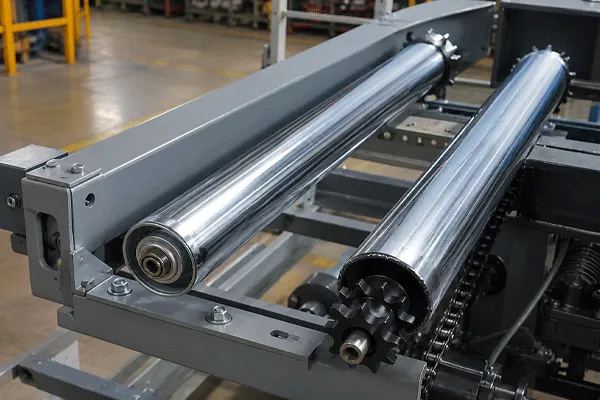
A drive roller is a powered roller. It is part of the power transmission system. It may move products directly or power other rollers through belts, O-rings, or chains. This makes it different from idler rollers, which usually rotate freely.
Here is the simple comparison:
| Item |
Powered? |
Main Job |
| Conveyor roller |
Sometimes |
Support or move goods |
| Drive roller |
Yes |
Provide motion |
| Idler roller |
No |
Support load or belt |
| Gravity rollers |
No |
Let goods move by slope or push force |
| Motorized roller |
Yes |
Move goods with built-in motor |
This difference matters because each roller type affects price, speed, noise, maintenance costs, and transmission efficiency.
What Are the Different Types of Conveyor Rollers?
There are many different types of conveyor rollers. Each one fits a different job. A warehouse may need quiet rollers for cartons. A steel processing plant may need heavy rollers for plates, pipes, or coils. A food plant may need stainless steel surfaces for cleaning.
Common types include:
- Gravity rollers for simple non-powered movement
- Drive rollers for powered movement
- Idler rollers for support
- Rubber-coated rollers for better grip and product protection
- Grooved rollers for belt or O-ring transmission
- Stainless steel rollers for wet or sanitary environments
- Heavy-duty steel rollers for pallets, pipes, and metal products
- Specialized rollers for high temperature, anti-static, or chemical conditions
The right roller depends on the load, speed, surface, working environment, and type of conveyor. A portable conveyor may need light rollers. A steel coil line needs stronger rollers. Big difference. Same word, very different job.
What Is an MDR Motor Driven Roller?
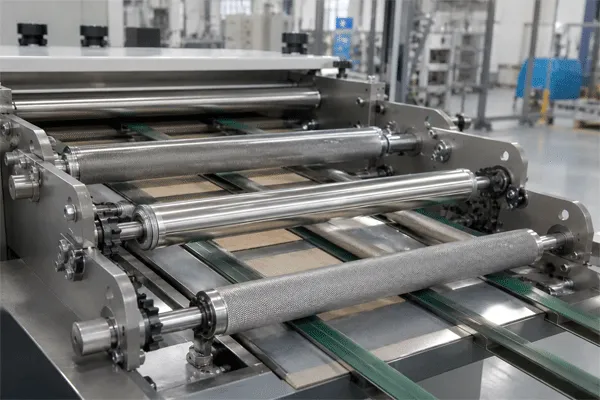
An MDR, or motor driven roller, is a roller with a motor inside the roller tube. Itoh Denki explains that a motorized conveyor roller, also called a motor driven roller or motorized drive roller, incorporates a 24V DC brushless motor within the tube.
This design removes the need for some external drive mechanisms. Instead of one large external motor powering many rollers, an MDR conveyor can use small powered zones. Each zone can run only when needed. That helps save energy, reduce noise, and support precise control.
A motorized drive roller is useful in modern conveyor systems because it is compact and modular. Interroll also describes its RollerDrive as a conveyor roller with an integrated drive, used for roller conveyors, conveyor zones, and belt conveyors.
In short, MDR technology puts the motor where the motion is needed: inside the roller.
What Is a Driven Roller? Drive Roller, Conveyor Roller, MDR, and Roller Conveyor Guide
How Does a Motorized Drive Roller Improve Automation?
A motorized roller helps automate product movement with better control. In traditional conveyor drives, one motor may run a long section. That can waste power when only one small package needs to move. MDR systems solve this by dividing the conveyor into zones.
Each zone can start, stop, and control speed. This is useful when products must not touch each other. It helps reduce product damage, improve sorting, and control flow into packing, scanning, weighing, or palletizing areas.
Benefits of a motorized conveyor system include:
| Benefit |
Why It Matters |
| Precise control |
Better product spacing and flow |
| Modular design |
Easier to expand or modify |
| Lower noise |
Better working environment |
| Energy-efficient operation |
Zones run only when needed |
| Less complex drive mechanisms |
Cleaner conveyor layout |
| Safer design |
Fewer exposed rotating parts |
MDR conveyor technology is popular in distribution centers, e-commerce warehouses, packaging lines, and light manufacturing. It helps automate movement without making the line too bulky.
Where Are Driven Roller Conveyors Used?
Driven roller conveyors are used in places where materials must move smoothly, safely, and repeatedly. They are common in warehouse operations, production lines, airports, parcel handling, carton transfer, and industrial assembly.
RS Components notes that roller conveyors are used in warehousing, package handling, and manufacturing to move materials, goods, and heavy loads safely.
Typical applications include:
- Warehouse carton movement
- Distribution centers
- Assembly lines
- Packaging lines
- Machinery factories
- Steel structure workshops
- Pipe and tube processing lines
- Building material production
- Pallet handling
- Conveyor belt transfer systems
In steel processing, conveyor rollers may move sheets, pipes, plates, sections, or finished parts between cutting, slitting, profiling, packaging, and inspection stations. The roller looks simple. But the job is serious.
What Materials Are Used to Make Conveyor Rollers?
Conveyor rollers can be made from carbon steel, galvanized steel, stainless steel, aluminum, plastic, or rubber-coated steel. The best material depends on load, corrosion risk, hygiene needs, surface friction, and working conditions.
As a professional steel manufacturer and integrated steel supplier in China, we often see conveyor roller buyers focus on three things: tube quality, surface finish, and dimensional accuracy. A roller may need a steel pipe body, shaft material, end caps, bearing seats, and surface treatment. If the material is poor, the roller may bend, rust, vibrate, or wear too quickly.
Material choices often look like this:
| Roller Material |
Best For |
Key Advantage |
| Carbon steel pipe |
General conveyor roller production |
Strength and cost balance |
| Galvanized steel |
Humid or outdoor environments |
Better corrosion resistance |
| Stainless steel |
Food, beverage, chemical, wet areas |
Clean surface and corrosion resistance |
| Aluminum |
Lightweight conveyor systems |
Lower weight |
| Rubber-coated steel |
Grip and noise reduction |
Helps protect products |
For B2B buyers, the steel material should match the real use case. A dry carton line is not the same as a wet processing room. A light parcel conveyor is not the same as a steel plate transfer line.
How Do Steel Quality and Surface Treatment Affect Roller Systems?
Steel quality affects roller life. A roller needs straightness, roundness, stable wall thickness, and good surface quality. If the pipe is not straight, the roller may wobble. If the surface is rough, it may scratch the product. If the coating is weak, rust can form.
Surface treatment also matters. Galvanizing, painting, polishing, chrome plating, rubber coating, and stainless steel finishing all change roller performance. For example, galvanized steel pipes can help in general corrosion conditions, while stainless steel pipes work better in clean or wet areas.
As a steel supplier, we support customized thickness, width, cutting, slitting, profiling, surface treatment, packaging, third-party inspection, and MTC documents. For conveyor roller manufacturers, this helps keep production stable. For engineering buyers, it improves traceability and lowers project risk.
A good roller starts before assembly. It starts with the metal.
How Is a Driven Roller Different from a Conveyor Belt Drive Pulley?
A drive roller and a drive pulley are related, but they are not always the same. A drive roller often moves goods directly in a roller conveyor. A drive pulley usually moves a conveyor belt. The pulley turns, the belt moves, and the belt carries the product.
In some systems, a roller can act like a pulley. In others, the drive roller is part of a powered roller conveyor. The main difference is what the powered part touches.
| Component |
Touches |
Main Function |
| Drive roller |
Product or nearby rollers |
Moves goods or transfers roller motion |
| Drive pulley |
Conveyor belt |
Pulls the belt |
| Idler pulley |
Belt |
Supports belt path |
| Idler rollers |
Product or belt |
Supports movement without power |
If your line uses a conveyor belt, you care about belt tension, pulley diameter, lagging, and tracking. If your line uses a roller conveyor, you care about roller spacing, roller diameter, load per roller, and drive method.
How Should B2B Buyers Choose a Conveyor Roller Supplier?
A good conveyor solution needs more than a cheap roller. It needs stable supply, correct material, accurate processing, and safe packaging. This is especially true for steel distributors, steel importers, machinery factories, construction contractors, and international project buyers.
When choosing steel materials for conveyor roller production, check:
- Material grade and standard
- Pipe diameter and wall thickness
- Straightness and roundness
- Surface finish
- Coating weight or corrosion protection
- Cutting length tolerance
- Packaging method
- MTC traceability
- Third-party inspection support
- Export experience and delivery stability
For buyers who produce conveyor roller parts, hollow sections, frames, brackets, shafts, and conveyor structures, integrated steel sourcing can save time. You may need steel pipes, galvanized coils, hot rolled sheets, cold rolled sheets, steel plates, stainless steel coils, and aluminum profiles in one project. A supplier who can process and export multiple steel categories can simplify purchasing.
That is where factory-direct steel supply becomes valuable. You get flexible OEM / ODM customization, faster quotation, safe seaworthy packaging, and long-term cooperation for material handling projects.
What Is a Driven Roller? Drive Roller, Conveyor Roller, MDR, and Roller Conveyor Guide
Simple Case Study: Steel Materials for a Roller Conveyor Line
A warehouse equipment manufacturer needed steel tubes for conveyor rollers, square tubes for frames, and galvanized sheets for guards. The first supplier could only provide pipe. The second supplier had sheet but no cutting service. The buyer had to manage too many vendors.
A better solution was integrated steel supply. The project used:
| Component |
Steel Material |
Processing Need |
| Conveyor roller tube |
Welded steel pipe |
Fixed-length cutting |
| Conveyor frame |
Square hollow section |
Custom length |
| Guard cover |
Galvanized sheet |
Cutting and bending |
| Support bracket |
Hot rolled plate |
Profiling |
| Wet area roller |
Stainless steel pipe |
Polished surface |
This reduced sourcing work and improved delivery coordination. The buyer still assembled the roller systems, but the material flow became easier and more predictable.
Small improvement? Maybe. But in real projects, fewer delays are a very big deal.
What Are the Key Advantages of Modern Conveyor Systems?
Modern conveyor systems are not only about moving goods from point A to point B. They support speed, safety, accuracy, and lower labor pressure. A good conveyor can help reduce manual handling, lower product damage, and improve production flow.
Modern conveyor systems may include sensors, MDR systems, zone control, smart panels, motorized roller sections, and modular frames. They can connect with scanners, sorters, robots, and packing equipment.
Main advantages include:
- Better material handling efficiency
- Easier automation
- Safer movement of products
- Less manual pushing or lifting
- Better control at different speeds
- Lower downtime with good design
- Cleaner layout with modular sections
For steel and metal buyers, this also creates demand for better raw materials. Stronger frames, smoother rollers, and better corrosion resistance all help the conveyor do its job.
FAQs About Driven Rollers and Conveyor Systems
What is a driven roller?
A driven roller is a powered roller used in a conveyor system. It receives power from a motor, belt, chain, pulley, or internal motor and creates motion to move products along the conveyor.
Is a drive roller the same as a motorized roller?
Not always. A drive roller can be powered by an external motor or belt. A motorized roller has the motor built inside the roller tube. All motorized rollers are driven rollers, but not all driven rollers are motorized.
What is an MDR conveyor?
An MDR conveyor uses motor driven roller technology. Each powered zone can use a motorized roller to move goods with better control. It is common in warehouse automation, packaging, and distribution centers.
What are gravity rollers?
Gravity rollers are non-powered rollers installed in a conveyor frame. Goods move by gravity, manual push, or product momentum. They are simple and cost-effective for light-duty movement.
What is the role of idler rollers?
Idler rollers support the product or conveyor belt but do not provide power. They help guide movement, reduce friction, and support load distribution.
What material is best for conveyor rollers?
It depends on the job. Carbon steel is common for general use. Galvanized steel helps with corrosion resistance. Stainless steel is better for wet, food, beverage, or chemical environments. Rubber-coated rollers help improve grip and reduce product damage.
Key Takeaways
- A driven roller is a powered roller that moves goods in a conveyor system.
- A drive roller can receive power from a motor, belt, chain, pulley, or internal electric motor.
- MDR means motor driven roller, often with a brushless motor within the roller tube.
- A roller conveyor may use both powered rollers and non-powered rollers.
- Gravity rollers are simple, while motorized rollers support better automation.
- Conveyor roller material affects strength, corrosion resistance, noise, grip, and service life.
- Steel pipe quality, straightness, coating, and processing accuracy are critical for roller production.
- For B2B conveyor projects, integrated steel sourcing can support stable quality, MTC traceability, third-party inspection, safe packaging, and long-term supply.
- The right conveyor roller choice reduces downtime, protects products, and improves material handling efficiency.












 16:33
16:33