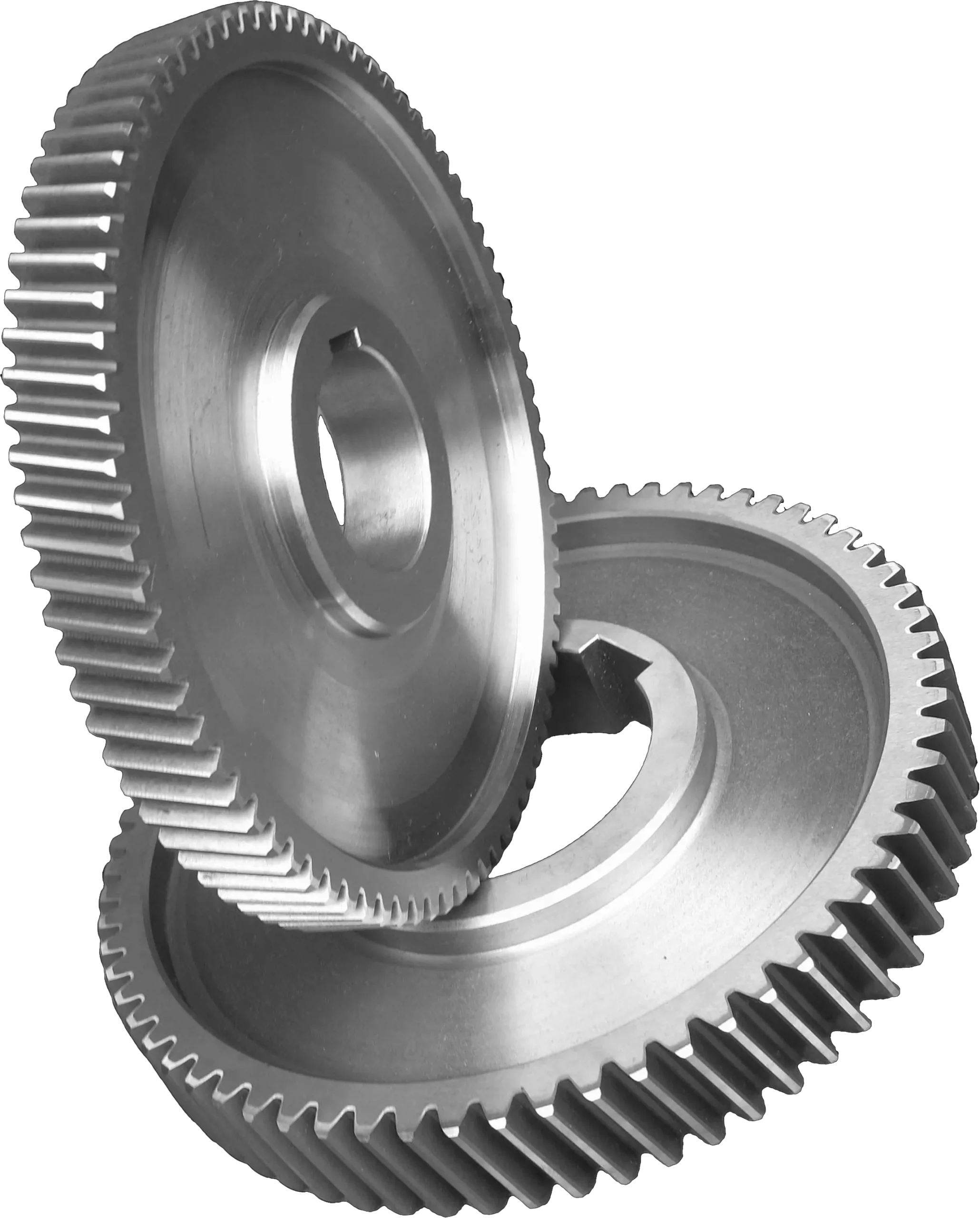
Choosing the wrong sprocket can cause noisy operation, poor chain engagement, fast wear, and costly downtime. The problem often starts with a small mismatch in pitch, bore, teeth, or hub style. Understanding the main sprocket types makes selection much safer and easier.
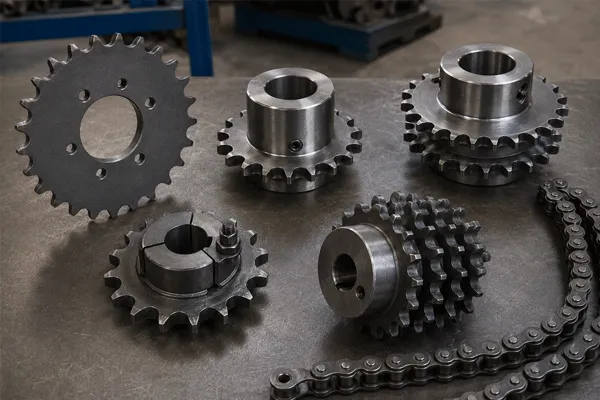
The main types of sprockets include Type A, Type B, Type C, and Type D hub styles, plus plain-bore, finished-bore, taper-bush, QD, idler, single-strand, double-strand, and triple-strand designs. The correct chain sprocket must match the chain pitch, roller size, shaft bore, tooth count, load, speed, mounting method, and operating environment.
What Are the Different Types of Sprockets? A Guide to Industrial Chain Sprockets
Article Outline
- What is a sprocket and how does a chain drive work?
- What are the four main sprocket hub types?
- What are plain-bore, pilot-bore, and finished-bore sprockets?
- What are taper bush, QD, and split-taper sprockets?
- What are single, double, and triple chain sprockets?
- What are drive sprockets and idler sprockets?
- Which materials are used for industrial sprockets?
- How do you choose the right sprocket for an industrial chain?
- What causes chain and sprocket wear?
- Where are industrial chains and sprockets used?
- How should heavy-duty buyers evaluate sprocket and trailer parts?
- FAQs and key takeaways
What Is a Sprocket and How Does a Chain Drive Work?
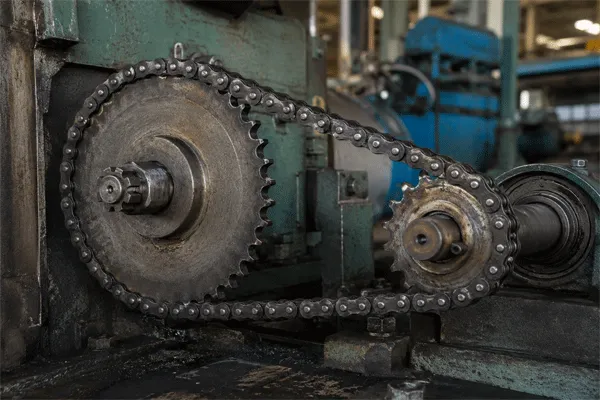
A sprocket is a toothed wheel designed to engage a chain. Unlike two gears, two sprockets do not normally contact each other directly. Instead, the sprocket teeth engage the rollers or links of the chain and transfer rotary motion from one shaft to another.
A basic chain drive includes:
- A drive sprocket
- A driven sprocket
- A roller chain or another industrial chain
- Shafts and bearings
- A tensioning or adjustment system
- Guards and lubrication when required
When the motor turns the drive sprocket, its sprocket teeth pull the chain. The chain then rotates the second sprocket. This simple system is widely used for power transmission because it can handle significant torque, operate over a useful range of shaft distances, and maintain a fixed speed relationship without the slip associated with some belt drives.
ASME B29.1 covers precision power transmission roller chains, attachments, and matching sprockets, including important dimensional relationships between the roller chain and sprocket tooth profile.
How does tooth count change speed?
If the drive sprocket has 15 teeth and the driven sprocket has 45 teeth:
Speed Ratio = Driven Sprocket Teeth ÷ Drive Sprocket Teeth

45 ÷ 15 = 3:1
The driven shaft will run at roughly one-third of the input speed, ignoring losses.
This is why tooth count matters. The sprocket and chain form a complete mechanical system.
What Are the Four Main Types of Sprockets by Hub Design?
One of the easiest ways to classify the different types of sprockets is by the hub.
U.S. Tsubaki describes four main configurations associated with ANSI sprocket designs: Type A, Type B, Type C, and an offset Type C or Type D arrangement.
| Type of sprocket |
Hub configuration |
Typical benefit |
| Type A |
No projecting hub |
Thin, compact installation |
| Type B |
Hub on one side |
Strong, common shaft mounting |
| Type C |
Hub on both sides |
Greater support for larger sprockets |
| Type D / Offset C |
Unequal hub extensions |
Specialized shaft-position requirements |
Type A sprockets
Type A sprockets are essentially flat plate sprockets. They do not have a projecting hub.
This design saves axial space and works well where a sprocket needs to sit close to another machine component. A Type A plate may also be combined with a separate weld-on hub.
Type B sprockets
Type B sprockets have a hub on one side. This is a very common type of sprocket because the hub gives enough material for a bore, keyway, and set screws while keeping overall width relatively compact.
Type B is widely used in machinery and general power transmission.
Type C sprockets
Type C sprockets have hub extensions on both sides.
The wider hub arrangement can provide added support, particularly for larger sprockets, heavier duty, or situations where a longer bore engagement is useful.
Type D sprockets
Type D sprockets, sometimes described as offset Type C sprockets, have hubs on both sides but with different hub lengths.
The asymmetric arrangement helps when equipment geometry prevents the sprocket plate from sitting at the center of the hub.
These 4 hub types are only the beginning. Bore design, chain rows, material, and mounting method create many more sprocket types.
What Are Pilot Bore, Plain Bore, and Finished Bore Sprockets?
The sprocket bore is the central hole that fits over the shaft. Bore configuration is one of the most important purchasing specifications.
Plain bore and pilot bore sprockets
A plain-bore sprocket has a basic center hole without final shaft-mounting features.
The term pilot bore sprockets is often used for sprockets supplied with a small unfinished bore so a machine shop can enlarge and finish it for the customer’s shaft.
This offers flexibility for OEM machinery and unusual shaft dimensions.
U.S. Tsubaki defines plain-bore sprockets as A, B, or C styles without special machining for keyways or set screws.
Finished bore sprockets
Finished bore sprockets are machined to a specific shaft diameter and normally include features such as:
- Standard bore
- Keyway
- Set screw
- Sometimes multiple set screws
They can reduce installation work because much of the shaft interface is already complete.
The correct bore must fit the shaft accurately. An oversized bore can produce movement and fretting. An undersized bore simply will not install correctly.
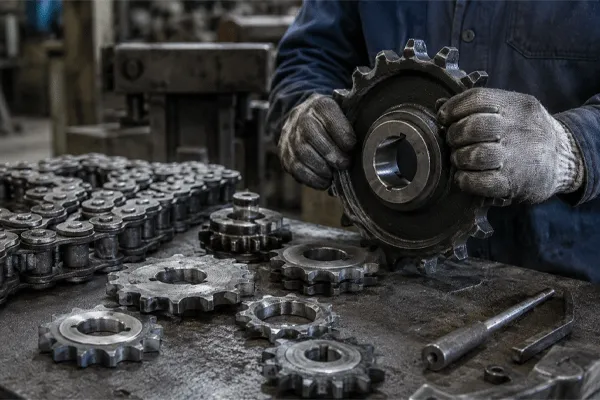
For replacement parts, do not order only by tooth count. Check the chain size, bore diameter, keyway, hub type, and shaft arrangement.
What Are the Different Types of Sprockets? A Guide to Industrial Chain Sprockets
What Are Taper Bush Sprockets, QD Sprockets, and Split-Taper Designs?
Heavy industrial equipment often needs a sprocket that can be installed and removed without permanently machining the sprocket to one exact shaft.
This is where bushing systems help.
Taper bush sprockets
Taper bush sprockets use a tapered bushing between the shaft and the sprocket hub. Tightening the screws draws the tapered parts together and creates a strong mechanical grip.
Advantages can include:
- Easy shaft-size adaptation
- Simple installation
- Easier removal
- Reduced need for custom machining
- Strong concentric mounting
TAPER-LOCK-style sprockets and hubs are one common industrial example. Tsubaki lists taper-lock, QD, and split-taper configurations among its roller chain sprockets.
QD sprockets
QD sprockets use quick-detachable bushings. The tapered bushing system allows the sprocket to clamp firmly to a shaft and also simplifies later removal.
This is valuable in industrial settings where maintenance time matters.
Split-taper sprockets
A split-taper bushing also grips the shaft through a tapered interface. Depending on the design, it can offer a compact connection with strong shaft holding capability.
These systems are useful when one industrial sprocket design must accommodate several shaft diameters through different bushings.
Practical point: Always confirm the exact bushing series, shaft diameter, keyway, maximum allowable bore, and torque requirement. Similar-looking taper systems are not automatically interchangeable.
What Are Single, Double, Triple, and Double-Single Chain Sprockets?
Another way to classify industrial sprockets is by the number and arrangement of chain strands.
Single-strand sprocket
A single-strand roller chain sprocket has one row of teeth for one chain.
This is the simplest arrangement and works for many machines with moderate power requirements.
Double-strand sprocket
A double or duplex sprocket has two aligned rows of teeth for a two-strand chain.
It increases the power and load capacity without requiring one extremely large single chain.
Triple sprockets
Triple sprockets, also called triplex sprockets, provide three rows of teeth for a three-strand roller chain.
They are used where higher torque or load capacity is required.
Tsubaki notes that multiple-strand sprockets are commonly used for higher torque and power requirements.
| Sprocket configuration |
Chain rows |
Typical use |
| Single |
1 |
General machinery |
| Double / Duplex |
2 |
Higher power |
| Triple / Triplex |
3 |
Heavy-duty power transmission |
| Multi-strand |
2+ |
High torque |
| Double-single |
Special paired arrangement |
Two independent chain paths |
What are double single sprockets?
Double single sprockets should not be confused with ordinary double-strand sprockets.
A double-strand sprocket engages one duplex chain. A double-single design is intended for separate single-strand chain paths in specialized arrangements.
Manufacturers offer double-single designs with taper-bushing configurations for industrial applications.
Selecting the correct one matters because the spacing between tooth rows must match the chain system.
What Are Drive Sprockets and Idler Sprockets?
A drive sprocket receives power from a motor, gearbox, shaft, or other rotating source. It pulls the chain and transfers torque through the chain system.
An idler sprocket serves a different role.
Idler sprockets can:
- Guide the chain
- Change the chain path
- Increase chain wrap around a drive sprocket
- Help maintain tension
- Support long chain spans
The idler does not normally supply the main driving power.
Industrial catalogs list idler sprockets separately from standard drive products because bearing arrangement, mounting, and wear conditions may differ.
Other specialized sprockets include:
- Double-pitch sprockets
- Conveyor-chain sprockets
- Segmental sprockets
- Split sprockets
- Weld-on sprockets
- Engineering-class sprockets
- Double-single sprockets
- Custom-tooth sprockets
Sprockets are commonly used with many different types of chains, so you must confirm that the chain and sprocket standards match.
A motorcycle rear sprocket, for example, follows the same basic principle of engaging a drive chain, but its design requirements differ from an industrial conveyor or mining sprocket.
Which Materials Are Used for Industrial Chain Sprockets?
Material choice has a direct effect on strength, corrosion resistance, tooth wear, cost, and expected service life.
Carbon steel sprockets
Steel sprockets are widely used because carbon steel provides a useful balance of:
- Strength
- Machinability
- Wear resistance
- Cost
- Availability
For demanding use, the teeth may receive heat treatment or induction hardening.
Stainless steel sprockets
Stainless steel sprockets are useful where corrosion resistance matters, such as:
- Food machinery
- Chemical environments
- Wet processing
- Outdoor exposure
- Wash-down equipment
Stainless material can cost more, so it should be chosen because the environment requires it rather than simply because it sounds more premium.
Cast iron and engineered alloys
Larger or specialized sprockets may use cast iron, alloy steel, or other engineered materials.
Tsubaki notes that industrial sprockets may use carbon steel as well as special alloys or stainless steel for corrosion resistance and specific industrial needs.
When should the teeth be hardened?
Hardening the sprocket teeth can improve wear resistance under conditions involving:
- High load
- High cycle count
- Abrasive contamination
- Long operating hours
- Higher chain speeds
But hardness alone does not solve bad alignment or poor lubrication. A hardened sprocket used with an unsuitable chain can still fail early.
How Do You Choose the Right Sprocket for an Industrial Chain?
Choosing the right sprocket requires matching mechanical dimensions and operating conditions.
Start with the chain.
1. Identify the chain size
The sprocket tooth profile must match:
- Chain pitch
- Roller diameter
- Inner width
- Number of strands
- Applicable chain standard
ASME B29.1 defines dimensional relationships for precision roller chains and sprockets, including sprocket tooth profiles.
Do not assume that two chains with similar pitch dimensions are fully interchangeable.
2. Select the number of teeth
Tooth count affects:
- Speed ratio
- Torque ratio
- Chain articulation
- Sprocket diameter
- Smoothness
- Available space
Very small sprockets force the chain to articulate through a sharper angle each time it enters and leaves the teeth. That can increase wear.
3. Check the shaft and sprocket bore
Record:
- Shaft diameter
- Keyway size
- Set-screw requirements
- Maximum permissible bore
- Hub length
- Available axial space
4. Choose the hub type
You may need:
- Type A
- Type B
- Type C
- Type D
- Finished bore
- Taper bush
- QD
- Split-taper
The right hub must fit both the shaft and surrounding equipment.
5. Calculate operating load
Engineers should review:
- Power
- Torque
- RPM
- Shock load
- Start-stop frequency
- Hours per day
- Environmental conditions
6. Check the environment
Different applications may involve:
- Dust
- Mud
- Water
- Salt
- Chemicals
- Extreme temperature
- Food contamination concerns
- High abrasion
This determines whether standard steel, hardened steel, coated material, or stainless steel is appropriate.
Sprocket selection checklist
| Item |
What to confirm |
| Chain |
Standard, pitch, roller size, strands |
| Teeth |
Tooth count |
| Bore |
Shaft diameter |
| Keyway |
Width and depth |
| Hub |
A, B, C, D or bushing type |
| Speed |
Input and output RPM |
| Load |
Torque and shock |
| Material |
Carbon steel, stainless, alloy |
| Environment |
Dust, moisture, chemicals, heat |
| Maintenance |
Lubrication and access |
| Alignment |
Shaft and sprocket position |
Choosing the right sprocket makes the entire chain system more reliable.
What Are the Different Types of Sprockets? A Guide to Industrial Chain Sprockets
What Causes Chain Wear and Sprocket Failure?
A new sprocket can wear quickly if installed with a badly worn chain.
As roller chain wears at its pins and bushings, its effective pitch becomes longer. The worn chain then stops seating correctly between the teeth.
The load begins concentrating on fewer areas, accelerating both chain wear and sprocket wear.
Common causes include:
- Poor lubrication
- Incorrect chain tension
- Misaligned shafts
- Worn bearings
- Abrasive dirt
- Excessive loading
- Shock loads
- Wrong chain size
- Mismatched sprocket and chain
- Worn or hooked teeth
What does a worn sprocket look like?
Watch for:
- Hooked tooth profiles
- Thin tooth tips
- Uneven tooth wear
- Polished wear on only one side
- Noise
- Vibration
- Chain jumping
- Irregular chain movement
Wear-monitoring sprocket technologies are used in mining, cement, conveyor, oil-and-gas, and other severe industrial applications, showing how important predictable tooth wear can be for maintenance planning.
When severe wear is present, replacing only the sprocket or only the chain may shorten the life of the new component.
For critical roller chain and sprocket systems, inspect both together.
Where Are Industrial Chains and Sprockets Used?
Industrial chains and sprockets appear wherever equipment needs positive mechanical motion or power transmission.
Typical industrial applications include:
- Conveyors
- Mining equipment
- Cement plants
- Material handling systems
- Packaging machinery
- Agricultural machinery
- Forestry equipment
- Oil and gas machinery
- Marine equipment
- Food processing machinery
- Steel production
- Civil engineering equipment
- Machine tools
U.S. Tsubaki identifies mining, cement, material handling, conveyor equipment, civil engineering, food processing, oil and gas, forestry, and many other markets as common applications for sprockets.
Different industries need different sprocket systems.
A conveyor may favor a large engineering-class sprocket. A packaging machine may use a smaller precision chain sprocket. Mining equipment may require hardened teeth and strong hubs. Food machinery may require stainless steel.
There is no single “best” industrial sprocket.
The correct design follows the application.
How Are Sprockets Relevant to Heavy-Duty Trailer and Transport Equipment?
Our primary expertise is heavy-duty semi trailer manufacturing, rather than manufacturing general industrial chain sprockets as a standalone product category.
However, knowledge of sprockets and chains remains useful in heavy transport because specialized trailers, attached equipment, loading systems, conveyor bodies, lifting accessories, workshop machinery, and project-support equipment may use chain-driven mechanisms.
As a professional semi trailer manufacturer in China, we design and export:
- Flatbed semi trailers
- Skeleton container trailers
- Side curtain trailers
- Sidewall and fence trailers
- Lowbed trailers
- Lowboy trailers
- Removable gooseneck trailers
- Fuel tanker trailers
- Aluminum tanker trailers
- Bulk cement tanker trailers
- Dump semi trailers
- Car carrier trailers
- Trucks and trailer parts
Our customers include fleet owners, logistics companies, port operators, construction contractors, mining companies, tanker operators, distributors, dealers, and international project buyers.
For these buyers, a small component can affect the reliability of a much larger system.
That is why trailer parts and mechanical interfaces should be evaluated for:
- Load capacity
- Material strength
- Fit and tolerance
- Welding quality
- Corrosion protection
- Road conditions
- Maintenance access
- Spare-parts availability
- Local transport requirements
If a chain sprocket forms part of an auxiliary mechanism on a customized trailer or project vehicle, our engineering team evaluates it as part of the overall system instead of treating it as an isolated component.
What Should Buyers Check When Sourcing Industrial Sprockets and Trailer Parts?
Price matters, but specification accuracy matters more.
Before approving a chain sprocket, ask the supplier for a clear drawing or specification.
A useful purchasing sheet may include:
| Specification |
Buyer should provide |
| Chain standard |
ANSI, ISO, BS, or other |
| Chain number |
Exact series |
| Pitch |
Exact dimension |
| Teeth |
Required count |
| Strands |
Single, double, triple |
| Bore |
Finished or unfinished dimension |
| Keyway |
Required size |
| Hub types |
A, B, C, D, QD, taper bush, etc. |
| Material |
Carbon steel, stainless, alloy |
| Heat treatment |
If required |
| Quantity |
Trial or production order |
| Application |
Conveyor, drive, machine, trailer accessory |
| Environment |
Wet, dusty, corrosive, high-temperature |
Never rely only on a photo.
Two sprockets can look almost identical while having different pitch, bore, roller compatibility, or hub dimensions.
For an OEM project, drawings and confirmed tolerances are far safer.
The same rule applies when we manufacture semi trailers. Before production, we review cargo type, payload, axle configuration, suspension, road conditions, loading method, local regulations, and customer operating requirements.
That engineering-first approach helps reduce problems after delivery.
An illustrative heavy-duty sourcing example
Consider a mining contractor ordering support trailers and replacement mechanical components.
The buyer first requests “heavy-duty sprockets.” That description is too broad.
After technical review, the real requirements are identified:
- Large industrial chain
- Low-speed, high-torque operation
- Abrasive dust
- Frequent shock loading
- Limited maintenance access
- Finished shaft dimensions
- Hardened steel teeth
Now the sourcing decision becomes much clearer.
The same principle applies to semi trailer configuration: the correct product starts with the real operating condition, not only the product name.
Frequently Asked Questions
What are the four main types of sprockets?
The four common hub configurations are Type A, Type B, Type C, and Type D. Type A has no projecting hub, Type B has a hub on one side, Type C has hubs on both sides, and Type D uses an offset or unequal two-sided hub configuration.
What is the most common type of sprocket?
Type B is a common industrial design because its one-sided hub provides room for the shaft bore, keyway, and locking method while keeping the sprocket reasonably compact.
What is the difference between Type A and Type B sprockets?
Type A has no projecting hub. Type B has a hub on one side. The Type B hub provides more material for machining a bore and attaching the sprocket to the shaft.
What are bore sprockets?
Bore sprockets are classified according to how the center hole fits the shaft. Common options include plain or pilot bore, finished bore, taper-bushed, QD, and split-taper sprockets.
How do I match a sprocket to a roller chain?
Match the sprocket to the chain standard, pitch, roller diameter, inner width, and number of strands. You must also confirm the tooth count, bore, hub, speed, torque, and operating environment.
Should I replace the chain and sprocket together?
If both are significantly worn, replacing them together is often the safer approach. A worn chain can quickly damage a new sprocket, while badly worn sprocket teeth can accelerate wear on a new chain.
Are stainless steel sprockets better than steel sprockets?
Not in every application. Stainless steel offers better corrosion resistance, while carbon steel is often more economical for dry general-purpose industrial use. Choose according to load, wear, corrosion, hygiene, and cost.
Are sprockets gears?
They are both toothed rotating components, but they work differently. Gears normally mesh directly with other gears. A sprocket engages a chain rather than directly engaging another sprocket.
Key Things to Remember
- A sprocket transfers power or motion by engaging a chain.
- The four main hub configurations are Type A, Type B, Type C, and Type D.
- Type A has no hub, Type B has one hub, and Type C has hubs on both sides.
- Plain or pilot bore sprockets require additional machining before final installation.
- Finished bore sprockets are supplied with a defined shaft bore and usually a keyway and set screws.
- Taper bush sprockets, QD sprockets, and split-taper designs simplify shaft mounting and removal.
- Single, double, triple, and other multiple-strand sprockets handle different power levels.
- Idler sprockets guide or tension a chain rather than provide the primary drive.
- Carbon steel is common; stainless steel sprockets suit more corrosive environments.
- Chain pitch, roller dimensions, tooth count, bore, hub, speed, and torque must all match.
- Incorrect alignment, poor lubrication, contamination, and worn chain can rapidly damage sprocket teeth.
- For critical systems, inspect the chain and sprocket together.
- Buyers should provide drawings and exact dimensions instead of ordering only from photos.
- In heavy transport projects, mechanical parts should be evaluated as part of the complete operating system.
- For OEM/ODM semi trailers, trailer parts, container transport equipment, lowbed solutions, tankers, and other heavy-duty fleet projects, a specification-based engineering approach helps deliver better long-term reliability.












 16:02
16:02