KTD Engineering Team | Application Engineering & DFM Team | Published: August 21, 2026
Poly-V pulleys carry 40° V-grooves at a rib pitch fixed by profile: PH 1.6 mm, PJ 2.34 mm, PK 3.56 mm, PL 4.70 mm, PM 9.40 mm. ISO 9982 and DIN 7867 standardize that geometry, so sections never interchange. Match profile, rib count and effective diameter, and belts fit across suppliers.
The reference tables that engineers actually need for this decision sit mostly in European catalogue PDFs and behind standards paywalls. What follows is the pulley-side geometry in one place, with the parts of ISO 9982 that change how you read a supplier’s dimension sheet.
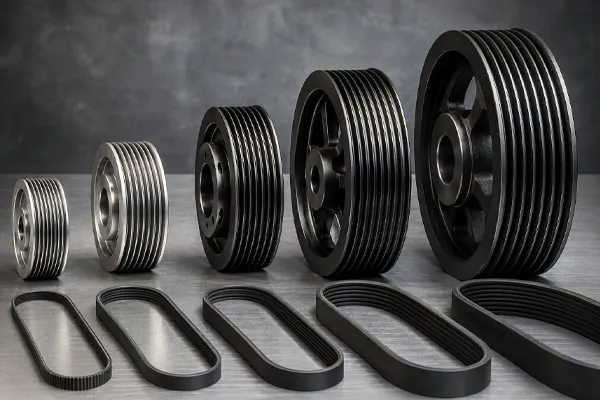
Pulegge Poly-V: profili da PH a PM, materiali e dimensionamento
Profile Reference: PH Through PM
| Profile |
Rib pitch |
Angolo di scanalatura |
Mansioni tipiche |
Published max belt speed |
| PH |
1.60 mm |
40° |
Appliance and light equipment drives; uncommon in industrial plant |
— |
| PJ |
2.34 mm |
40° |
Fractional-horsepower equipment, compact machinery |
≈ 60 m/s |
| PK |
3.56 mm |
40° |
Automotive accessory drives; industrial crossover use |
≈ 50 m/s |
| PL |
4.70 mm |
40° |
Mid-range industrial drives |
≈ 40 m/s |
| PM |
9.40 mm |
40° |
High-horsepower machinery, heavy industrial drives |
≈ 30 m/s |
Rib pitch, groove dimensions and minimum diameters all follow DIN 7867 and ISO 9982, which is what allows belts and sheaves to interchange between brands. The speed figures are published section maxima and drop as the section grows; treat them as a screening limit, not a design target.
PH deserves a note. It exists in the standard and it is real, but the smaller PH section is rarely encountered in industrial plants. If a drive specification calls for PH, confirm the belt is actually available in the length you need before committing the pulley geometry.
PK sits in two standards at once. ISO 9982 covers PH through PM for industrial applications, while ISO 9981:2020 addresses PK specifically for automotive accessory drives — and states that PK belt profile dimensions and tolerances are identical in both International Standards. A PK pulley cut to either document is dimensionally the same part. The difference lives in the surrounding application requirements, not the groove.
What ISO 9982 Specifies, and What It Leaves to You
The current edition is ISO 9982:2021, third edition, published September 2021 by the International Organization for Standardization under technical committee ISO/TC 41/SC 1 Its scope is the principal dimensional characteristics of V-ribbed pulley groove profiles together with the corresponding endless belts, for PH, PJ, PK, PL and PM profiles in general industrial applications, excluding elastic belts.
Three things inside it change how a dimension sheet should be read.
Effective diameter is not pitch diameter, and neither is outside diameter. The true pitch diameter of a V-ribbed pulley is slightly larger than the effective diameter. Effective diameter is the working figure for speed ratio. Outside diameter is what you measure with a caliper. Suppliers publish different ones, and a ratio calculated from an outside diameter is wrong by an amount that grows as the pulley gets smaller.
Groove surface finish is specified, not left to machining preference. The 1998 edition called for pulley groove surface roughness below Ra 3.2 μm Rough grooves accelerate rib wear because a V-ribbed belt transmits power by friction across the flanks, and the flank is where the belt lives.
Minimum effective diameter is tabulated per profile. ISO 9982 gives minimum recommended effective diameters for V-ribbed pulleys in a dedicated table. The specific values belong to the standard document, and any supplier quoting below a section’s minimum should be asked why. Going under it forces rib compression the belt was not designed for, and the failure shows up as rib cracking rather than as slip.
What the standard does not give you is power rating. Rating comes from the belt manufacturer, against your rib count, effective diameter, wrap angle and service factor. A pulley conforming to ISO 9982 tells you the belt will fit. It does not tell you the drive will carry the load.
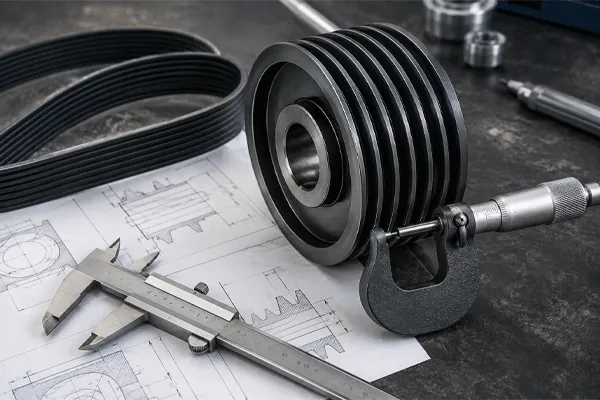
Pulegge Poly-V: profili da PH a PM, materiali e dimensionamento
Reading and Writing a Poly-V Designation
A Poly-V pulley is fully described by four items:
- Profile letter— PH, PJ, PK, PL or PM.
- Number of ribs— the count of grooves, which must match the belt’s rib count exactly.
- Effective diameterin millimetres.
- Mounting— taper bush size, or finished bore with tolerance class and keyway.
A drive quoted as “PK, 6 ribs, 112 mm effective, taper bush 1610” is buildable. “PK 112” is not, because it omits both the rib count and how the pulley attaches to a shaft.
Rib count is where field substitutions go wrong most often. A 6-rib belt on an 8-rib pulley runs, and it runs badly: the belt tracks toward one end, the loaded ribs carry proportionally more tension than the design assumed, and the two unused grooves collect debris. Maintenance teams accept this because the machine keeps turning. Belt life falls by a margin nobody logs.
Material Selection
| Materiale |
Where it belongs |
Trade-off |
| HT150 gray cast iron |
General industrial drives, standard taper-bush pulleys |
Mass; brittle under impact loading |
| HT200 gray cast iron |
Higher-load industrial drives, better wear resistance |
Higher cost than HT150; same brittleness class |
| 6061-T6 aluminum |
High-speed and high-acceleration drives where inertia dominates |
Softer groove flanks; wears faster in abrasive air |
| Acciaio al carbonio |
High torque, welded or fabricated assemblies |
Corrosion protection required; heaviest option |
| Stainless steel (custom) |
Washdown, chemical exposure, food and pharma equipment |
Machining cost; quoted as custom |
| Engineering plastics (custom) |
Corrosion resistance, low noise, light duty |
Dimensional movement with temperature and humidity |
KTD’s stated operating range for its Poly-V line is −30 °C to +90 °C. That figure is a system limit rather than a metal limit, because it is the belt compound that governs the ceiling in most drives. Cast iron does not care about 90 °C. The rubber running in its grooves does.
Cast iron remains the default for industrial Poly-V because the profile is usually applied where a V-belt drive is being replaced for power density, and those drives are not inertia-limited. Aluminum earns its place on the driven side of high-acceleration machinery, where the rotating mass of a cast-iron pulley costs more in acceleration torque than it returns in wear life.
Taper-Lock Versus Solid Bore
| |
Boccola conica |
Solid / finished bore |
| Shaft diameter change |
Swap the bush, keep the pulley |
New pulley required |
| Stock strategy |
One pulley covers a bore range |
One SKU per bore size |
| Concentricity |
Depends on bush seating and correct torque |
Machined directly, one interface fewer |
| Axial space |
Bush adds length beyond the hub |
Compact |
| Removal |
Designed for repeated removal |
Puller, and often heat |
| Small diameters |
Constrained; bush needs hub wall |
Available down to small pitch diameters |
| Torque transfer |
Friction across the tapered interface, plus key |
Keyway, set screw, or interference fit |
Taper bushes dominate industrial Poly-V for a maintenance reason rather than an engineering one: the same pulley fits several shaft diameters, and a plant carrying twelve machines carries fewer spares. What it costs is axial length and one more interface that can be assembled wrong. A bush torqued below specification slips under load and polishes the taper, which then never grips properly even after re-torquing.
Solid bore wins where axial space is tight, where diameters are small enough that a bush leaves no hub wall, and where concentricity matters to the drive. KTD supplies both configurations, along with heavy-duty and steel variants for higher-torque service.
Compared with the catalogue-style listings that dominate this search, which present bore options as a selection field, the choice is a maintenance-strategy decision made once per machine platform rather than once per pulley.
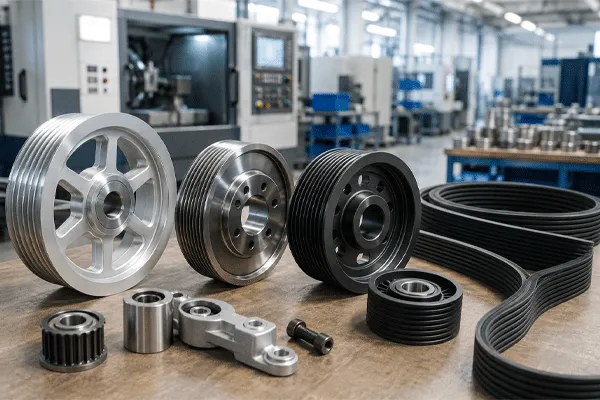
Pulegge Poly-V: profili da PH a PM, materiali e dimensionamento
Trattamento Superficiale
Four options apply to the Poly-V line:
- Anti-rust oil— transit and storage protection on cast iron and steel. Not a service finish, and it must be removed before the belt runs, since oil on a friction drive is a slip source.
- Black oxide— mild corrosion resistance on steel with minimal dimensional change. Suitable where the groove tolerance is tight.
- Phosphating— better corrosion resistance than black oxide on cast iron and steel, and a common choice for pulleys exposed to humid plant air.
- Hard anodizing— aluminum only. This is the answer to the soft-flank problem in the material table above: it hardens the groove surface where an aluminum pulley would otherwise wear.
A coating that builds thickness changes groove geometry, which on a Poly-V pulley means changing the belt’s ride position. If a treatment is specified on a pulley with a tight effective-diameter tolerance, the drawing needs to state whether the tolerance applies before or after treatment.
Sizing Sequence
- Take the profile from the belt, or from the drive it replaces.Profile is not a free choice once a belt is in the system.
- Set the speed ratio from effective diameters, not outside diameters. Confirm which figure the supplier’s table publishes.
- Check both pulleys against the minimum effective diameterfor that profile in ISO 9982. The small pulley is the one that fails this check.
- Fix the rib countto match the belt exactly, then confirm face width accommodates it with the flank clearance the profile requires.
- Choose mountingusing the taper-bush versus solid-bore table above, then confirm the bush size exists for your shaft diameter and the pulley’s hub.
- Pick material against inertia and environment, and add surface treatment last, since treatment is constrained by material.
- Verify against the belt manufacturer’s power ratingwith your wrap angle and service factor. This is the step ISO 9982 does not cover.
Steps 2 and 3 in that order matter. Teams that size for ratio first and check minimum diameter afterward frequently find the small pulley is under the limit, at which point the ratio has to be rebuilt around a larger centre distance.
Three Specification Errors Worth Naming
Substituting sections because the rib count matches. A 6-rib PJ and a 6-rib PK look similar on a parts list and share nothing dimensionally. Rib pitch differs by more than 50%, and the belt will sit on rib tips rather than in the grooves.
Reading DIN 7867 and ISO 9982 as different geometry. They are aligned for these profiles. A pulley described against one is compatible with a belt described against the other, at the same profile and rib count.
Assuming antistatic behaviour comes with the standard. ISO 9982 covers dimensions. Electrical conductivity of antistatic V-ribbed belts is a separate document, ISO 1813, and a drive in an area with an explosion-protection requirement needs the belt specified against it. The pulley standard says nothing about it.
Domande frequenti
Q: Can I run a PK belt on a pulley cut to ISO 9981 instead of ISO 9982?
A: Yes. ISO 9981:2020 states that PK profile dimensions and tolerances are the same in both standards, with ISO 9981 scoped to automotive accessory drives and ISO 9982 to general industrial use.
Q: What is the difference between effective diameter and outside diameter on a Poly-V pulley?
A: Effective diameter is the working diameter at the belt’s ride position and the figure to use for speed ratio. Outside diameter is the measurable outer dimension, larger by the depth the belt sits into the grooves. True pitch diameter is a third figure, slightly larger than the effective diameter.
Q: Are Poly-V, Micro-V, multi-rib and serpentine belts the same thing?
A: They describe the same V-ribbed product under different supplier and application names. Match section, rib count and effective length and the belt will fit regardless of which name appears on the packaging.
Q: What is the operating temperature range?
A: KTD states −30 °C to +90 °C for its Poly-V pulley line. In practice the belt compound sets the upper limit in most drives, so confirm the belt’s rating alongside the pulley’s.
Q: Can a Poly-V pulley be made in stainless steel?
A: Yes, as a custom item. Stainless and engineering plastics sit outside the standard cast iron, aluminum and carbon steel range and are quoted per project.
D: Come vengono stabiliti i prezzi?
R: I prezzi variano a seconda del progetto e vengono comunicati nel preventivo in base al materiale, alle dimensioni, alla complessità della lavorazione, alla quantità, al trattamento superficiale e ad altri requisiti tecnici.
Q: Do I need to specify groove surface finish on a drawing?
A: If the drive is high-speed or the application is wear-critical, state it. ISO 9982’s 1998 edition set the groove roughness requirement below Ra 3.2 μm, and calling it out makes the requirement inspectable rather than assumed.












 10:54
10:54