KTD Manufacturing & Quality Team | Precision Manufacturing and Quality Control Team | Published: September 2026
Most gear supplier pages describe what they make. This checklist covers what to ask before you sign a PO: how a claimed quality grade is documented, which heat treatment actually applies to your material, what inspection data you get back, and how drawing formats and MOQ shape your first order.
How to Choose a Custom Gear Manufacturer: OEM Checklists
“High-precision gears” is not a specification
A supplier telling you their gears are “high-precision” or “premium quality” hasn’t told you anything you can verify. Precision in gearing is expressed as a quality grade tied to a specific standard — AGMA or ISO 1328 being the two most common — and those two systems don’t even move in the same direction. AGMA grade numbers get better as they go up; a higher number means tighter tolerance. ISO 1328 grade numbers work the other way — a lower number is the tighter, more precise grade. A supplier who quotes “grade 10” without saying which standard they mean could be describing two very different tolerance bands. Before any other evaluation step, ask which standard the quoted grade is measured against, and ask for the inspection report that backs it up rather than the number alone.
Step 1: Ask for quality grade evidence, not adjectives
- Request the specific standard (AGMA or ISO 1328) behind any quality-grade claim, not just the grade number.
- Ask whether the grade applies to the finished, heat-treated part or only to the pre-treatment cut — heat treatment distortion can shift a part out of its as-cut grade if it isn’t accounted for in the process.
- Ask for a sample inspection report from a comparable part, not a generic capability statement.
- Confirm whether tighter grades (finish grinding after heat treatment, for example) are offered as standard or as a separate line item.
Organizations such as the American Gear Manufacturers Association, now operating under the Motion + Power Manufacturers Alliance, maintain the AGMA gearing standards and participate in the corresponding ISO gearing work — so a supplier’s documentation should trace back to one of those reference frameworks, not an internal or undefined scale.
Step 2: Verify what heat treatment is actually doing to your part
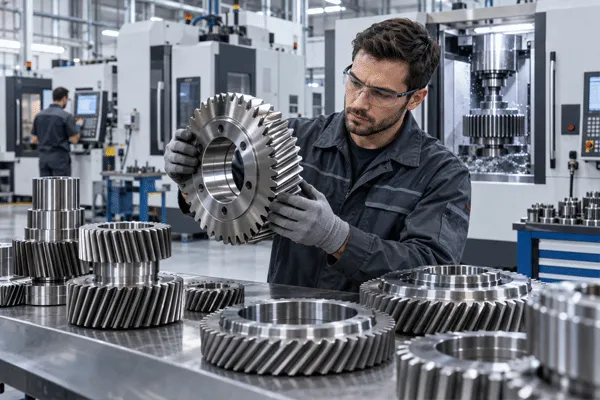
Heat treatment is where a lot of gear quality problems originate, and it’s also where suppliers are vaguest. Three treatments come up most often in custom gear quoting: induction hardening, carburizing, and nitriding. Each changes case depth, core hardness and distortion risk differently, and the right one depends on your load type and base material — a 20CrMnTi alloy steel gear built for repeated shock loading is not treated the same way as an SUS304 stainless gear specified for a washdown or corrosive environment.
Ask the supplier to name the specific treatment for your material and application, not just confirm that “heat treatment is available.” Then ask what post-treatment step corrects for distortion — usually precision grinding or honing — because a hardening process without a stated correction step is a warning sign, not a feature.
How to Choose a Custom Gear Manufacturer: OEM Checklists
Step 3: Confirm the inspection method, and what data you actually receive
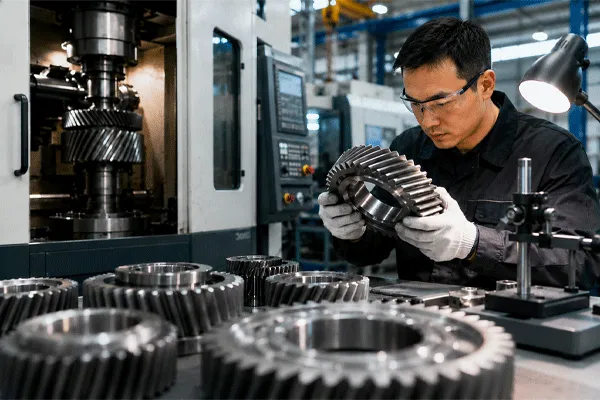
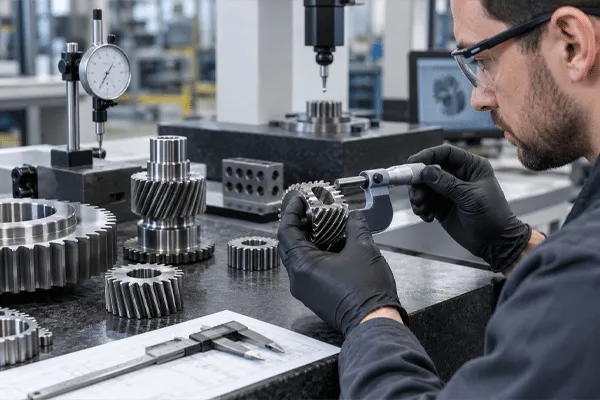
“We inspect every part” means very little without a method attached. Coordinate measuring machine (CMM) inspection is the standard for verifying gear tooth geometry and bore dimensions against drawing tolerances, and it’s also what produces the traceable report you’ll want on file for an OEM program. Ask specifically:
- Is CMM inspection standard, or only available on request or at extra cost?
- Do you receive a per-batch or per-lot inspection report, or only a pass/fail confirmation?
- Is material composition verified separately from dimensional inspection, particularly for alloy or stainless substitutions?
A quality process that runs DFM review, then a prototype stage, then First Article Inspection before mass production gives you two checkpoints to catch a problem before it’s baked into a 5,000-piece run — ask whether First Article Inspection is a distinct, documented stage or gets folded into general production.
Step 4: Understand MOQ and how volume actually scales
Custom gear programs rarely start at full production volume, and MOQ terms vary widely across suppliers — some quote per-part-number minimums in the low hundreds; others, including KTD, will run custom orders from as few as 20 pieces for prototyping or low-volume OEM needs, scaling up to 10,000-plus pieces per run once a design is validated. The gap matters if you’re validating a new assembly before committing to a production forecast. Ask whether pricing per piece changes meaningfully between prototype-volume and production-volume orders, and whether tooling or setup costs are amortized differently at each tier.
Step 5: Drawing formats and how DFM feedback actually happens
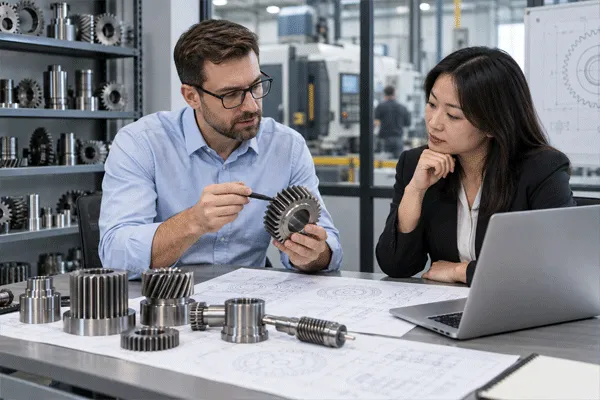
A supplier that only accepts a PDF drawing is going to lose tolerance and datum information a 3D model carries. Confirm upfront which formats they accept — STEP, IGES, DWG, DXF and SLDPRT cover most CAD systems, and native 3D formats let an engineer actually review geometry rather than re-derive it from a 2D print. Then ask a more direct question: does DFM feedback come from an engineer who reviews the drawing against manufacturability and material selection, or is it a generic checklist response? The difference shows up in whether the supplier flags things like a bore-to-tooth-root clearance issue before cutting, not after a failed first article.
How to Choose a Custom Gear Manufacturer: OEM Checklists
Gear program specification range at a glance
| Parameter |
Range |
| Gear types |
Spur, Helical, Internal, Straight Bevel, Spiral Bevel, Worm, Gear Rack |
| Materials |
S45C/1045 carbon steel, SCM415, 20CrMnTi, SUS304 stainless steel, cast iron, MC Nylon, POM |
| Heat treatments |
Induction hardening, carburizing, nitriding |
| Finishing options |
Precision grinding, honing, black oxide, zinc plating |
| Bore tolerance capability |
Up to H6 |
| Standards referenced |
ISO, AGMA and DIN gearing standards; AGMA 10-quality grinding capability offered as a custom service |
| MOQ / scalability |
From 20 pieces up to 10,000+ pieces per production run |
| Accepted drawing formats |
STEP, IGES, DWG, DXF, SLDPRT, PDF |
No individual gear product certificate number or issuing body is published here — treat “AGMA-certified” claims from any supplier as something to verify against actual documentation rather than take at face value.
Sourcing agent versus in-house manufacturer: what actually differs
Compared to a trading-company sourcing model, where drawings are passed to a third-party factory and quality feedback loops through an intermediary, an in-house manufacturer evaluation should focus on where control actually sits:
| Evaluation point |
Trading / sourcing agent |
In-house precision manufacturer |
| DFM feedback source |
Relayed secondhand from factory |
Direct from the engineer reviewing your file |
| Inspection data ownership |
Often summarized, not raw |
Raw CMM/material reports available |
| Heat-treatment process visibility |
Frequently undisclosed |
Process and correction step stated per material |
| First Article Inspection |
Inconsistent across factories |
Standardized checkpoint before mass production |
| Tooling continuity across reorders |
Can shift between factory partners |
Fixed to one production line |
Neither model is inherently wrong for every program — a sourcing agent can work for standardized, low-risk parts. The evaluation matters most when tolerance stack-up, material traceability or a documented quality grade genuinely affects how the part performs in your assembly.
What this checklist doesn’t cover
This checklist focuses on evaluating manufacturing and quality control claims. It doesn’t cover export documentation, customs classification or international freight terms for gear shipments — that’s a separate evaluation question worth its own framework if you’re sourcing cross-border for the first time.
FAQ
Q: What’s a reasonable MOQ to expect for a custom gear order?
A: MOQ terms vary by supplier. Some manufacturers, including KTD, will accept orders from 20 pieces for prototype or low-volume OEM runs, with production scaling to 10,000+ pieces once a design is validated.
Q: How do I verify a supplier’s stated gear quality grade without visiting their facility?
A: Ask which standard (AGMA or ISO 1328) the grade is measured against, and request a sample CMM inspection report from a comparable part rather than accepting the grade number on its own.
Q: Does heat treatment always change a gear’s dimensions?
A: It can. Processes like induction hardening and carburizing introduce distortion risk, which is why asking about the post-treatment correction step — typically precision grinding or honing — matters as much as asking which treatment is used.
Q: Can I send a 2D PDF drawing instead of a 3D CAD file?
A: Most suppliers accept PDF, but 3D formats such as STEP, IGES, DWG, DXF or SLDPRT carry tolerance and datum information a 2D print doesn’t, which supports a more accurate DFM review.












 09:27
09:27