KTD Engineering Team | Application Engineering & DFM Team | Published: September 2026
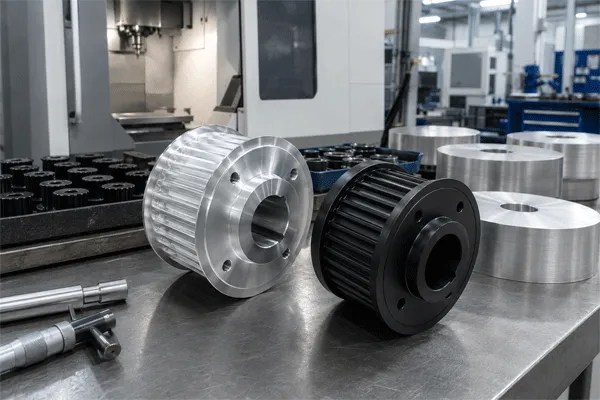
Aluminum timing pulleys are typically specified in 6061 or 7075 alloy, with clear or hard anodizing applied for wear resistance. The alloy and anodizing choice affects load capacity, bore tolerance and corrosion resistance — and in some applications, steel or stainless is the better fit.
Aluminum Timing Pulleys: Alloys Anodizing Bore Specses
6061 versus 7075: what the alloy choice actually changes
Both alloys show up on aluminum timing pulley spec sheets, and the difference isn’t just “which is stronger.” 6061 is the more commonly stocked general-purpose alloy — it machines predictably, anodizes evenly, and costs less, which makes it the default for moderate-load automation applications. 7075 trades some of that machinability and corrosion resistance for meaningfully higher tensile and fatigue strength, which matters in higher-load or higher-cycle positions where a 6061 pulley would be the weaker link in the drive train, not the belt.
| Dimension |
6061 Aluminum |
7075 Aluminum |
| Relative strength/fatigue resistance |
Moderate |
Higher |
| Machinability |
Easier, more forgiving on tolerance holds |
More demanding, tighter process control needed |
| Corrosion resistance (bare, untreated) |
Better |
Lower — typically needs anodizing or another surface treatment |
| Typical fit |
Cost-sensitive, moderate-load automation positions |
Higher-load or higher-cycle drive positions |
Neither alloy is a universal default. Specifying 7075 across an entire assembly to “future-proof” against load isn’t free — it adds machining cost and, in the standard bare condition, exchanges some corrosion resistance you may not need back.
Clear versus hard anodizing: the part most spec sheets skip
Clear anodizing and hard anodizing aren’t the same process at different thicknesses so much as different targets. Clear (standard/Type II-style) anodizing is mainly cosmetic and light corrosion protection, applied where wear resistance isn’t the primary driver. Hard anodizing produces a thicker, denser oxide layer specifically for wear resistance in sliding or repeated-contact surfaces — the coating most timing pulley programs actually want when belt-tooth engagement wear is the concern.
Here’s the detail that gets missed: anodized coating doesn’t sit entirely on top of the base metal. Roughly half the coating thickness grows outward from the original surface, and roughly half converts inward into the aluminum itself. On an outside diameter that’s a rounding error. On a bore, it isn’t — a hard-anodized bore can close measurably compared to its pre-anodize machined dimension, which is exactly the kind of thing that turns into a failed fit-check if the pre-treatment tolerance wasn’t adjusted for it.
Bore tolerance: standard, tightened, and what anodizing does to it
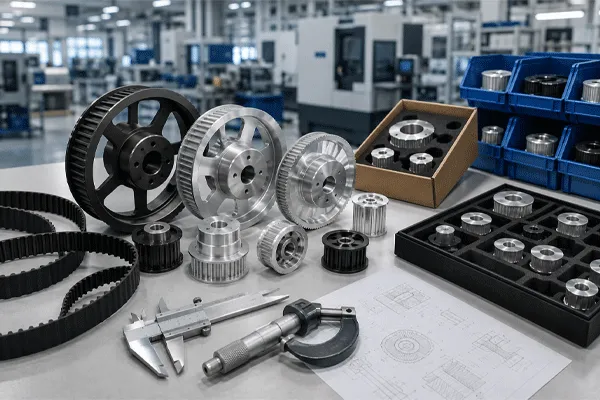
H7 is the standard bore tolerance on KTD aluminum timing pulleys; H6 is available on request where a tighter shaft fit is required. The anodizing-growth effect above is why bore tolerance and surface treatment can’t be specified as two independent line items on a drawing — the pre-anodize bore dimension needs to account for the coating buildup, or the finished part won’t hold the tolerance called out on the print.
| Parameter |
Range |
| Alloys available |
6061 / 7075 aluminum (carbon steel, stainless steel, brass and nylon also available as alternate materials) |
| Bore tolerance |
H7 standard; H6 available upon request |
| Surface treatments |
Anti-rust oil, clear anodizing, hard anodizing, black oxide, electroless nickel plating, induction hardening |
| Custom bore options |
Spline bores, D-shaped bores, taper bores, keyways, specialized hubs |
| Tooth count |
Non-standard tooth counts available on custom orders |
| Standards referenced |
ISO / DIN / AGMA standards stated on the product page |
When a bore is going to be hard-anodized, it’s worth asking the supplier directly whether the quoted bore tolerance is the pre-treatment or post-treatment dimension — the two aren’t interchangeable, and a quality system that verifies dimensions after every process step (consistent with an ISO 9001:2015-aligned quality management approach) should be able to state which one you’re getting a number for.
Aluminum Timing Pulleys: Alloys Anodizing Bore Specses
When aluminum is the wrong choice
Aluminum’s advantages — light weight, easy machining, cost — stop being advantages once the application pushes into conditions where steel or stainless steel options perform meaningfully better.
| Application factor |
Aluminum (6061/7075) |
Steel / Stainless |
| Sustained high-temperature exposure |
Properties degrade at elevated heat |
Retains strength better at higher temperatures |
| Washdown or corrosive environment |
Needs anodizing or plating to hold up |
Stainless resists corrosion without added coating |
| Heavy cyclic fatigue loading |
Lower fatigue life than steel |
Higher fatigue strength |
| Weight-sensitive positions (e.g., high-speed indexing) |
Lightweight advantage |
Added mass can affect dynamic response |
| Budget-driven, moderate-load runs |
Lower material and machining cost |
Stainless in particular carries a cost premium |
A washdown-rated automation cell and a lightweight, high-speed indexing axis can both call for a timing pulley on the same line — and land on opposite material answers for reasons that have nothing to do with load alone.
Custom bore and tooth configurations
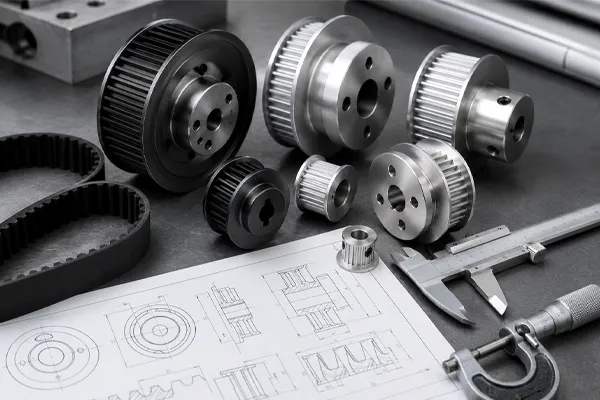
Beyond stock bore sizes, aluminum timing pulleys are available with spline bores, D-shaped bores, taper bores, keyways and specialized hub configurations, along with non-standard tooth counts for center-distance or ratio requirements that don’t match a catalog part. These options apply across both 6061 and 7075, though a taper-bore or spline configuration on 7075 should be flagged early in DFM review given the alloy’s reduced machinability margin compared to 6061.
Aluminum Timing Pulleys: Alloys Anodizing Bore Specses
What this guide doesn’t cover
This guide focuses on the pulley side of the assembly. It doesn’t get into belt-material compatibility with anodized versus untreated pulley surfaces — a related selection question that affects wear life on the belt side and deserves its own breakdown.
FAQ
Q: Does hard anodizing change the bore dimension of a timing pulley?
A: Yes. Anodized coating grows roughly half outward and half inward into the base material, which can measurably close a bore if the pre-treatment machining dimension wasn’t adjusted to account for it.
Q: Is 7075 aluminum always the better choice over 6061?
A: No. 7075 offers higher tensile and fatigue strength for higher-load positions, but 6061 machines more predictably, anodizes more evenly, and costs less for moderate-load applications.
Q: What bore tolerance is standard on aluminum timing pulleys?
A: H7 is standard; H6 is available on request for applications needing a tighter shaft fit.
Q: When should I specify steel or stainless steel instead of aluminum?
A: In sustained high-heat, washdown/corrosive, or heavy cyclic-fatigue applications, steel or stainless steel typically outperform aluminum without added surface treatment.












 10:05
10:05