KTD Technical Support Team | Application & Customer Technical Support | Published: September 2026
A roller chain sprocket’s pitch, bore configuration and strand count all trace back to a standard designation — but most size charts stop at the number and never connect it to which bore or hub configuration to actually order. This guide ties the two together.
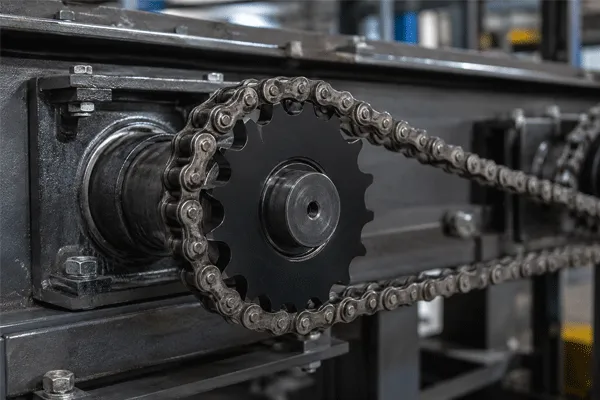
Roller Chain Sprockets: Pitch Bore and Standards Guides
“ANSI B29.1” and “ASME B29.1” aren’t two different standards
Product pages, including sprocket catalog pages generally, often reference “ANSI B29.1.” The current, more precise reference is ASME B29.1-2011 (R2022) — ASME maintains the standard, with availability through ANSI. It’s the same roller chain and sprocket standard under its current designation, not a separate or outdated one. When comparing quotes or documentation between suppliers, don’t treat “ANSI B29.1” and “ASME B29.1-2011 (R2022)” as a discrepancy — treat them as the same reference cited two different ways, and use the fuller designation in your own documentation for clarity.
What the chain/sprocket number actually tells you
ANSI roller chain numbering (the system ASME B29.1 documents) encodes pitch directly: the chain number divided by 8 gives the pitch in inches. A #40 chain runs a 1/2 inch pitch; a #60 chain runs 3/4 inch; a #80 chain runs 1 inch. Sprockets are sized to match, spanning roughly 1/4 inch to 2 inches in pitch across the ANSI range, with metric equivalents specified under ISO 606 and DIN 8187 for programs built on metric drawings.
| Chain/pitch class |
Approx. pitch |
Typical load range |
| Light-duty (#25, #35) |
1/4–3/8 in |
Light conveying, low-torque indexing |
| Standard-duty (#40, #50) |
1/2–5/8 in |
General industrial machinery, moderate loads |
| Heavy-duty (#60, #80) |
3/4–1 in |
Heavier conveyor and drive applications |
| High-load (#100–#160) |
1 1/4–2 in |
High-torque, heavy machinery drive lines |
Pitch selection isn’t just about load — it also sets the sprocket’s minimum practical tooth count and pitch diameter, which matters when space around the drive shaft is tight. Confirm actual availability and lead time against your specific pitch and tooth count when quoting; this table reflects standard ANSI/ASME B29.1 designation logic, not a fixed stocked-parts list.
Bore configuration: pilot, finished, and taper-bushed
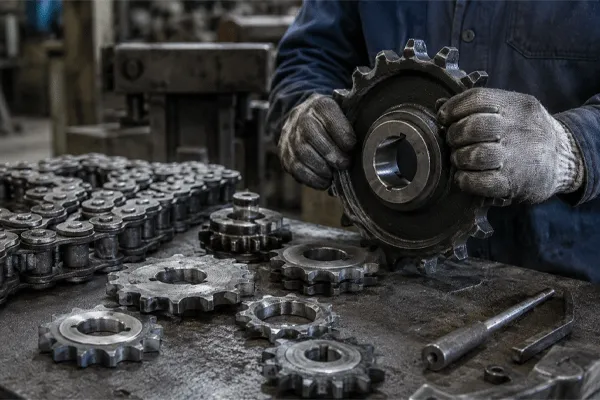
A sprocket’s bore configuration is a separate decision from its pitch, and mixing them up on a drawing causes fit problems downstream. Three configurations come up most often:
- Pilot bore— undersized or unfinished bore machined to final dimension after the sprocket is selected, used when the shaft size isn’t finalized at order time.
- Finished bore with keyway/set screw— bore machined to final shaft dimension with a keyway and set screw provision, the standard configuration for a fixed, known shaft size.
- Taper-bushed / QD-style— bushing-based mounting that lets one sprocket bore accommodate a range of shaft sizes via interchangeable bushings, useful where the same sprocket needs to serve multiple shaft diameters across an equipment line.
Taper-bushed configurations reduce inventory complexity if you’re running several shaft sizes across similar machines, but they add a bushing interface that a finished bore doesn’t have — worth weighing against a fixed-bore sprocket if your shaft size is already locked in.
Roller Chain Sprockets: Pitch Bore and Standards Guides
Single, double, and triple strand: when multi-strand actually matters
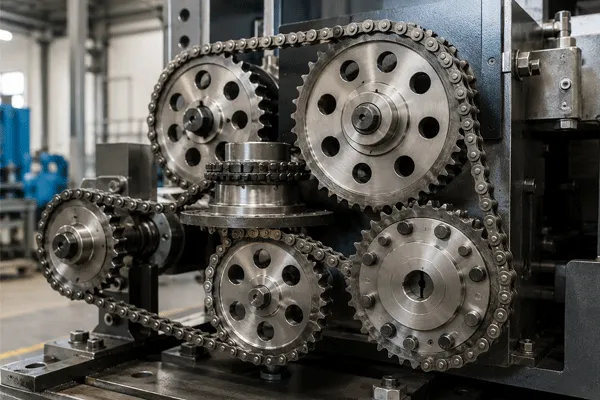
Simplex (single-strand), duplex (double-strand) and triplex (triple-strand) sprockets aren’t simply “more strands equals more capacity” — they’re a response to specific load and redundancy requirements.
| Configuration |
When it applies |
| Simplex (single strand) |
Standard-duty drives where a single chain meets the torque requirement |
| Duplex (double strand) |
Higher torque loads, or where chain life needs a safety margin without moving to a larger pitch |
| Triplex (triple strand) |
Heavy machinery drive lines where load or shock requirements exceed what duplex configurations comfortably handle |
| Custom multi-strand |
Non-standard load distribution requirements outside the simplex/duplex/triplex range |
Jumping straight to duplex or triplex to “be safe” adds width, weight and cost to the drive assembly. In many standard-duty positions, the more direct fix for chain life is pitch selection or material upgrade, not strand count.
Materials and finishing
Roller chain sprockets are available in 1045 carbon steel, alloy steel, and 304/316 stainless steel, with specialized materials available for specific custom applications. Surface treatment options include black oxide, zinc plating and specialized anti-corrosion finishes. Stainless steel sprockets are the standard answer for washdown or corrosive environments; black oxide and zinc plating address general wear and mild corrosion protection on carbon or alloy steel sprockets without the cost premium of stainless.
Roller Chain Sprockets: Pitch Bore and Standards Guides
Standard designations: what to actually put on a quote request
ANSI/ASME B29.1, ISO 606 and DIN 8187 aren’t interchangeable labels for “roller chain sprocket standard” — they’re the same family of dimensional and strength requirements referenced under different regional/organizational systems. ISO 606:2015 specifically covers dimensions, tolerances, strength and associated sprockets for short-pitch precision roller and bush chains, and is the reference to cite on a metric-drawing quote request. Compared to a typical stock-catalog page that lists sizes without connecting them to a specific standard or bore configuration, a quote request that names the pitch, the standard reference and the bore configuration together gets a supplier to a workable drawing faster than a part number alone.
What this guide doesn’t cover
This guide covers designation, pitch and bore selection. It doesn’t get into chain wear elongation monitoring or re-tensioning intervals — a maintenance-side topic that deserves separate treatment from sprocket selection itself.
FAQ
Q: Is “ANSI B29.1” different from “ASME B29.1-2011 (R2022)”?
A: No. They refer to the same roller chain and sprocket standard; ASME maintains it, and ANSI makes it available. The fuller designation is the more precise one to use in documentation.
Q: How do I know what pitch I need from a chain number?
A: Divide the chain number by 8 to get the pitch in inches — a #40 chain is 1/2 inch pitch, a #60 chain is 3/4 inch, and so on, per the ANSI numbering system documented under ASME B29.1.
Q: When do I need a duplex or triplex sprocket instead of simplex?
A: When torque load or chain-life margin exceeds what a single strand comfortably handles. For many standard-duty applications, adjusting pitch or upgrading material addresses the same problem without adding strand width.
Q: What’s the difference between a pilot bore and a finished bore?
A: A pilot bore is machined to final dimension after the shaft size is confirmed; a finished bore already has the keyway and set screw provision cut for a known, fixed shaft size.












 10:06
10:06