A bent support or loose mounting can turn smooth material handling into spills and downtime. Replacing the belt alone may not solve the problem. Knowing the structure beneath it helps you ask better questions, spot weak points, and plan a more dependable loading operation.
A conveyor frame usually includes longitudinal side rails or stringers, cross members, support legs or trestles, bracing, mounting plates, and connection hardware. Baseplates and anchors secure fixed installations. Beds, rollers, pulleys, and take-up assemblies attach to this structure but are separate working components. The exact arrangement depends on the conveyor type, load, span, and installation conditions.
What Are the Parts of a Conveyor Frame? A Guide to Conveyor Belt and Belt Conveyor Components
As a professional semi trailer manufacturer in China, we focus on heavy-duty transport and OEM/ODM solutions. Conveyor loading points often connect directly with the work of fleet owners, mines, ports, and construction sites. Understanding that connection helps buyers coordinate equipment, vehicles, and cargo handling.
Article outline
- Structural parts versus operating equipment
- Side rails, cross members, and bracing
- Legs, baseplates, and anchors
- Beds, rollers, and idlers
- Pulleys, drives, and take-up assemblies
- Tracking and alignment
- Cleaners, loading protection, and guards
- Design choices and load checks
- Purchasing and transport coordination
- Frequently asked questions
1. What Are the Main Parts of a Conveyor Frame?
The supporting structure holds the conveyor in its intended shape and position. It carries loads through connected members into the floor, foundation, or mobile base. A compact packaging line may use aluminum sections. A bulk-material line may use steel channels or trusses. SKE Industries’ structural overview identifies stringers, cross members, stands, and foundations among the core elements.
The broader components of a conveyor system also include the carrying belt, drive, pulleys, supports, and controls. These are not all structural members. Keeping the distinction clear helps when requesting drawings or spare parts: a cracked mounting plate and a worn bearing require different repairs.
| Structural part |
Main purpose |
| Side rails or stringers |
Carry loads along the machine |
| Cross members |
Connect the sides and maintain spacing |
| Legs or trestles |
Transfer loads to the supporting surface |
| Braces and gussets |
Resist sway, twisting, and joint movement |
| Mounting plates and brackets |
Locate operating equipment |
| Splice plates and fasteners |
Join sections and attachments |
| Baseplates and anchors |
Secure fixed supports to a suitable foundation |
2. How Do Side Rails and Cross Members Support the Conveyor?
Longitudinal rails run along each side of the conveyor. Depending on the application, they may be formed channels, tubular sections, extrusions, or truss members. Cross members connect them across the width. Together, they provide stable mounting locations and help preserve the spacing of the working equipment.
Braces resist sideways movement, while gussets strengthen selected joints. A heavy structure can still flex too much if its members or connections are poorly arranged. Tanax’s conveyor fabrication description illustrates the use of channel stringers, trusses, end structures, and cross bracing in fabricated assemblies.
For a modular conveyor section, request drawings showing splice locations and assembly tolerances. Welding quality matters, but so do hole position, straightness, and fit-up. Buyers should ask how the fabricator checks these features before shipment. Correct assembly protects the alignment of equipment installed later.
3. What Do Support Legs, Baseplates, and Anchors Do?
Legs provide support to the conveyor and establish its working height. Trestles or towers may serve elevated bulk-handling lines. Some smaller installations use adjustable stands. The correct choice depends on weight, support spacing, access, and the forces created during starting, stopping, and loading.
Baseplates spread reactions into the supporting surface. Anchors hold fixed installations in place, but their adequacy depends on the foundation as well as the bolts. A sound conveyor on a weak or uneven base can still develop alignment problems. Review floor conditions and foundation details before installation.
Leave planned access underneath the conveyor where servicing requires it, while guarding reachable hazards. Also check space for tools and component removal. An installation that fits neatly on a drawing may be difficult to maintain if a support blocks a bearing housing or take-up adjustment.
4. How Do a Conveyor Bed and Conveyor Roller Support the Belt?
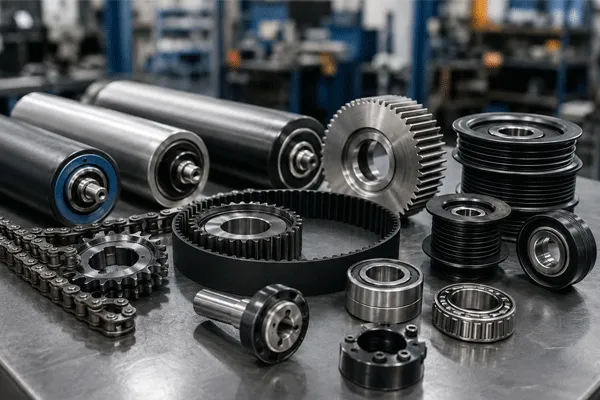
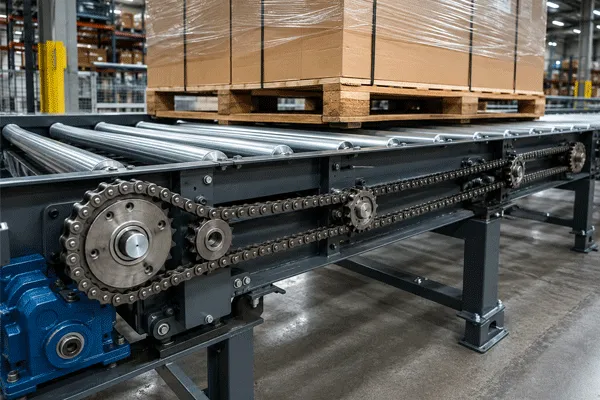
A slider bed gives the carrying run a continuous surface to slide over. In a roller bed belt conveyor, rollers support the belt and reduce sliding contact. Bulk-handling equipment often uses sets of angled idlers to form the belt into a trough. Return idlers carry the empty run toward the loading end.
These parts mount to the main structure through brackets or supports. Their spacing and capacity must suit the belt and its load. The phrase “bearings across a conveyor bed” is imprecise: bearings normally sit within rollers or in shaft housings. Dorner’s parts guide distinguishes bearings, bedplates, stands, and other replaceable assemblies.
Choose the support arrangement for the product. Small packages need stable transfer and adequate support beneath them. Heavy bulk material needs suitable idlers and loading-zone protection. Request a component schedule that identifies roller dimensions, bearing specifications, and replacement access instead of relying on a general capacity claim.
What Are the Parts of a Conveyor Frame? A Guide to Conveyor Belt and Belt Conveyor Components
5. Which Conveyor Pulley, Drive, and Take-Up Parts Attach to the Structure?
The drive supplies power to the belt through a powered pulley. In many layouts, the head pulley drives the belt at the discharge end, but this is not universal. Tail drives and other arrangements also exist. Rulmeca’s tail-drive explanation gives an example of a different drive location.
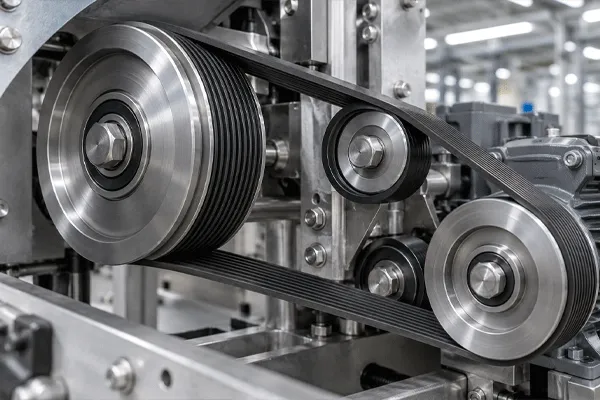
The types of belt conveyor pulleys include drive, tail, snub, bend, and take-up pulleys. Not every machine uses them all. Snub pulleys increase wrap around another pulley; bend pulleys redirect the path. Bearings and mounting plates must withstand the forces associated with the selected arrangement.
A take-up adjusts the path length to manage belt tension. Maintaining proper belt tension helps limit sag and belt slippage in friction-driven designs. More tension is not always better: excess force can overload shafts, bearings, and supports. Follow the supplier’s specified settings and adjustment method rather than tightening until a symptom disappears.
6. How Does Belt Conveyor Frame Design Affect Belt Tracking?
Straight, square supports help keep rotating components correctly positioned. In a conventional straight run, ordinary pulley and idler axes generally start square to the centerline—at a 90-degree angle to the belt travel direction. Specialized training assemblies may work differently. The approved installation drawing should define the starting geometry.
If the belt drifts to one side, inspect the cause before adding tracking devices. Uneven loading, material buildup, seized rollers, a poor splice, or distorted supports can contribute. Martin Engineering’s tracking guidance recommends surveying the structure and components when investigating mistracking.
Purpose-built trainers can guide the belt back toward the intended path, but they cannot repair a bent structure. Treat rubbing on one side of the belt as a fault to investigate. Good belt alignment helps protect the belt edges and reduce spillage; forcing them against an improvised guide may cause further damage.
7. Where Do Belt Cleaners, Impact Supports, and Guards Fit?
Loading zones need special attention. Heavy lumps dropping onto the belt create impact as well as static weight. Impact beds or suitable impact idlers help absorb and distribute these loads. Skirting helps contain material, but its support and adjustment must suit the belt path. Flexco describes impact beds and skirting as coordinated loading-zone components.
Belt cleaners and scrapers remove carryback: material that sticks after discharge. This reduces buildup on the return run and nearby equipment. Cleaner selection depends on the cargo, belt surface, splice, and operating conditions. Provide access for blade replacement and adjustment rather than placing brackets where technicians cannot reach them.
Guards restrict access to nip points and other moving parts. Emergency stops serve a different purpose and do not replace guarding or energy isolation. Before maintenance, follow a task-specific isolation procedure that addresses electrical power and stored energy, including gravity take-ups. OSHA’s hazardous-energy guidance explains the purpose of lockout/tagout; applicable rules depend on the site and jurisdiction.
8. How Do You Select the Right Conveyor Structure for the Load?
The requirements of the conveyor system start with the material, hourly output, route, and operating environment. Cargo density, lump size, loading height, incline, and support span all affect selection. The design of the frame must address both strength and acceptable deflection. A member that does not break can still bend enough to disturb operation.
Among the types of belt conveyor, a flat belt arrangement may suit cartons, while a troughed configuration suits many bulk materials. A cleated belt can help retain suitable cargo on an inclined conveyor. Different types of conveyor belt also need compatible pulleys, support surfaces, and clearances. No single belt material is ideal for every abrasive, hot, wet, or hygienic application.
Illustrative load calculation: Suppose a line carries 60 metric tonnes per hour at a belt speed of 1 metre per second. The average cargo load is 60,000 ÷ 3,600 ÷ 1 = 16.7 kg per metre. An 18-metre loaded run therefore carries about 300 kg of material at steady flow. This is not the structure’s design load.
| Additional factor |
Why it matters |
| Equipment and belting weight |
Adds permanent load |
| Loading impact and start-up forces |
Creates dynamic effects |
| Take-up and drive reactions |
Loads supports and connections |
| Uneven loading or accumulation |
Changes local demand |
| Wind, seismic action, or access loads |
May apply to the installation |
| Required design factors |
Depend on the governing design basis |
What Are the Parts of a Conveyor Frame? A Guide to Conveyor Belt and Belt Conveyor Components
9. How Should Buyers Specify Conveyor Parts for Specific Transport Projects?
Ask for more than a width and a throughput figure. A useful quotation includes the layout, operating assumptions, load basis, materials, component schedule, access arrangements, and inspection scope. For industrial conveyor systems, define who supplies foundations, electrical work, guarding, erection, and commissioning. Clear boundaries reduce costly gaps between suppliers.
As a Chinese semi trailer manufacturer, we provide customized transport equipment for container logistics, bulk cargo, machinery movement, and infrastructure projects. Conveyor coordination matters when a loading line fills a trailer or when conveyor modules travel to a site. Our engineering discussion should cover the trailer’s payload, deck dimensions, loading method, and cargo support points.
Contact us with your cargo drawings, weights, loading process, and destination requirements for an OEM/ODM trailer proposal. A lowbed may suit some tall equipment; a flatbed may suit certain structural modules. Final selection requires dimensions, axle-load review, securement planning, and route checks. For loading operations, coordinate discharge position and cargo distribution with the conveyor supplier.
Information to prepare
- Cargo or equipment dimensions, weight, and center of gravity.
- Loading and unloading method, including lifting points.
- Trailer access, site surface, and discharge clearances.
- Operating country, proposed route, and project schedule.
- Required trailer configuration, documentation, and spare parts.
Our planning principle: match the transport equipment to the real load and handling process before comparing purchase prices.
10. FAQs About Belt Conveyors and Their Components
Is the conveyor belt part of the supporting structure?
No. The conveyor belt is the moving carrying element. Rails, cross members, and supports hold its operating equipment in position. A conveyor belt system combines these structural and working parts with a drive and controls.
What is the difference between a roller conveyor and a belt conveyor?
A roller conveyor carries goods directly on rollers. A belt conveyor carries them on a continuous belt, which may itself run over rollers or a sliding surface. Package shape, weight, and transfer needs help determine the suitable type.
Is thicker steel always better?
No. Section shape, span, joints, and bracing strongly affect stiffness. Extra thickness adds weight and may complicate transport without solving poor geometry. Ask for a design based on the actual loads and allowable movement.
How can buyers check the alignment of the conveyor belt?
Request the manufacturer’s inspection and commissioning procedure. Check structural geometry and mounting positions while safely isolated. Any running observation or testing should follow an approved procedure with guarding in place and personnel clear of hazards.
Can one conveyor transfer material to another conveyor?
Yes, but the transfer needs engineering. Check discharge height, trajectory, receiving capacity, and the speed of the conveyor on each side. Poor coordination can produce impact, off-center loading, or spillage even when both machines work correctly alone.
What helps extend the lifespan of the conveyor system?
Regular inspections, suitable loading, cleaning, and prompt repairs all help. Check fasteners, supports, rollers, pulleys, and wear items according to the manual. Keep parts records so replacements match the original specification rather than merely looking similar.
Key points to remember
- Structural members include side rails, cross members, supports, braces, and connections.
- Beds, rollers, pulleys, and drives mount to that structure but perform different jobs.
- Correct geometry supports tracking and reduces avoidable wear.
- Calculate for equipment weight, cargo, dynamic forces, and installation conditions.
- Plan guarding, energy isolation, and maintenance access from the start.
- Coordinate conveyor loading or equipment delivery with the trailer specification.












 18:15
18:15