Choosing the wrong pulley can increase the force required, waste motion, and create unstable lifting or transmission. In real machinery, that means slower work, more wear, and poor system design. The fix is simple: understand the right type of pulley before you build or buy.
The four basic pulley types commonly taught in simple lifting systems are the fixed pulley, movable pulley, compound pulley, and block and tackle. A cone pulley is also important in machine-tool and speed-changing motion systems, but it is usually treated as a specialized industrial pulley rather than one of the four basic lifting types.
Outline
What is a pulley, and why is it called a simple machine?
What are the 4 types of pulleys?
How does a fixed pulley change the direction of the force?
How does a movable pulley reduce the amount of force?
What is a compound pulley, and why do multiple pulleys help?
How does a block and tackle multiply lifting power?
Is a cone pulley one of the common types of pulleys in motion systems?
How do pulleys work in modern industrial power transmission?
Where are pulleys used in cranes, gym equipment, and manufacturing?
How should buyers choose the right pulley supplier or manufacturer?
What is a pulley, and why is it called a simple machine?
A pulley is a wheel on an axle that carries a flexible rope, cable, chain, or belt on the rim. Britannica explains that pulleys are used singly or in combination to transmit energy and motion, and that pulleys with grooved rims are called a sheave. In other words, a pulley is not just a lifting tool. It is also a power and motion control part used across many systems.
A pulley is a simple mechanical device because it helps a person or machine do work more effectively. Energy Education says a pulley is a simple machine that can change the magnitude and direction of an applied force, while TeachEngineering explains that pulleys are one of the six simple machines and help make difficult tasks possible by using mechanical advantage.
At the most basic level, a pulley system consists of a wheel and rope or belt. The rope and wheel and axle work together so the user can redirect force, lift a heavy object, or transmit rotary motion between shafts. That is why pulleys are essential both in lifting and moving loads and in modern motion systems.
What are the 4 types of pulleys?
In basic mechanics, the four most common teaching categories are the fixed pulley, movable pulley, compound pulley, and block and tackle. TeachEngineering identifies fixed, movable, and compound pulley arrangements, while Britannica explains that a combination of pulleys, blocks, and rope is referred to as a block and tackle.
These four categories matter because each type of pulley solves a different problem. One may only change the direction of a pull. Another may reduce the amount of force needed. Another may combine both goals. If you are lifting a heavy load, the right pulley system can make the job safer and more efficient.
Here is a quick comparison:
| Type of pulley |
What it does best |
Key idea |
| Fixed pulley |
Changes pull direction |
Pull down to lift up |
| Movable pulley |
Reduces force required |
Pulley moves with the load |
| Compound pulley |
Changes direction and reduces force |
Combines fixed and movable |
| Block and tackle |
Lifts very heavy loads |
Uses multiple pulleys and rope sections |
This is why the different types of pulleys are still taught today. They are simple, but they remain useful in real engineering and industrial work.
How does a fixed pulley change the direction of the force?
A fixed pulley is attached to a support and stays in one place while the rope moves over it. TeachEngineering says a fixed pulley has a wheel secured in a single spot and changes the direction of the force needed to lift an object. The pulley itself stays still while the load moves with the rope.
This matters because a fixed pulley lets the user pull down instead of lifting straight up. So the main benefit is not that it reduces the total weight. It changes the direction of the applied force. Britannica Kids explains the same basic idea: pulling a rope over a single fixed pulley merely changes the direction of the force.
A common example is a flagpole or well bucket. You pull down on one end of the rope, and the load rises. That makes the task feel more natural, even though the ideal input force is still close to the load itself. A fixed pulley is simple, but it is often the first step in making lifting easier.
How does a movable pulley reduce the amount of force?
A movable pulley is attached to the load, so the pulley moves with the object being lifted. TeachEngineering says a movable pulley has a pulley attached to the object, with one end of the rope attached to a fixed point and the other end left free. This arrangement helps reduce the force needed to lift the load.
The reason is simple. The load is supported by more than one section of rope, so the required force is shared. Energy Education explains that the force is distributed among the supporting rope segments, which reduces the force that must be applied. In a basic two-support setup, the system can make it possible to lift the same load with roughly half the pull, ignoring friction.
That is why a moveable pulley is useful when the goal is to lift heavy objects with less force. It does not remove the work completely, because the rope has to travel farther. But it does reduce the effort required to move the load at one time. This is one of the clearest examples of simple mechanical advantage.
What is a compound pulley, and why do multiple pulleys help?
A compound pulley combines fixed and movable pulleys in one system. TeachEngineering says a compound pulley is a combination of a fixed and movable pulley used to maximize the mechanical advantage of the system. Britannica also notes that Archimedes reportedly used compound pulley systems to pull a ship onto dry land.
The main idea is that multiple pulleys can do two things at once: they can change the direction of the pull, and they can reduce the force required. This gives the designer more control over the lifting process. Instead of pulling straight up with full weight, the user can pull in a more convenient direction and with lower force.
A compound arrangement is especially useful when you need to lift heavy loads but also need practical rope routing. That is why pulleys are often used in hoists, workshops, ship rigging, and lifting frames. In real engineering, a compound design helps balance geometry, operator effort, and the path of the rope.
How does a block and tackle multiply lifting power?
A block and tackle is a pulley system made from blocks, pulleys, and rope. Britannica says that a combination of pulleys, blocks, and rope or other flexible material is referred to as a block and tackle, and one or more independently rotating pulleys can be used to gain mechanical advantage, especially for lifting weights.
The reason it can multiply force is that the moving block is supported by several rope sections. The more rope sections support the moving block, the more the load is shared. Energy Education explains that as more pulleys are added, the applied force needed to lift the object is reduced, even though the rope must be pulled a greater distance.
This makes a block and tackle one of the best-known ways of lifting heavy objects. It is a common solution where a heavy load must be raised with limited human effort, such as marine rigging, stage systems, workshop hoists, or manual lifting frames. If you want to help you lift heavier loads with manageable force, this is one of the smartest classical pulley arrangements.
Is a cone pulley one of the common types of pulleys in motion systems?
A cone pulley is a real pulley type, but it is usually not listed as one of the four basic lifting pulleys. Instead, it is a specialized machine-tool or speed-changing pulley used in motion systems. Britannica Kids notes that the headstock of a lathe contains a cone pulley that provides variable operating speeds.
This is an important distinction. A fixed pulley, movable pulley, compound pulley, and block and tackle are basic simple machine lifting arrangements. A cone pulley is more closely linked to mechanical transmission and speed variation. Britannica’s transmission article explains that variable-speed drives can use pulleys with conical sides to change speed ratio.
So if someone asks, “What are the four basic pulley types?” the safest answer is fixed, movable, compound, and block and tackle. If someone asks about various types of pulleys in broader engineering, then a cone pulley belongs in the conversation too. It plays an integral role when variable speed or stepped motion is required in machine tools and similar equipment.
How do pulleys work in modern industrial power transmission?
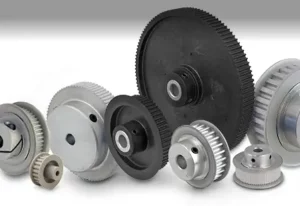
Not every pulley is used to lift weights. Britannica explains that in belt drive, pulleys are affixed to shafts at their axes, and power is transmitted between shafts by endless belts. This means pulleys also transmit power in industrial drives, not just support a rope.
In these systems, the key job of the pulley is motion control. The pulley and belt work together to transfer rotary motion from one shaft to another. The pulley may have a groove or shaped surface to guide the belt, and the surface condition matters because it affects grip, wear, and tracking. That is why pulleys also matter in drive trains, fans, compressors, conveyors, and automation modules.
For B2B industrial buyers, this matters a lot. Your uploaded brief describes a China-based manufacturer supplying standard and custom timing pulleys, timing belts, industrial gears, poly V pulleys, sprockets, chains, and conveyor roller solutions for global machinery and automation customers. In that context, understanding pulley basics is not only academic. It affects real sourcing, manufacturing, and system design.
Where are pulleys used in cranes, gym equipment, and manufacturing?
Pulleys are used anywhere engineers need lifting, moving, or controlled motion. TeachEngineering mentions elevators, crane systems, and bulldozers as familiar examples where modern engineers rely on pulleys. Britannica and Energy Education also show that pulleys remain central wherever a rope or belt must change the direction of motion or reduce lifting effort.
In everyday life, pulleys appear in blinds, garage doors, home exercise systems, and gym equipment. In industry, they appear in hoists, conveyors, machine tools, lifting frames, and production lines. In power transmission, pulleys may carry belts rather than ropes, but the core principle is the same: a wheel on an axle helps control force and motion.
For manufacturers, the important question is not only “where are pulleys used?” but “what pulley type fits the job?” A lifting frame may need a block and tackle. A simple hoist may need a fixed and movable pair. A lathe may need a cone pulley. A conveyor may need belt pulleys designed for stable rotary transmission. That is why pulley selection belongs in every serious design review.
How should buyers choose the right pulley supplier or manufacturer?
If you are a machinery OEM, automation integrator, distributor, or conveyor builder, the right pulley is only part of the decision. You also need a supplier or manufacturer that understands dimension control, material selection, machining quality, balancing, and matching parts such as timing belts, poly V pulleys, sprockets, chains, and rollers. Your uploaded brief makes clear that these are the exact buyer concerns in this market.
A smart buyer should compare more than price. Look at whether the supplier can support standard and custom parts, whether they understand motion systems, whether they can help with shaft fit and belt matching, and whether they can offer technical support after purchase. In real B2B procurement, expertise is often worth more than a small unit-price difference.
I usually suggest checking these points before ordering:
- pulley type and intended application
- material and machining quality
- groove or belt compatibility
- shaft bore, keyway, and hub details
- surface treatment and environment fit
- delivery stability and technical support
For global industrial buyers, that is how you build trust in a long-term partner, not just in a single component.
A practical selection table for buyers and engineers
| Use case |
Best starting pulley type |
Why |
| Lift a load but only change pull direction |
Fixed pulley |
Simple, stable, easy to use |
| Reduce force for manual lifting |
Movable pulley |
Load shares across rope sections |
| Lift and redirect in one setup |
Compound pulley |
Combines fixed and movable |
| Lift very heavy loads manually |
Block and tackle |
Uses multiple pulleys for strong advantage |
| Change operating speed in machine tools |
Cone pulley |
Supports variable speed control |
| Transmit rotary motion with a belt |
Power-transmission pulley |
Moves power between shafts |
This table is simple, but it shows why different types of pulleys still matter in modern engineering. Each one solves a different motion or force problem.
FAQs
What are the 4 types of pulleys?
The four basic pulley types commonly taught in simple mechanics are the fixed pulley, movable pulley, compound pulley, and block and tackle. These are the main forms used to change force direction, reduce lifting effort, or combine both functions.
What does a fixed pulley do?
A fixed pulley changes the direction of force so a user can pull down to lift an object up. It does not usually reduce the load itself, but it makes the lifting action more convenient.
Why is a movable pulley easier to use?
A movable pulley is easier because the load is supported by more than one section of rope, so the force is shared. That means less force is needed to lift the same object, although the rope must travel farther.
What is the difference between a compound pulley and a block and tackle?
A compound pulley is a combined system of fixed and movable pulleys. A block and tackle is a specific compound arrangement using blocks, multiple pulleys, and rope to gain stronger lifting advantage for heavier loads.
Is a cone pulley one of the four main types?
Not usually. A cone pulley is important in machine-tool and speed-changing systems, but it is generally treated as a specialized pulley for variable speed rather than one of the four basic lifting pulley types.
Where are pulleys used today?
Pulleys are used in cranes, hoists, elevators, blinds, garage doors, gym equipment, machine tools, conveyors, and belt-driven industrial systems. They still matter because they help control force, motion, and power transfer.
Key things to remember
A pulley is a wheel on an axle that works with a rope, chain, cable, or belt.
The four basic lifting pulley types are fixed pulley, movable pulley, compound pulley, and block and tackle.
A fixed pulley mainly changes the direction of the pull.
A movable pulley helps reduce the force required to lift a load.
A compound pulley combines fixed and movable designs for better control and lifting advantage.
A block and tackle uses multiple pulleys to lift heavier loads more easily.
A cone pulley is a specialized speed-changing pulley used in machine tools and variable motion systems.
For industrial buyers, the right pulley choice depends on the load, motion path, transmission method, and supplier capability.












 16:24
16:24