KTD Mühendislik Ekibi | Application Engineering & DFM Team | Updated 27, August 2026
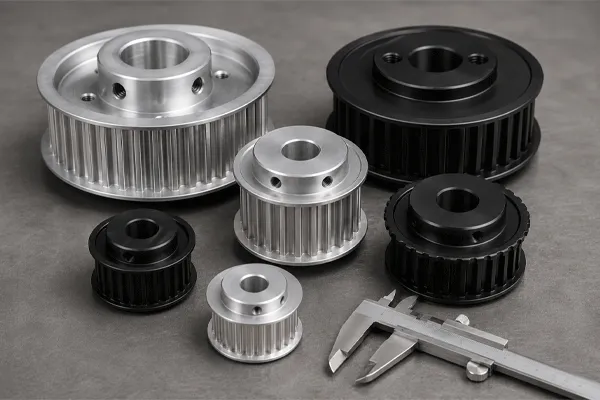
Aluminum timing pulleys suit drives where inertia and mass matter more than surface hardness. 6061-T6 covers most automation work; 7075-T6 buys roughly 80% more yield strength for hub-critical parts. Anodizing adds wear life but grows into the bore, so tolerance and masking must be specified together.
Alüminyum Zamanlama Kasnakları: Alaşımlar, Eloksal Kaplama, Delik Özellikleri
Two alloys, one decision point: strength or forgiveness
Most aluminum zamanlama kasnakları on the market are 6061-T6, and for good reason. It machines cleanly, anodizes to a consistent finish, and holds up in the tension ranges that automation drives actually run at. 7075-T6 is the alloy people reach for when the hub is doing something difficult — a thin web, a small bore under a large tooth count, or a taper-lock seat carrying real clamping stress.
| Property |
6061-T6 |
7075-T6 |
| Typical yield strength |
~276 MPa |
~503 MPa |
| Typical tensile strength |
~310 MPa |
~572 MPa |
| Density |
2.70 g/cm³ |
2.81 g/cm³ |
| İşlenebilirlik |
Good; predictable chip control |
Good, but more tool wear and burr sensitivity |
| Anodizing response (clear) |
Consistent, light straw to clear |
Slightly darker, less uniform on large faces |
| Hard anodizing response |
Consistent, hard uniform layer |
Serviceable but more prone to edge burn on thin sections |
| Korozyon direnci |
Daha iyi |
Lower; copper content makes it more sensitive to humid or chemical exposure |
| Weldability |
Weldable |
Not practically weldable |
| Typical use in pulleys |
General automation, conveyors, positioning axes |
Thin-web pulleys, small bores with high clamping stress, weight-critical rotating assemblies |
The trap is treating 7075 as a straight upgrade. It costs more, corrodes faster in washdown or humid environments, and gains you nothing if the failure mode you are worried about is tooth wear rather than hub yield. Tooth wear is a surface problem, and the base alloy does very little about it.
A second point that gets missed: 7075 in a humid plant with stainless fasteners is a galvanic pairing waiting to happen. If the pulley lives near water, 6061 with a proper anodic layer is usually the better answer, and stainless steel is a better answer still.
What the mass saving is actually worth
The argument for aluminum is inertia, so it helps to size the effect rather than assert it.
Take a 60 mm outside diameter pulley with a 20 mm face width, treated as a solid disc:
- Steel (7850 kg/m³): ~0.44 kg, J ≈ 2.0 × 10⁻⁴ kg·m²
- Aluminum (2700 kg/m³): ~0.15 kg, J ≈ 6.9 × 10⁻⁵ kg·m²
That is roughly a 66% reduction in rotational inertia for identical geometry. Bore and hub relief shift the absolute numbers but not the ratio, since both materials lose the same volume.
For a servo axis doing short indexing moves, that reduction lands directly on acceleration torque and on settling time. For a continuously running conveyor drive at steady speed, it lands almost nowhere. Automation builders sizing motors around a duty cycle that is 90% constant velocity often pay an aluminum premium for a benefit their motion profile never uses.
Alüminyum Zamanlama Kasnakları: Alaşımlar, Eloksal Kaplama, Delik Özellikleri
Anodizing: what each class changes, and what it does to your bore
Aluminum timing pulleys ship in several surface conditions. KTD’s published options across the timing pulley line include anti-rust oil, clear anodizing, hard anodizing, black oxide, electroless nickel plating and induction hardening, with the last three applying to the steel and stainless variants rather than aluminum.
| Yüzey durumu |
Typical layer |
What it changes |
Nereye sığar? |
| Anti-rust oil only |
None |
Storage protection during shipping and shelf time |
Dry indoor drives, low duty, cost-driven builds |
| Clear anodize (conventional) |
Roughly 5–25 µm |
Corrosion resistance, moderate surface hardness, dielectric layer |
General automation, indoor, light to medium belt tension |
| Hard anodize |
Roughly 25–50 µm |
Substantially harder tooth flanks, better abrasion resistance, dark grey to black appearance |
Abrasive environments, high cycle counts, dusty plants, aramid or steel-cord belts |
| Dyed black anodize |
Follows the underlying class |
Appearance, light absorption for vision systems |
Optical inspection cells, machine aesthetics |
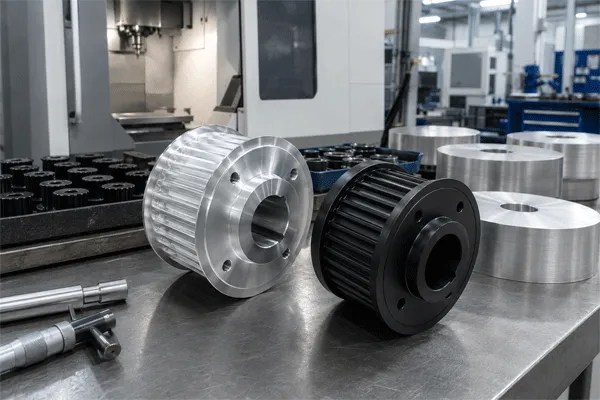
The detail that catches drawings out: an anodic layer is not a coating sitting on top of the part. It converts the surface, and roughly half of the layer thickness builds outward from the original surface. On a bore, that outward growth closes the hole.
A 25 µm hard anodic layer grows about 12.5 µm per surface, which removes about 25 µm from bore diameter. On a 10 mm H7 bore, the entire tolerance band is 0 to +15 µm. The anodizing process alone will push a bore that was in the middle of tolerance straight under the low limit, and the pulley will not go onto the shaft.
There are two clean ways to handle it, and the drawing has to say which one applies:
- Mask the bore and keyway before anodizing, then note “bore and keyway masked, tolerance applies after surface treatment” on the drawing.
- Anodize first, then finish-machine the bore to size. This gives a bare aluminum bore, which is fine mechanically but gives up the corrosion protection at that surface.
Masking is the more common route for pulleys with set-screw hubs, because the threaded hole has the same problem and is harder to correct after the fact.
Hard anodize has its own limits. The layer is hard but brittle, so it chips at sharp edges and does not survive impact loading well. It also does nothing for tooth root fatigue, which is a bulk property. If teeth are shearing rather than wearing, the answer is a wider belt or a different pitch, not a thicker anodic layer.
Compared with the stock catalogue listings that dominate search results for this component — which typically state “black anodized” with no class, no thickness, and no note on post-treatment bore condition — this is the layer of information that determines whether the part actually assembles.
KTD aluminum timing pulley specifications
The parameters below come from KTD’s published timing pulley configuration range.
| Parametre |
Aralık |
| Aluminum alloys |
6061, 7075 |
| Other materials in the same line |
Carbon steel, stainless steel, brass, nylon |
| Standard bore tolerance |
H7 |
| Tighter bore tolerance |
H6, on request |
| Bore configurations |
Pilot bore, finished bore with keyway, D-shaped bore, spline bore, taper bore |
| Hub options |
Standard hub, extended hub, flangeless, specialized hub geometries |
| Tooth counts |
Standard and non-standard counts to drawing |
| Aluminum surface treatments |
Anti-rust oil, clear anodizing, hard anodizing |
| Stated standards on the product line |
ISO, DIN, AGMA references |
| Özel sipariş miktarı |
20 parçadan başlayarak, her üretim partisinde 10.000+ parçaya kadar ölçeklenebilir |
| Kabul edilen çizim formatları |
STEP, IGES, DWG, DXF, SLDPRT, PDF |
H6 versus H7 in numbers
Both are ISO limits-and-fits hole grades. The grade tolerance values for common pulley bore ranges:
| Nominal bore |
H7 (µm) |
H6 (µm) |
| Over 3 to 6 mm |
0 / +12 |
0 / +8 |
| Over 6 to 10 mm |
0 / +15 |
0 / +9 |
| Over 10 to 18 mm |
0 / +18 |
0 / +11 |
| Over 18 to 30 mm |
0 / +21 |
0 / +13 |
| Over 30 to 50 mm |
0 / +25 |
0 / +16 |
H7 is the working default for keyed and set-screw hubs on shafts made to h6 or h7. H6 is worth specifying when the pulley runs on a precision ground shaft in a positioning axis and radial runout at the belt pitch line is part of your accuracy budget. It is not worth specifying to compensate for a shaft you have not toleranced, which is the more common reason it appears on drawings.
Manufacturing runs through DFM review, prototype, First Article Inspection, series production and CMM plus material inspection before shipment, under KTD’s stated ISO 9001:2015 quality management system. The International Organization for Standardization identifies ISO 9001 as the internationally recognized quality management system standard. For export shipments, wooden packaging is stated to meet ISPM 15, the International Plant Protection Convention measure covering raw-wood packaging in international trade — relevant if your receiving site rejects non-compliant crating at customs.
Alüminyum Zamanlama Kasnakları: Alaşımlar, Eloksal Kaplama, Delik Özellikleri
Set screws, keyways and the aluminum thread problem
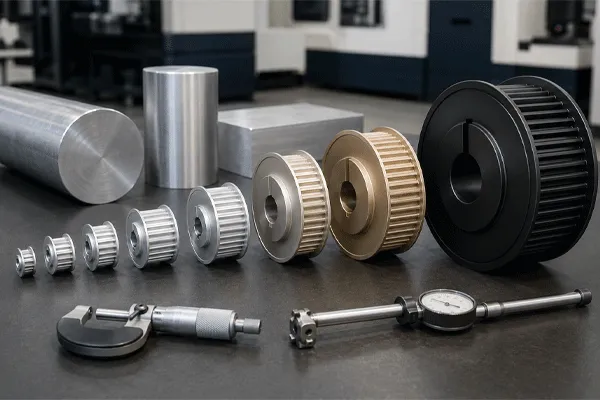
Aluminum hubs and steel set screws do not have equal strength, and the thread loses first. Three practical consequences:
- A set screw torqued to a steel-hub value will strip or deform an aluminum thread. Specify the hub material on the assembly instruction, not just the fastener size.
- A cup-point set screw biting directly into a hardened shaft raises a burr that makes removal difficult and can gall the aluminum bore during extraction. A ground flat on the shaft solves it.
- On repeated-service axes where the pulley comes off regularly, a threaded steel insert in the aluminum hub outlasts a tapped aluminum thread by a wide margin.
For pulleys above roughly 30 mm bore carrying real torque, a keyway or taper bore transfers load through geometry rather than friction and removes the question entirely.
When aluminum is the wrong material
| Condition |
Why aluminum struggles |
Better option from the same product line |
| High-pressure chemical washdown, food contact |
Anodic layer degrades under caustic cleaning; bare aluminum pits |
304 veya 316 paslanmaz çelik |
| Abrasive dust or grit at high cycle counts |
Tooth flank wear even with hard anodize |
Carbon steel with induction-hardened teeth |
| High shock or reversing torque at the hub |
Lower yield strength; hub deformation before tooth failure |
Carbon steel, or steel with black oxide |
| Continuous high ambient temperature |
Modulus falls with temperature; clamping preload relaxes |
Steel or stainless |
| Small pulleys in high volume |
Steel bar stock and machining time can be cheaper at small diameters |
Karbonlu çelik |
| Electrically isolating or non-marking requirement |
Anodize is dielectric but chips |
Naylon |
One more that rarely appears in catalogues: pulley flanges. Aluminum flanges on narrow pulleys dimple and roll over when a belt tracks hard against them for extended periods. If your belt tracking depends on flange contact rather than correct pulley alignment, the flange material matters more than the body material.
How to specify an aluminum pulley so it arrives usable
- State the belt profile and pitch, the tooth count, and the belt width the pulley must accept.
- State the alloy explicitly: “6061-T6” rather than “aluminum.”
- State the bore nominal and the grade — H7 or H6 — and whether it applies before or after surface treatment.
- If anodizing, state the class and target thickness range, and mark masked surfaces on the drawing.
- Dimension the keyway or flat separately with its own tolerance; do not leave it to standard practice.
- Call out flange requirement per side, since single-flange and double-flange pulleys pair differently across a two-pulley drive.
- State runout requirements at the pitch diameter if the axis has a positioning accuracy specification.
- Send the model in a native or neutral 3D format alongside the dimensioned PDF, so the DFM review catches conflicts between the two before tooling.
Steps 3 and 4 together account for most of the aluminum pulley fit problems we see at First Article Inspection. They are also the two lines most often missing from the drawings that arrive.
Sık Sorulan Sorular
Q: Does hard anodizing make aluminum teeth as hard as steel teeth?
A: The surface layer reaches hardness values in the range of hardened steel, but it is a thin brittle layer over a soft substrate. Under point loading it can crack and expose base aluminum. It extends wear life meaningfully in abrasive conditions; it does not convert an aluminum pulley into a steel one.
Q: Can I anodize a pulley after the keyway is cut?
A: Yes, and this is the normal sequence. The keyway must be masked or the width will close by roughly the same amount as the bore, and a masked keyway leaves bare aluminum on those faces.
Q: Is 7075 worth the cost for a standard conveyor drive?
A: Usually not. Conveyor drives fail at the tooth surface or the belt, not at the aluminum hub. Spend the money on the surface condition or the belt width instead.
Q: What bore tolerance should I put on the drawing if I am unsure?
A: H7 with a stated shaft tolerance. H6 without a controlled shaft gives you a tighter hole running on an uncontrolled pin, which does not improve the fit.
Q: What do aluminum timing pulleys cost?
A: Pricing is project-specific and provided upon quotation based on material, dimensions, machining complexity, quantity, surface treatment and other technical requirements. Alloy choice, anodizing class and bore grade all move the number, which is why quotations are issued against a drawing rather than a part description.
Q: Can I mix an aluminum pulley with a steel-cord belt?
A: It runs, but a steel-cord belt at high tension accelerates tooth flank wear on bare aluminum. Hard anodize, or move to a steel pulley on the driver where tension is highest.












 11:45
11:45